
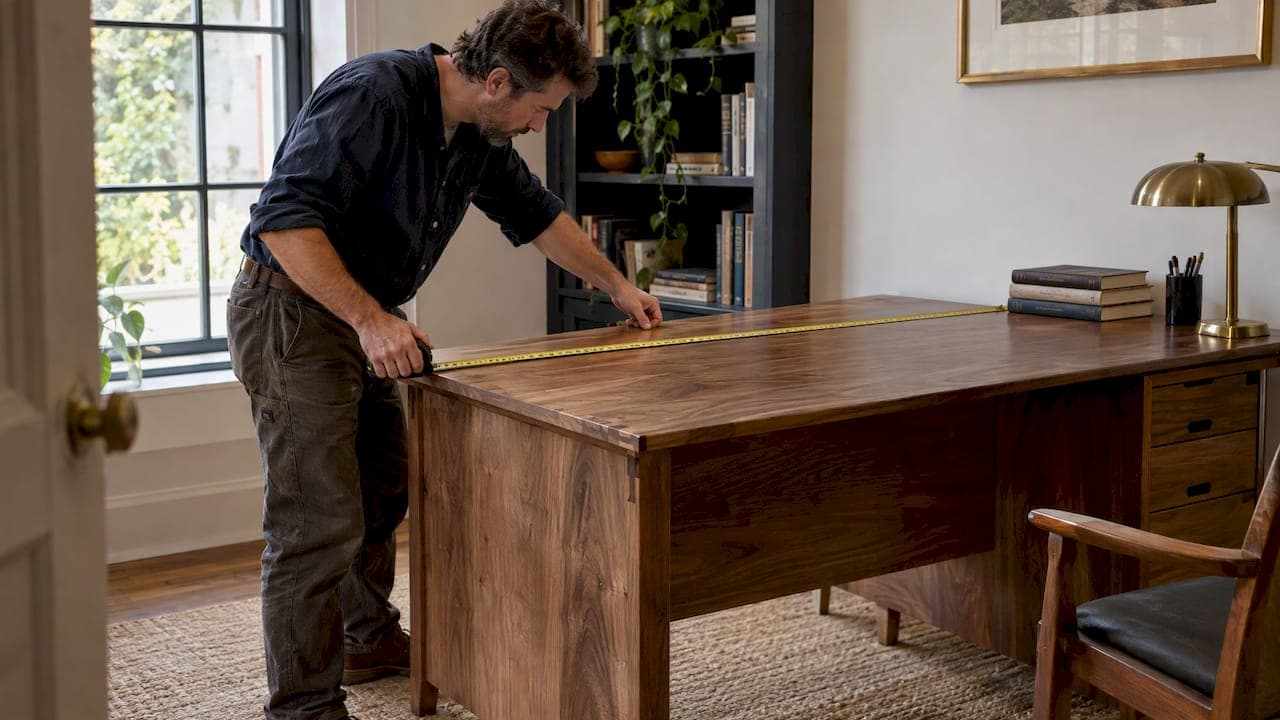
Solid wood is never entirely still. It swells as it takes on moisture from the air and shrinks as it gives moisture back, almost entirely across the width and thickness of a board rather than along its length. In a well-made piece of furniture this is simply accommodated: panels float, fixings have room to breathe, and a tabletop is free to widen in a damp November and narrow again in a centrally heated February. In a poorly made one, the same movement shows up as split tops, sticking drawers and open joints.
This guide explains what is happening inside the timber, how to estimate it, what UK homes and hotels do to it, and how we design bespoke furniture so that movement is managed rather than fought.
TL;DR
- Wood moves because its moisture content follows the humidity around it. Movement is largely across the grain; along the length it is negligible.
- Tangential movement (parallel to the growth rings) is roughly twice radial movement, so how a board is sawn matters as much as the species.
- You can estimate change with a simple formula: starting dimension × species coefficient × change in moisture content.
- Finishes slow the exchange of moisture but never stop it. Good design (floating panels, slotted fixings, oversized holes) is what keeps furniture sound.
- In a heated UK interior, aim for stable humidity and timber conditioned to the room before it is cut and joined.
Table of Contents
- What wood movement actually is
- What it looks like in the home
- How to estimate the movement
- The UK context: heated rooms and target moisture content
- How bespoke makers design for movement
- What finishes can and cannot do
- Choosing species and cut with movement in mind
- Our perspective
- Bespoke pieces built to move gracefully
- Living with solid wood: a short care routine
- FAQ
- Sources
What wood movement actually is
Timber is hygroscopic: it constantly trades moisture with the surrounding air until it reaches equilibrium with it. That equilibrium is called the equilibrium moisture content, or EMC. When humidity rises, the cell walls take up water and the board swells; when the air dries, they release it and the board shrinks. The University of Melbourne's workshop notes describe this swelling and shrinking and point out that the changes are seasonal, because air is typically drier in summer than in winter in that climate.
Three truths follow, neatly put by the woodworking press: wood moves, it never stops moving, and attempts to constrain it cause problems. A centuries-old dining table is still breathing. That is not a flaw to be cured; it is a property of the material to be designed around.
Why direction matters
Movement is not equal in every direction:
- Along the grain (longitudinal): so small it is usually ignored.
- Radial (across the growth rings, towards the centre of the tree): moderate.
- Tangential (parallel to the growth rings): roughly twice the radial figure, depending on species.
This is why a wide plain-sawn board tends to cup, while a quarter-sawn board of the same species is calmer. We look at the trade-offs between the two in our piece on quarter sawn versus plain sawn timber.
What it looks like in the home
Movement rarely announces itself as movement. It arrives as symptoms:
- A hairline split along the middle of a solid tabletop in the first winter of central heating.
- A drawer that glides beautifully in autumn and sticks the following August.
- A gap opening between a door and its frame, or at a mitred corner. One joinery text describes gaps in door architrave mitres caused by shrinkage in new houses, where trim is fitted before the heating has been run.
- A breadboard end that either fractures or leaves the tabletop proud at the edges.
One furniture-grade moisture guide gives a stark example: a wide board losing about 0.355 inches of width, more than three-eighths of an inch, enough to break a rigidly fixed breadboard end or strain a glued panel seam. Wide solid panels are where the physics is least forgiving.
How to estimate the movement
Professionals use the estimating equation from the USDA Wood Handbook. The Sawdust Journey walkthrough states it plainly:
Dimension change = starting dimension × dimensional change coefficient × change in moisture content (percentage points)
The coefficient is specific to species and to the direction of the grain, and the calculator on the same site holds values by species. The estimate is most reliable for furniture kept between roughly 6% and 14% moisture content, and the calculator notes that below the fibre-saturation point (around 28 to 30%) wood shrinks as it dries and swells as it absorbs.

A worked example
The coefficient below is a round, illustrative figure, not a species value: use the real one for the timber you are specifying.
- A solid tabletop is 900 mm wide, plain sawn.
- Take an illustrative coefficient of 0.004 per percentage point of moisture content.
- Suppose the room swings by 4 points between a damp autumn and a heated midwinter.
- 900 × 0.004 × 4 = 14.4 mm of total width change across the season.
Nearly a centimetre and a half is far more than any glue line or rigid screw can resist. That single sum explains why the fixings under a table matter more than the finish on top of it.
The UK context: heated rooms and target moisture content
British homes, and especially hotels and apartments with continuous heating, tend to be drier in winter than the timber was when it left the seasoning yard. The relevant benchmark is BS 1186-3, the British standard for joinery timber. According to the English Woodlands Timber knowledge base, it recommends:
| Setting | Recommended moisture content |
|---|---|
| Exterior joinery | 13–19% |
| Intermittently heated buildings | 13–17% |
| Continuously heated, 12–19°C | 10–14% |
| Continuously heated, 20–24°C | 8–12% |
For furniture destined for a hotel suite or a well-heated townhouse, the lower rows are the ones that matter. A piece made from timber conditioned for a damp workshop and then delivered into a 22°C room will go on shrinking for weeks. That is why we ask about a client's heating and ventilation early in a commission.
Humidity in the room, not only in the workshop
A maker can only condition the timber; the room does the rest. Keeping indoor humidity within a sensible band protects wood and the people living with it. A homeowner's guide to ideal indoor humidity levels is a useful starting point if you want to measure before you decorate. A simple hygrometer on the wall costs little and tells you more than guesswork.
How bespoke makers design for movement
The principle is the same one that has kept antique furniture sound for centuries: let the wood move where it needs to, and hold it firmly only where it cannot do harm. Canadian Woodworking frames the maker's two tasks well: secure the joinery, and allow movement to happen freely.
Frame-and-panel construction
A large panel sits in a groove within a stable frame, unglued, so it can swell and shrink without pushing the frame apart. The result is the classic cabinet door, and the logic applies equally to sideboard backs and wardrobe flanks.

Tabletop fixings that slide
A solid top should never be screwed tight to the rails. Slotted holes, figure-of-eight fasteners or buttons let the top glide across its width while the base stays square. Across a 900 mm top, those 14 mm or so of seasonal travel have somewhere to go.
Slightly generous tolerances
One woodworking text suggests slightly oversized holes for fasteners so the timber can breathe without compromising the structure. The same thinking tempers a common request: the perfect, permanent piston-fit drawer. In solid wood, a tolerance that is exact in one season will not be exact in the next, so we build in a small, deliberate clearance and finish the runners well.
Matching the joint to the grain
Cross-grain joints are the danger zone, and the right joint depends on where the grain runs. We have set out how common joints behave in our guide to furniture joinery types. Short rails joined to wide, cross-grain parts need particular care.
Conditioning before cutting
The most overlooked step is also the simplest. The same moisture guide advises that components should be within one percentage point of the workshop's measured EMC before joinery is cut, and that local measurement beats regional averages. Timber that has been allowed to settle moves less after it is shaped.
What finishes can and cannot do
A good oil, wax or lacquer is part of the story, but a smaller part than most people expect. Finishes slow the rate at which wood trades moisture with the air; they do not stop it. Purdue Extension's guidance on wood and moisture covers this in its FNR-163 publication. Think of a finish as a buffer that buys time through a short damp spell, not a seal against a whole season.
In practice that means:
- Finish all faces of a solid top, including the underside, so moisture is exchanged evenly and the board does not cup.
- Choose the finish for how the piece will be used and cleaned. Our overview of furniture finish types sets out the choices, and our note on low-VOC finishes matters for specifiers working in occupied spaces.
- Do not rely on a finish to cover a design that fights the grain.
Choosing species and cut with movement in mind
Not all timbers move alike. Species differ in their coefficients, and the way a board is cut from the log changes the result again. Oak and walnut, for instance, behave differently and age differently on the dining table, which we explore in oak versus walnut furniture. If you are specifying for a project, our wood species selection guide for interior designers covers stability alongside colour and character.
A few rules of thumb we use when advising:
- For very wide solid tops, favour quarter-sawn stock where the budget and the look allow.
- Narrow boards, glued up with alternating growth ring orientation, share out the stresses.
- For very large dimensions, consider a veneered substrate for the panel and solid timber for the edges and legs.
Our perspective
We make furniture to order, with artisans, and we have never thought of movement as a problem to be solved once and forgotten. It is the reason a handmade table feels alive, and the reason a rushed one fails. The pieces that last are those where the maker understood the timber well enough to give it room.
When a designer or hotel procurement team briefs us, we ask about the room as well as the piece: how it is heated, how large the top needs to be, whether the finish needs to cope with heat or spills. Those answers shape the construction as much as the sketch does. Custom size and finish are the heart of what we do, and it is precisely because we can adjust both that we can also adjust how a piece is built to live in your particular space.
We would rather tell a client that a perfectly flush, permanently tight solid-wood drawer front is not realistic than promise it. A small, even reveal that stays graceful through the seasons is the more honest, and the more beautiful, result.
— Luke
Bespoke pieces built to move gracefully
If you are planning a dining table, console or coffee table and want the construction to suit your room, we would be happy to talk it through. Every piece in our bespoke furniture collection is handcrafted to order, with size and finish tailored to your space. You can also browse our gallery for finished work, or look at the bespoke nest of coffee tables to see how made-to-order proportions work in practice.
Living with solid wood: a short care routine
- Keep humidity steady. Avoid placing solid-wood pieces directly against radiators or in the path of a hot-air outlet.
- Let new pieces settle. Give a new table a few weeks to adjust to the room before judging small changes.
- Do not force it. A tight drawer in a damp spell usually eases by itself. Resist planing it hard in August, because it may be loose in January.
- Refresh the finish. Re-oiling or re-waxing as recommended for the finish keeps the exchange of moisture slow and even.
- Ask early. Hairline changes in the first season are common; a wide split or a rigidly failing joint is worth a conversation with the maker.
FAQ
What is wood movement?
It is the swelling and shrinking of solid wood as its moisture content follows the humidity of the surrounding air. It occurs mostly across the grain, with almost none along the length of a board. It is continuous and seasonal, and cannot be eliminated, only designed for.
How do you calculate wood movement?
Multiply the starting dimension by the species' dimensional change coefficient and by the change in moisture content in percentage points. The method comes from the USDA Wood Handbook and is described in this step-by-step guide. It is an estimate, most reliable in the 6 to 14% moisture range.
Will swollen wood go back to normal?
Usually yes, if the swelling is from moisture and the wood is allowed to dry slowly and evenly, because the exchange of moisture is reversible. Damage from being forced while swollen, such as crushed fibres or a split once it shrinks, may not reverse. If a piece has been wet, not just humid, ask a restorer or the maker to assess it.
Can a finish stop wood from moving?
No. Oils, waxes and lacquers only slow the rate at which moisture is exchanged. Construction details such as floating panels and slotted fixings do the real work.
Sources
- Seasonal Movement, Machine Workshop (University of Melbourne)
- Dealing with Wood Movement, WOOD Magazine
- Dealing with wood movement, Canadian Woodworking
- Our Timber Knowledge Base, English Woodlands Timber
- How to Calculate Wood Movement, Sawdust Journey
- Wood Movement Calculator, Sawdust Journey
- Moisture Content of Wood for Woodworking, Sensora Home
- Cut and Dried excerpt, Lost Art Press
- FNR-163, Purdue Extension