
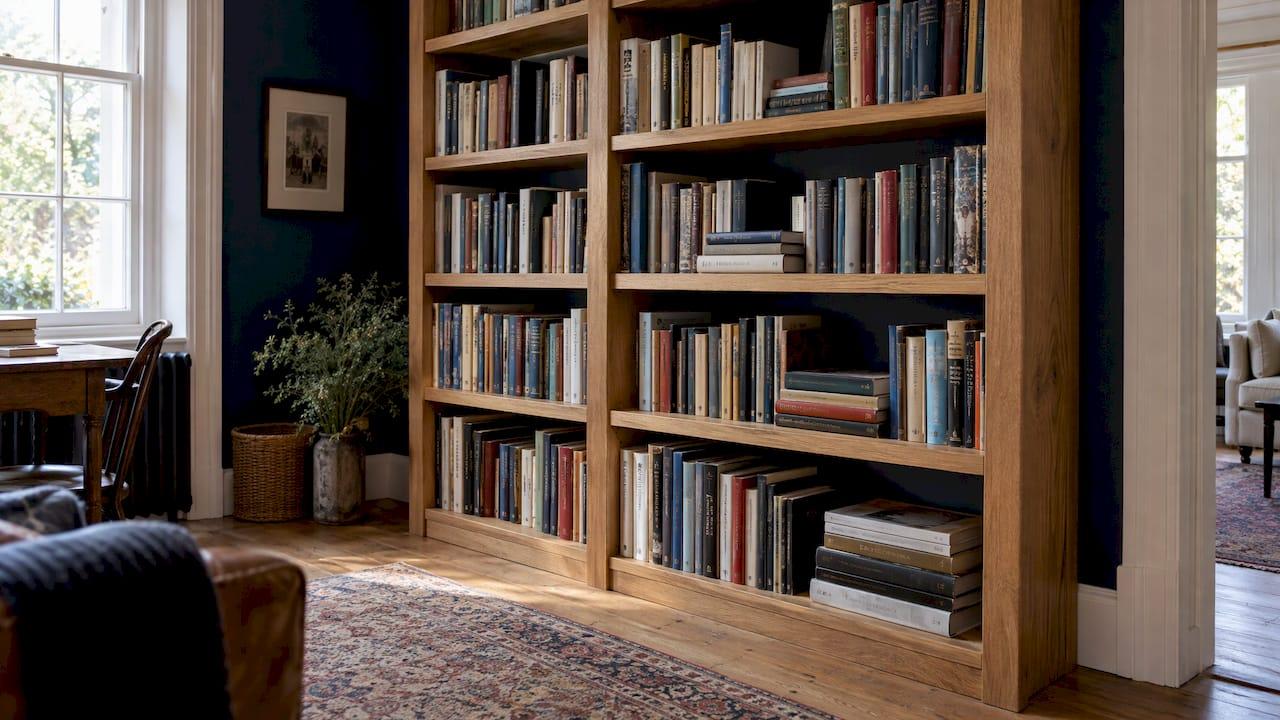
For a bookcase that will carry books for decades, plan on 25 mm for a shelf of around a metre, and on 18 mm only where the span between supports stays under roughly 600 to 800 mm, depending on the material. Thickness is only one half of the answer: the distance between supports, the material, the depth of the shelf and the way its front edge is finished decide whether a shelf stays flat or slowly bows. Because every library is different, this is the sort of decision we settle piece by piece when a bookcase is made to order, sized to your books and your wall.
TL;DR
- Use 25 mm as your starting point for book-laden shelves of about a metre; 18 mm suits shorter spans, typically 600 to 800 mm depending on material.
- Doubling thickness cuts sag eightfold, while doubling span multiplies it eightfold, so a divider often does more than extra thickness.
- Deeper shelves bend more readily, and a deep front lipping is one of the most effective stiffeners.
- Measure your tallest books first, then fix the spacing, span and thickness around them.
- A bespoke bookcase lets the shelf thickness, divider positions and finish be set to your collection rather than to a catalogue size.
Table of Contents
- The short answer by material
- Why thickness matters so much
- Book weight: the load you are really designing for
- Span: the other half of the equation
- Plywood, MDF, chipboard and solid timber compared
- Depth changes the answer
- Planning the spacing between shelves
- A worked example
- Perspective
- Commissioning a bookcase sized to your collection
- Frequently asked questions
- Sources
The short answer by material
Shelf thickness cannot be quoted without a material and a span. The ranges below come from UK board suppliers' guides and assume shelves carrying books, which are among the densest everyday loads a shelf meets.
| Material and thickness | Typical span for book loads | Source |
|---|---|---|
| 12 mm MDF | 300 to 400 mm (light duty only) | MDF Direct |
| 18 mm MDF | 600 to 800 mm for moderate loads | MDF Direct |
| 25 mm MDF | 800 to 1,000 mm for heavier items such as books | MDF Direct |
| 18 mm plywood | Around 800 mm for medium loads | WEL BM |
| 25 mm plywood | Wider bookcases and heavier-duty storage | WEL BM |
Two things stand out. First, a quarter-inch of extra thickness buys far more than it appears to, because stiffness rises steeply with thickness. Second, the figures differ between suppliers, because each assumes a slightly different load and an acceptable amount of sag. Treat them as a corridor, not a single number, and leave yourself margin.
Why thickness matters so much
A shelf is a beam, and beams obey a cube law. Cutspan's board guide explains that a shelf half as thick sags eight times as much under the same load. Going the other way, a modest increase pays off: according to Popular Woodworking, adding 10 per cent to a shelf's thickness makes it 21 per cent stronger, and a 7/8 in shelf is about 36 per cent stronger than a 3/4 in one.
Sag also happens in two stages. The same article describes an initial deflection when the books go on, followed by creep over the years. A shelf that looks perfect on day one can still be curving a few years later, which is why a bookcase should be sized for the long haul and not for the day it is filled.
What counts as acceptable sag
The Composite Panel Association's technical bulletin on particleboard and MDF shelving calculates the maximum span that keeps deflection under span divided by 240. That works out at about 4 mm over a metre. The bulletin names shelf thickness and the distance between supports as the two most important factors in designing a shelf, which is a good order of priority for any bookcase you plan.
Book weight: the load you are really designing for
Books are heavier than most people expect. The research behind this article offers a few reference points:
- Elfa recommends a maximum load of 40 kg for a 450 mm section width, 30 kg for 600 mm and 20 kg for 900 mm on its 19 mm melamine-faced chipboard shelf. The wider the shelf, the less it should carry.
- MDF Direct states that 18 mm MDF at a 600 to 800 mm span holds 20 to 25 kg before sag becomes visible, falling to 15 to 20 kg at 800 to 1,000 mm, whereas 25 mm MDF at 600 to 800 mm holds 30 to 35 kg with minimal sag.
A full shelf of hardbacks or art books can easily exceed these loads, so work from your heaviest shelf, not the average one. Reference books, atlases and photography volumes tend to live together, and that is the shelf to size generously.
Span: the other half of the equation

Thickness and span work together. Cutspan estimates, for a 300 mm deep shelf loaded with books at about 25 kg per metre, that 18 mm MDF keeps sag below span/600 up to 525 mm, 25 mm MDF up to 716 mm, 18 mm birch plywood up to 736 mm and 18 mm melamine-faced chipboard up to 474 mm. Those are tighter limits than many general guides suggest, and they show why a one-metre run of 18 mm board with books on it so often ends in a smile-shaped curve.
The practical rules that follow:
- Keep the clear span between vertical supports short for thinner boards, in the region of 600 to 800 mm at 18 mm.
- Step up to 25 mm where you want a wider bay of around a metre.
- Where a span is borderline, add a vertical divider. Popular Woodworking points out that a centre support strengthens a shelf more than you might expect, and that one long shelf with a centre support can hold more than two shorter shelves.
Different materials resist bending differently, so it helps to understand what you are choosing between. Our guide to MDF versus plywood in furniture sets out where each board belongs, and our wood species selection guide covers the solid timber options.
Plywood, MDF, chipboard and solid timber compared
Plywood
Plywood has a layered grain structure, which helps it resist bending. WEL BM describes 18 mm plywood as the usual choice for bookcases and utility units, commonly suiting spans around 800 mm for medium loads, with 25 mm a sound choice for wider bookcases and heavier storage. Lighter material needs shorter spans: the same source says 12 mm plywood suits light-duty shelving, with supports kept around 400 to 500 mm apart and the shelf properly housed into the sides. Plywood Etc suggests 12 to 18 mm for book shelving, with 15 or 18 mm or intermediate supports for longer runs.
Plywood is also a pleasure to cut cleanly. If you are curious how sheet material is shaped to fine tolerances, there is a useful overview of plywood machining on a CNC, which explains why clean edges and accurate housings come from good tooling and hold-down.
MDF
MDF takes paint beautifully and gives a smooth, even surface, which is why it is so widely used for painted built-in joinery. It has no grain structure to resist bending, so it rewards generous thickness and short spans. MDF Direct recommends front lipping, cleats or battens, a shorter span, a centre support or thicker board to keep it flat under load.
Solid timber
Solid hardwood combines stiffness with beauty, and a visible edge needs no covering. Timber shelves in the 25 mm region suit longer bays, and sculptural thicker edges can become a design feature in their own right. Joinery matters too: how a shelf meets the carcass side affects both strength and appearance, and our overview of furniture joinery types walks through the options.
Depth changes the answer
A deeper shelf places the load further from the back support, so it bends more readily. WEL BM makes the point directly. Most bookcases sit between about 250 and 300 mm deep, which is enough for the majority of books; a deeper shelf for oversized art volumes or a display shelf deserves extra thickness or a stiffer front edge.
Stiffening the front edge
A front lipping is the classic remedy. WEL BM calls a lipping strip 44 to 69 mm deep, fixed to the front edge, one of the most effective upgrades for long bookcase shelves. The Composite Panel Association notes likewise that a strip of lumber attached under the front edge provides additional resistance to deflection. In a bespoke piece, this becomes a design decision: a deep, slim lipping can look deliberate and refined, and it lets a thinner-looking shelf behave like a thicker one.

Back supports and fixing
The same CPA bulletin says the most efficient use of a shelf's capacity comes from end supports plus continuous support along the rear edge, fastened at six-inch (about 150 mm) intervals. A fixed shelf is also far stiffer than one resting on pins, so adjustability costs you some rigidity and the shelves you adjust most should be given a little more thickness.
Planning the spacing between shelves
Thickness is no use if the shelf height does not suit the books. Measure your tallest volumes first, then allow a little finger room above them so they can be pulled out easily. As a rough guide from WoodCalcs-style planning tables, paperbacks need roughly 200 to 230 mm between shelves, hardbacks 260 to 300 mm and large art books 320 to 380 mm.
If you are also designing the reading corner around the bookcase, our partner-free reading is simple: think about lighting and surfaces together. A tidy study layout, as described in this guide to setting up a minimalist study desk, makes it easier to decide how much storage you actually need within reach.
A worked example
Imagine an alcove 1,000 mm wide, 300 mm deep, holding a mixed library with hardbacks on the lower shelves.
- A single 18 mm MDF shelf across the full 1,000 mm is beyond the spans the guides give for that board with books, and would sag over time.
- Moving to 25 mm MDF takes you to the 800 to 1,000 mm band for heavy items, but at the top of its range.
- Adding a central divider halves the span to about 500 mm. At that span, 18 mm board with a front lipping is comfortable, and the shelves look slimmer.
- The lower shelves, carrying the heaviest books, can then take 25 mm for a margin of safety.
There is rarely one right answer, which is the reason to treat thickness, span and divider as one decision. For wall-fixed pieces, remember too that the wall itself must carry the load: our guide to what the wall must carry covers fixings and wall construction.
Perspective
We have a simple view on shelf thickness: the books should decide it, not the catalogue. A bookcase is rarely a generic object. It is a particular wall, a particular collection and often a particular person's idea of how a room should feel.
Because every piece we make is handcrafted to order, with the size and finish set to the client, we can give the heavy shelves the presence they need and keep lighter shelves delicate. A slim shelf with a deeper front edge, a sculptural divider that does structural work and a finish chosen to suit the room can all be part of one design.
That is where working with skilled artisans pays off. The proportions, the materials and the details are considered together, and we are always happy to work with you and your designer on getting them right.
Luke
Commissioning a bookcase sized to your collection
If you would rather not calculate spans and lipping depths yourself, a bespoke commission takes that off your hands. Simmons Interior Supply makes handcrafted furniture to order, with sizes and finishes customised for residential and hospitality interiors, and we work with interior designers, architects, homeowners and luxury hotels. Tell us how wide the wall is and what the shelves will hold, and the piece is shaped around your books.

Explore the bespoke furniture collection to see the kind of work we make. If you are a designer or specifier, our guide to writing a supplier-ready furniture brief shows how to set out dimensions and tolerances clearly.
Frequently asked questions
How thick should a bookcase shelf be?
For a shelf of around a metre carrying books, 25 mm is the safer choice. For shorter spans of 600 to 800 mm, 18 mm board can work, as the MDF Direct and WEL BM guides show. Adding a centre divider lets you use thinner material over a wider bay.
Is 12 mm plywood strong enough for a bookshelf?
It suits light-duty shelving at short spans, with supports about 400 to 500 mm apart and the shelf properly housed into the sides, according to WEL BM. For a full run of books, 18 mm or 25 mm gives a far better margin.
How can I stop a bookshelf from sagging?
Shorten the span, add a centre support, choose thicker board or fix a deep front lipping. MDF Direct lists these same measures, and the Composite Panel Association recommends continuous rear support. Fixed shelves are also stiffer than ones resting on pins.
How deep should a bookcase shelf be?
Most books sit comfortably on shelves around 250 to 300 mm deep. Deeper shelves bend more readily because the load sits further from the back support, so give them extra thickness or a stiffer front edge.
Sources
- Technical Bulletin: Particleboard and MDF for Shelving, Composite Panel Association
- Build Stronger, Sag-Proof Shelves, Popular Woodworking
- Melamine shelf, Elfa
- MDF and Plywood Thickness Guide, Cutspan
- MDF Shelving Boards: Thickness Guide, MDF Direct
- MDF Shelf Weight: How Much Can It Hold?, MDF Direct
- Plywood Shelf Thickness for Stronger Shelving, WEL BM
- What Thickness Plywood for Shelving?, Plywood Etc
- Bookshelf Calculator, WoodCalcs
- Plywood Machining on a CNC