
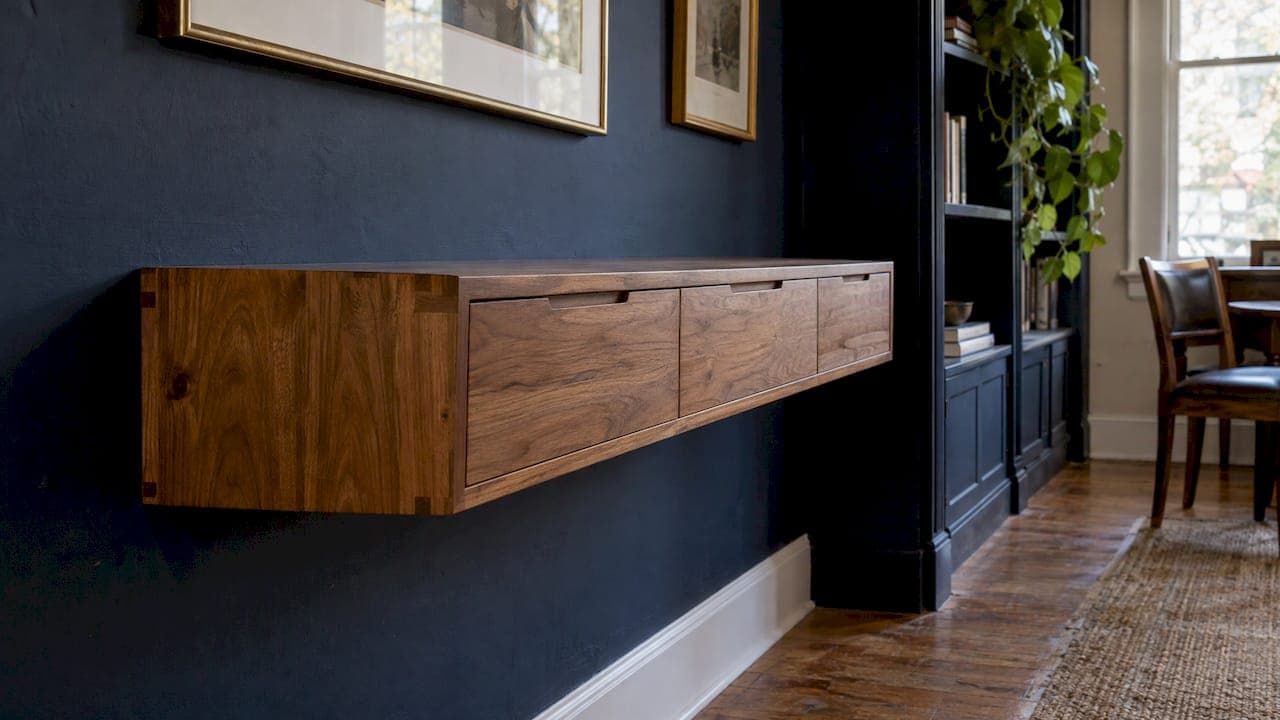
There is no single weight limit for a wall-hung console, because the limit belongs to the wall and the fixings as much as to the furniture. The figure you need is the total load: the console itself, everything it holds, and the leverage created by its depth. Divide that load across properly chosen fixings, anchor them into studs or masonry rather than bare plasterboard, and allow a generous safety margin.
Below, we explain how to calculate that load, what different UK walls can take, and which fixing methods suit a heavy, handcrafted piece.
TL;DR
- A wall-hung console's safe weight depends on three things: the console and its contents, the wall type, and the fixings. The furniture's own rating never overrides the wall.
- Add the empty console, the TV, the stored items and any bracket, then divide by the number of fixings and apply a safety factor.
- Plasterboard alone carries very little. Heavy consoles belong on studs, a backing board spanning studs, or masonry behind a dot and dab wall.
- Depth matters: the further a load sits from the wall, the harder it pulls on the top fixings.
- For a bespoke piece, give your maker the wall construction and intended contents before sizing and fixing details are settled.
Table of Contents
- Why a console has no single weight limit
- Step one: add up the total load
- Step two: apply safety factors
- Step three: know your wall
- Step four: respect leverage
- Fixing methods for a heavy console
- Before you drill
- Our perspective
- Designing a console that suits your wall
- Planning around wires and storage
- FAQ
- Sources
Why a console has no single weight limit
Search for wall-hung consoles and you will find listings quoting capacities of up to 150 kg. Those numbers describe the cabinet, not your wall. The relevant British standard, BS EN 14749, covers the strength of wall hanging units only as far as the cabinet, its components and the attachment devices. The wall itself and the fixings you choose for it fall outside the standard's scope.
In plain terms, a console can be perfectly strong and still come off the wall if it is fixed into the wrong substrate with the wrong anchors. The same standard also includes informative annexes with an example of loading wall hanging units and a method for calculating vertical and horizontal forces, which tells you how the industry thinks about the problem: forces in two directions, not just weight pulling down.
Step one: add up the total load
The load on the wall is more than the furniture. List every item:
- The empty console, including its top, drawers and doors. A solid timber or metal piece is heavier than a veneered carcass, so ask the maker for the finished weight.
- What it supports on top: a television, lamps, sculpture, a stack of books.
- What it stores inside: media equipment, linens, glassware, files.
- Any bracket, rail or hanging cleat that is part of the fixing system.
A sound approach, set out in a guide to fastening heavy objects to plasterboard, is to calculate the total weight of the object and its mounting bracket, choose anchors rated for that load, and spread the load across several anchor points.
A worked example
The figures below are illustrative, not a product specification. Imagine a 1.4 m console in solid timber:
| Item | Weight |
|---|---|
| Empty console | 28 kg |
| 55-inch TV and soundbar on top | 18 kg |
| Stored items in drawers and cupboard | 14 kg |
| Total static load | 60 kg |
Fixed on four anchors, the static load is 15 kg per anchor. That is the starting number, not the finishing one.
Allow for the TV and its bracket
Televisions need particular care. A 65-inch television can weigh 20 to 25 kg, and once you add a bracket and a swivel arm extended outwards, the load on each fixing point can be significantly higher than the screen's weight alone. If the TV is mounted on the wall above the console rather than standing on it, treat the two as separate fixing problems and do not share anchors between them.
Step two: apply safety factors
Fixing manufacturers publish loads for ideal conditions. Practical guidance from UK fixing suppliers is to divide the total static load by the number of anchors, then apply a safety factor, commonly between 1.5 and 3, plus a dynamic multiplier of 1.5 to 2 for occasional impacts. A drawer slammed shut or a shelf knocked by a passing hip is a dynamic load.
A second supplier explains the idea of the Safe Working Load: the maximum load divided by a safety factor, typically 2 for standard DIY work. A fixing with a 100 kg maximum therefore has a Safe Working Load of 50 kg. The same guide adds that if packaging does not make clear whether the printed figure is a maximum or a failure load, you should treat it as a maximum and halve it.
Continuing our example: 15 kg per anchor, multiplied by a safety factor of 2, means each anchor should be rated for at least 30 kg of safe working load in the direction it will be loaded. If you also allow for knocks with a dynamic multiplier, the requirement rises further. Choosing fixings comfortably above that figure is the whole point.
Step three: know your wall
Most British homes have one of two kinds of internal or lining wall. According to a UK builders' guide, they are stud walls, with a timber or metal frame and plasterboard on both faces, or dot and dab walls, where plasterboard is bonded to solid masonry with adhesive and leaves a 10 to 25 mm gap. Older properties, solid plaster and brick, behave differently again, which is common in period London townhouses and mansion flats.
Stud walls
On a stud wall, the strongest option is to screw directly into the timber studs. If the console's fixing points do not line up with studs, a timber batten or backing board screwed across two studs gives a solid surface to fix into. In practice, a bespoke console can be made with its fixing rail positioned to meet your stud layout, which is much easier to arrange before it is made than after.

Dot and dab walls
Behind the plasterboard on a dot and dab wall is a hollow gap, then blockwork or brick. For anything heavy, the sensible route is to secure the load to the blockwork, which is far stronger than the plasterboard. For televisions in particular, the same builders' guide says to use through fixings into the masonry and never rely on plasterboard anchors alone.
What bare plasterboard can take
Plasterboard is a modest structural material. One manufacturer's guidance puts it at roughly 15 kg per square metre for single plasterboard, 25 kg for double and 35 kg for triple. A 60 kg console, a few kilograms of which hangs well away from the wall, is not a job for the board by itself. Spread the load into the studs or the structure behind.
Step four: respect leverage
A console is not a flat picture. It projects from the wall, typically by 30 to 45 cm, and that depth multiplies the force on the upper fixings. As one UK guide explains, cantilevered loads create leverage that multiplies the force at the top fixings, so a load can generate pull-out forces well beyond its actual weight.
Manufacturer data sheets show how sharply this changes the figures. For one 15 mm plasterboard fixing, the published tension safe load is 20 kg, but the safe load for a cantilever at 150 mm overhang is 16 kg per fixing. A console is usually deeper than 150 mm, so the real allowance would be lower again. Use the data sheet for the exact fixing you choose, and where the maker quotes a cantilever figure, work from that rather than the straight-pull one.

For a deeper look at how projection and proportions interact, see our console table dimensions guide.
Fixing methods for a heavy console
| Wall | Preferred method | Why |
|---|---|---|
| Stud wall, studs line up | Screw through the fixing rail into the studs | The frame carries the load, not the board |
| Stud wall, studs do not line up | Plywood or timber backing board across two or more studs | Creates a solid surface at the right positions |
| Dot and dab wall | Through-fixings into the blockwork behind | Masonry is far stronger than board |
| Solid masonry | Fixings rated for the substrate and condition | Check for cracks and edge distances |
| Light loads on board only | Heavy-duty plasterboard fixings, rated for tension and cantilever | Only suited to modest weight |
For stud walls, one UK guide suggests a mounting plate of 18 mm plywood spanning two or more studs for heavy storage units, with the unit then fixed to the plate. That plate also forgives small differences in positioning, which is helpful with a made-to-measure piece.
Fixing performance also depends on conditions. A trade reference notes that its table values assume ideal conditions and that reduced loads apply in cracked masonry, close to edges, or in poor-quality substrates. Multiple heavy-duty plasterboard fixings also need minimum edge and centre distances, so do not crowd them together to fit a narrow rail.
Before you drill
- Identify the wall. Tap along it: a hollow sound suggests stud or dot and dab, a dull one suggests solid masonry. Then confirm with a stud detector.
- Mark studs, cables and pipes. Hidden services are a real hazard when drilling. Use a detector, and if you are unsure, call a qualified electrician or plumber first.
- Weigh or confirm the weight. Include contents and any TV.
- Work out the load per fixing, then apply your safety factor.
- Pick fixings from the manufacturer's published data for the substrate and the cantilever load, and follow their installation instructions.
- Fit, then test gently before loading the piece fully.
For anything load bearing or hung in a public space, it is worth having the work checked by a qualified tradesperson. That applies to hotel corridors, reception areas and any installation where a failure could injure someone. For our trade clients, this is part of project planning, not an afterthought.
If you also hang mirrors above your console, our guides on mirror mounting systems and installing a large mirror safely cover that second load, which should always have its own fixings. Similar principles appear in our guide to wall mounted headboard fixing.
Our perspective
We make bespoke furniture, so we are often asked what a piece will hold on the wall. Our honest answer starts with the wall, not the table.
A handcrafted console is made from scratch to your size and finish, which is exactly why it is worth planning the fixing at the same moment as the design. A fixing rail can be positioned to meet your studs, the depth can be considered against the load it will carry, and the finish can be chosen knowing how the piece will sit against the wall. Retrofitting a heavy piece to a wall that was never considered is where trouble starts.
Our advice to designers and architects is simple: send the wall construction and the intended contents with your brief. A television, a collection of ceramics or a lamp and a stack of art books each change the answer. We are always happy to work with you to shape a design that looks effortless and is fixed with care.
Luke
Designing a console that suits your wall
When we work on a bespoke console, we are happy to talk through size, finish and how it will be fixed. Our Hammered Console Table and Park Console Table show the kind of craftsmanship we bring to the form, and every piece can be customised in size and finish to fit your space.

If you are specifying for a residential scheme or a hospitality project, explore the Simmons Interior Supply bespoke collection and tell us about your project and walls.
Planning around wires and storage
A console that holds a television or hi-fi also carries cables, and those affect both weight and layout. Our guide to wire management in bespoke furniture explains how to plan routes you can still reach. Doors and drawers matter too: a heavier door or fully loaded drawer changes how the console behaves when opened, which is one more reason to specify good soft close hinges. The quality of the joinery also bears on how well a piece handles its own weight, as we discuss in dovetail versus dowel joints.
FAQ
How much weight can a wall-hung console hold?
There is no universal figure. It depends on the cabinet's construction, the wall behind it and the fixings. The relevant standard only covers the cabinet and its attachment devices, not the wall. Work out your own total load and fix to studs or masonry.
Can I hang a console on plasterboard alone?
Only for light loads. Plasterboard supports roughly 15 kg per square metre in single thickness, so a console with contents should be fixed into studs, a backing board across studs, or the masonry behind a dot and dab wall.
Does the TV on top change the calculation?
Yes. Count the TV's weight, and its bracket if wall-mounted, as part of the load. A 65-inch set can weigh 20 to 25 kg, and an extended arm increases the pull-out force on the fixings well beyond that.
What safety factor should I use?
UK fixing suppliers commonly advise a safety factor of 1.5 to 3, with a further dynamic multiplier of 1.5 to 2 for occasional impacts. A factor of 2 is typical for standard domestic work. Always check the fixing manufacturer's own data.
Sources
- BS EN 14749:2016+A1:2022, BSI Knowledge (scope and strength of wall hanging units)
- BS EN 14749:2016+A1:2022, BSI Knowledge (annexes on loading and forces)
- Best Plasterboard Fixings for Heavy Loads UK Guide, BookaBuilderUK
- Heavy duty wall mounting guide, AlwaysFirst4Fixings
- 5 Tips For Finding The Right Wall Fixing, Corefix Fixings
- Fastening Heavy Objects to Plasterboard, Rapid
- TV Mounting on Plasterboard, Mount TV
- GripIt Plasterboard Fixings data sheet
- Cavity Wall Fixings Guide, Tool Compatibility
- Fixings Reference Guide, TradeCalculator
- Concrete Screws, Wall Plugs and Anchors Explained, Screwkart