
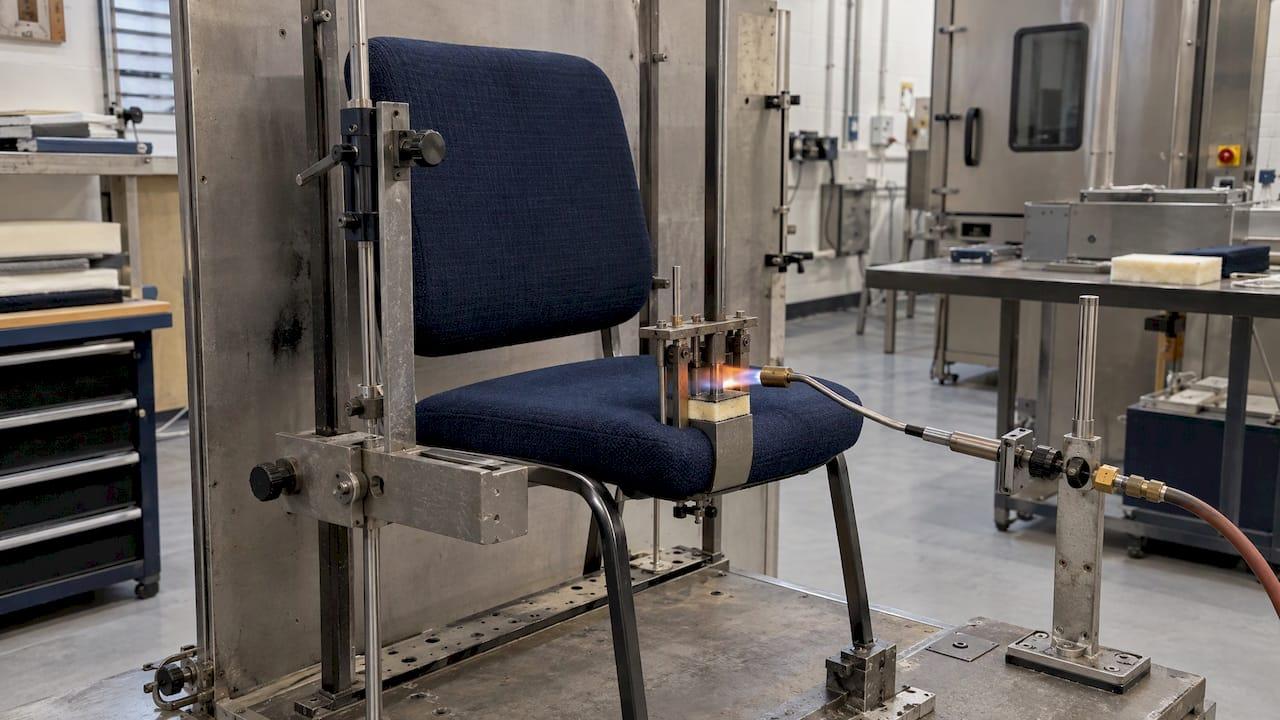
There is no single "contract furniture standard" in the UK. There is a short chain of rules: a fire risk assessment for the building, a British Standard that turns that assessment into a test level, and durability standards for the way the piece will be used. Get the chain right and a specification fits on a few lines. Get it wrong and a beautiful commission can be turned away at handover. We make bespoke furniture to order, with sizes and finishes set to each project, so we write this as people who work from a specification, not around one.
TL;DR
- Domestic furniture is covered by the 1988 fire regulations, which place the duty on the maker. In contract settings, the duty to assess fire risk sits with the building's owner or user.
- Specify upholstered seating by one line, for example BS 7176 at medium hazard, so that ignition level, foam and treatment durability are all defined together.
- Durability is separate from fire: non-domestic seating, office chairs and worktables each have their own EN standards.
- Ask for test evidence worded the way test houses actually issue it, and keep it with the project file.
- Rules changed on 30 October 2025, but permanent labelling duties stayed.
Table of Contents
- What contract furniture means, and why the standards differ
- The fire safety chain, step by step
- Durability and safety standards beyond fire
- What evidence to put in the specification
- What changed on 30 October 2025
- Rugs, mirrors and the rest of the scheme
- Our view
- Commissioning bespoke contract pieces with us
- FAQ
- Sources
What contract furniture means, and why the standards differ
Contract furniture is furniture made for non-domestic use: hotels, restaurants, offices, healthcare, education and the communal parts of residential schemes. It is expected to work harder and to meet stricter safety expectations than a piece in a private home. Our own guide to what contract grade furniture means covers when to specify it.
The legal split matters. The Furniture and Furnishings (Fire) (Safety) Regulations 1988 apply to furniture ordinarily intended for private use in a dwelling. FIRA's Specifying Furniture Guide explains the consequence: in the domestic sector the manufacturer is legally responsible for supplying fire-safe furniture, while in the contract sector the Regulatory Reform (Fire Safety) Order 2005 puts responsibility on the owner or user of the building, who must assess fire risk, including the contents.
In practice this means a hotel group, a managing agent or a client's facilities team owns the risk, and the designer's specification is how that risk is managed. Homeowners commissioning for a private dwelling are on the domestic side of the line, and the maker carries the legal duty.

The fire safety chain, step by step
1. The fire risk assessment
Under the 2005 Order the responsible person must make a suitable and sufficient assessment of the risks to people on the premises and keep it under review. Furniture is part of what that assessment considers. A bar with late-night trade, a care home lounge and a boardroom do not carry the same risk, and the assessment says so.
2. Turning the assessment into a hazard level
The British Furniture Confederation's contract flammability guide sets out how the required ignition resistance is then specified using BS 7176 for seating or BS 7177 for mattresses and bed bases. The level follows the hazard of the premises:
| Hazard level | What the tests add | Typical thinking |
|---|---|---|
| Low | EN 1021-1 and EN 1021-2 tests (cigarette and match-equivalent sources) | Lower-risk, well-managed spaces |
| Medium | The above, plus Crib 5 | Many hotels, offices, public areas |
| High | Crib 7 | Higher-risk occupancy |
| Very high | Specified individually | Highest-risk premises |
The hazard level is for the building's responsible person and their fire adviser to determine, not for the maker to guess. If you are working on upholstery for a medium hazard scheme, our Crib 5 upholstery guide for UK trade goes deeper into what that level involves.
3. The filling tests still apply
Contract seating is not exempt from the domestic rules underneath. According to the same BFC guide, BS 7176 requires fillings at every hazard category to pass the relevant tests in the 1988 Regulations. So a contract sofa sits on top of the foam and filling requirements, not instead of them.
The 1988 Regulations also set the baseline tests themselves. Upholstery must pass the cigarette test in Part I of Schedule 4, and visible cover fabric is match-tested under BS 5852 Part 1 using a butane flame (ignition source 1), over a defined polyurethane foam, with any flame-retardant-treated fabric soaked in water for 30 minutes first. This is what people mean when they ask about "BS 5852": it is the test method, with ignition sources of increasing severity, that the later standards build on.

4. Write one line, not five
The BFC guide recommends a single statement such as BS 7176:2007 for Medium Hazard. It sets the ignition-resistance level, requires combustion-modified foam under Schedule 1 Part 1 of the 1988 Regulations and clarifies how durable any flame-retardant treatment must be. One statement defines the whole fire requirement, which keeps drawings, schedules and tender documents consistent.
Durability and safety standards beyond fire
Fire is the headline, but contract pieces are also judged on strength, stability and ergonomics. The NHS Supply Chain's December 2025 product and service specification for contract furniture is a useful snapshot of what a demanding public buyer asks for:
- BS EN 16139:2013 for strength, durability and stability of non-domestic seating.
- BS EN 1335-2:2018 for the safety of office work chairs.
- BS EN 527-1:2016+A1:2019 for office worktables.
- BS 5852:2006, BS EN 1021-1 and BS EN 1021-2 for ignitability.
The same document reserves the right to suspend product lines if suppliers cannot show evidence of compliance when asked. That is a good model for any client: the standard is only as useful as the paper behind it.
For public-sector work, the Government Buying Standard for office furniture makes it a mandatory requirement that furniture complies with the relevant UK technical and quality standards, with suppliers providing documentation to show it. Private hospitality clients are not bound by it, but many borrow the approach.
What evidence to put in the specification
A specification that names a standard but asks for no evidence is half finished. The BFC guide lists what testing gives a buyer: independent assurance that products are legal, pre-qualification for tenders, fewer failures and complaints, a due-diligence defence if an incident occurs and protection against recalls. It also notes that repeat testing on representative samples is needed to show continued compliance, so a single old certificate is not enough for a repeat order.
Two practical points on wording:
- Expect the certificate to say "complies with the ignition resistance requirements of BS 7176 Medium Hazard". The BFC guide explains that test houses are unlikely to certify full compliance with BS 7176 or BS 7177, because labelling and re-test requirements are hard to police. Do not write a specification that demands a certificate no test house issues.
- Allow for the water-soak. Any flame-retardant treatment on covers or fire barriers is soaked for 30 minutes before conditioning and testing under the relevant annexes of BS EN 1021 and BS 5852. If a treated fabric is changed, the result may not carry over.
For each commission, keep a simple file: the fire risk assessment's hazard level, the named standard, the test evidence for the cover and filling combination, and the warranty terms. Our note on warranty clauses specifiers should lock into contract furniture orders covers the last item.
What changed on 30 October 2025
The Furniture and Furnishings (Fire) (Safety) (Amendment) Regulations 2025 came into force on 30 October 2025. They removed certain baby and young children's products from scope, removed the requirement for a display label on new products and extended the time limit for enforcement authorities to begin legal proceedings from 6 to 12 months. The permanent-labelling obligations in regulation 11 and Schedule 7 were not changed.
For products taken out of scope, GOV.UK guidance says producers must still ensure safety under the UK General Product Safety Regulations, and may use established standards such as BS EN 1021 Parts 1 and 2 or BS 7177 to show fire-safety compliance. For most contract upholstery the practical effect is small: the specification chain above is unchanged.
Rugs, mirrors and the rest of the scheme
Standards do not stop at the sofa. Floorcoverings in public areas raise their own fire questions, which we cover in rug fire ratings in England. For hospitality schemes where every piece must last, designing hotel furniture to last ten years looks at construction and finish choices that complement the standards. And where a budget has to be met without losing compliance, value engineering bespoke FF&E explains where to save and where not to.
Our view
Standards can feel like the opposite of craft, but we have found they are the brief that lets craft be trusted. A hotel owner is not choosing between a bespoke piece and a compliant one. They want both, and a clear specification is what makes that possible.
Every piece we make is handcrafted to order with our artisans, with size and finish set around the space. That is precisely why we like to begin with the hazard level, the required standards and the dimensions in one conversation: it lets us shape the piece around the requirement from the first drawing, rather than adapting it afterwards.
Our advice to designers is simple. Name the standard in one line, ask for the evidence in the words test houses really use, and keep the file. Then spend your energy on proportion, material and finish, which is where a room is won.
Luke
Commissioning bespoke contract pieces with us
If your scheme calls for distinctive furniture made to a stated specification, our bespoke furniture collection is made to order in custom sizes and finishes, for residential and hospitality interiors. We also offer trade-only made-to-order rugs and mirrors from partner brands, accessed through a trade account. Bring us your drawings and the standard your project requires, and we will work from there. You can see the full range at Simmons Interior Supply.
To prepare, our guides to custom furniture CAD drawings and to the supplier-ready furniture brief show what a clean brief contains.
FAQ
Who is legally responsible for fire safety of furniture in a hotel or office?
In non-domestic buildings the Regulatory Reform (Fire Safety) Order 2005 makes the responsible person, usually the owner or user, accountable for assessing fire risk, including furniture. The assessment sets the hazard level, and the specification then names the matching standard. A qualified fire risk assessor can advise on the level for a specific building.
What is BS 5852?
BS 5852 is the method for testing the ignitability of upholstered seating using flaming ignition sources of increasing severity. The 1988 Regulations use it for the match test on cover fabrics, and it sits behind the Crib 5 and Crib 7 levels used in contract specifications.
Is contract furniture exempt from the 1988 Regulations?
Not entirely. The Regulations target furniture for private dwellings, but BS 7176 requires fillings at every hazard category to pass the relevant tests in them. Contract seating therefore carries the filling requirements as well as its own ignition-resistance level.
Did the 2025 amendment change what contract buyers need?
The amendment, in force from 30 October 2025, removed some children's products from scope and the display label for new products, and lengthened the enforcement time limit to 12 months. Permanent labelling duties were unchanged, so the specification routine stays the same.
Sources
- The Furniture and Furnishings (Fire) (Safety) Regulations 1988
- The 1988 Regulations as made, Schedule 5 match test
- Regulatory Reform (Fire Safety) Order 2005, Part 2
- FIRA Specifying Furniture Guide
- BFC contract flammability guide
- NHS Supply Chain product and service specification, December 2025
- Government Buying Standard for office furniture, procurers' note
- Furniture and Furnishings (Fire) (Safety) (Amendment) Regulations 2025, GOV.UK