
There is no single "fire rating" stamped on every rug. In England, a rug's fire performance is described by a classification such as Cfl-s1 or Bfl-s1, issued under the European system EN 13501-1 after laboratory testing. Whether you need one depends on where the rug will lie: a loose rug in a private living room sits in a very different regulatory position from a rug laid across a hotel corridor. This guide explains the classes, the tests behind them, where the rules bite, and how to read the paperwork when a project demands it.
TL;DR
- Flooring fire performance in the UK is classified under EN 13501-1, from A1fl (non-combustible) to Ffl (easily flammable); the specification wording most often seen for commercial flooring is Bfl-s1.
- The Furniture and Furnishings (Fire) (Safety) Regulations 1988 do not treat floor coverings as "furniture", so the familiar upholstery tests do not apply to rugs.
- A classification applies only to the exact product tested. A change in composition, thickness, density or colour can invalidate it.
- For hotels and public buildings, ask for the laboratory report, match it to the rug being supplied, and agree the required class with your fire safety adviser early.
- Bespoke rugs can be specified to a brief, so state the fire requirement at the start of the commission.
Table of Contents
- What a rug fire rating actually means
- The EN 13501-1 classes for floor coverings
- How rugs are tested
- Do the regulations require a rug to have a rating?
- Why classification standards for rugs can confuse
- Materials and fire-retardant treatments
- How to check a fire classification report
- Specifying for hotels and public buildings
- Our perspective
- Commissioning a rug with fire requirements in mind
- FAQ
- Sources
What a rug fire rating actually means
A fire rating is shorthand for a reaction to fire classification: how readily a material ignites, how far flame spreads across it, and how much smoke it gives off. It is not the same as fire resistance, the word used for walls, floors and doors that must hold back a fire for 30 or 60 minutes. Search results for this topic are full of fire door ratings (FD30, FD60) and structural resistance criteria, and none of that applies to a rug.
It is also different from the upholstery tests designers know well. BS 5852 tests a composite of cover fabric and filling against an ignition source at the seat-back junction, and the result applies to that specific combination. A rug has no filling and no seat-back, which is why flooring has its own test regime.
The EN 13501-1 classes for floor coverings
Under EN 13501-1, flooring classes run from A1fl, which is non-combustible, through A2fl, Bfl, Cfl and Dfl to Efl and Ffl, the last being easily flammable. Each class carries a smoke suffix too. The letters tell you how combustible the material is, fl marks it as a flooring classification, and s1 means low smoke quantity and speed while s3 means high.
| Class | In plain terms | Typical use in specifications |
|---|---|---|
| A1fl | Non-combustible | Rare for textiles |
| A2fl-s1 | Very limited contribution to fire, low smoke | Demanding public areas |
| Bfl-s1 | Limited contribution to fire, low smoke | The wording most often seen for commercial flooring |
| Cfl-s1 | Flame-retardant, low smoke | Many commercial and hospitality settings |
| Dfl | Normal flammability | Lower-risk areas |
| Efl, Ffl | Normal to easily flammable | Not usually acceptable where a class is demanded |
One source describes Bfl-s1 as the typical specification language for flooring, and another notes that Cfl-s1 meets the requirements of most commercial or hospitality settings. Treat both as a starting point for conversation: the class a given building needs is set by its fire strategy, not by a rule of thumb.
What the numbers mean
The class comes from measured values. For Bfl-s1, the critical heat flux must be at least 8.0 kW/m², average smoke development no more than 750 %.min, and flame spread within 20 seconds no more than 150 mm, with no flaming droplets igniting the filter paper. For Cfl, the critical flux requirement is 4.5 kW/m² with the same flame spread limit.

Critical heat flux is the radiant heat level at which flames stop spreading along the specimen. The higher the figure, the harder the surface is to keep burning.
How rugs are tested
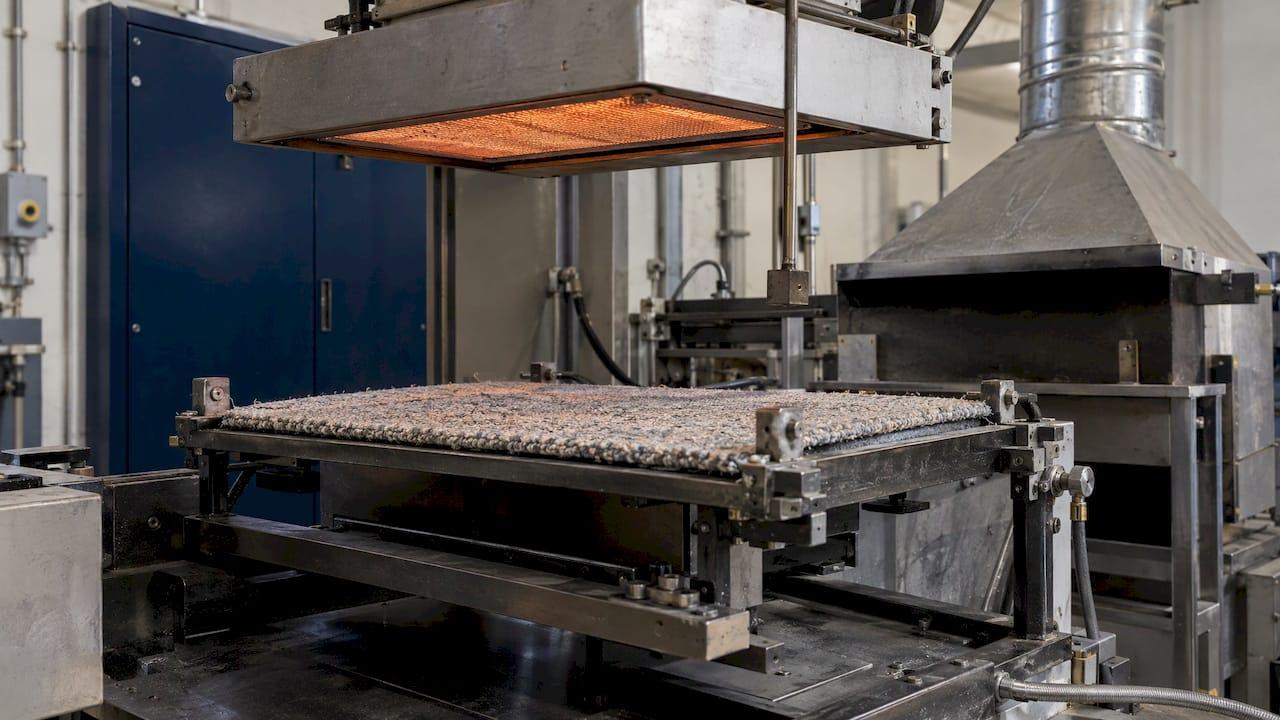
Two tests do most of the work for textile flooring. EN ISO 11925-2 is a small-flame test. EN ISO 9239-1 is the radiant panel test, which evaluates the critical radiant flux below which flames no longer spread across a horizontal specimen, with smoke measured in the exhaust stack.
Which tests are needed depends on the class sought. Efl and Ffl need only the small-flame test; Dfl, Cfl and Bfl need both; A2fl adds non-combustibility or calorific tests; A1fl needs those two alone. UK laboratories such as BTTG offer BS EN 13501-1 classification using the single-flame, SBI and radiant panel methods, the radiant panel being for floorings only.

What about the old BS 476 certificates?
You will still meet BS 476 Part 6 and Part 7 on older specifications. These are current but not for use in the UK, having been superseded by BS EN 13823 and classification against BS EN 13501-1. New briefs should ask for EN 13501-1 classes, and where a legacy certificate turns up, ask the specifier whether it still satisfies the project.
Do the regulations require a rug to have a rating?
For a loose rug in a private home, the short answer is that no specific rug rating is demanded. The Furniture and Furnishings (Fire) (Safety) Regulations 1988 define furniture so that it does not include bedding or floor coverings, carpets and mats included. A professional guide from FIRA confirms the same and adds that carpets and curtains fall under the General Product Safety Regulations, so a product must still be safe.
The Building Regulations 2010 work differently. They require that building work uses adequate and proper materials appropriate for the circumstances in which they are used. In practice, a hotel, restaurant or public building will have a fire risk assessment and a fire strategy, and these set what the flooring, including any fixed or runner-style rugs on escape routes, must achieve. A specifier or the responsible person for the building has the last word, so take the number from them rather than from a general article.
For commercial settings more broadly, VisitBritain's guidance says furniture and furnishings in medium-hazard properties should comply with BS 7176, BS 7177 and BS 5867, which give greater protection than domestic products. Those cover upholstery, mattresses and curtains rather than rugs, but they show the direction of travel: commercial interiors are held to a higher standard than homes.
A practical reading by setting
| Setting | What usually happens |
|---|---|
| Private living room, bedroom, dining room | No rug-specific rating required; choose natural or well-made fibres and sensible placement |
| Hotel bedroom | Follow the operator's fire risk assessment and brand standards |
| Hotel corridors, lobbies, escape routes | A specified EN 13501-1 class, commonly Cfl-s1 or Bfl-s1, supported by a report |
| Restaurants, bars, event spaces | Set by the premises' fire strategy and insurer |
The general view in trade guides is that area rugs used as accessories rarely face stringent ratings, while rugs that function as the floor finish in circulation areas do. The distinction is whether the rug is a decorative layer or part of the route out of the building.
Why classification standards for rugs can confuse
Two other standards appear in rug conversations and are easy to mistake for fire ratings. Neither is.
- BS EN 14215 classifies woven, tufted, knitted, needled, flocked, bonded and hand-tufted rugs and runners into use classes for wear and appearance retention. It is not applicable to hand-knotted rugs. The 2025 edition supersedes the 2018 one, and the UK committee voted against approving it because of its reliance on appearance retention tests under significant review.
- BS EN 1307 covers textile floor coverings and carpet tiles, excluding rugs and runners, in use classes for wear and appearance.
Both describe durability. For a hotel scheme you will want durability evidence alongside fire evidence; our guides on Martindale rub counts and pile specifications for hotel rug durability cover that side.
Materials and fire-retardant treatments
Fibre choice shapes fire behaviour. Wool is widely described as naturally flame-resistant and prone to self-extinguish, while polyester and polypropylene can melt and burn fast. That is a generalisation, and the finished rug's construction, backing and dyes matter as much as the fibre, which is why the classification attaches to the product rather than the fibre.
Treatment is another route. One UK treatment provider states that loose rugs and carpet pieces can be fire-retardant treated when the fibres are absorbent and there is no water-resistant finish or rubber backing, and that the treatment has been tested to Class Bfl. The same page notes that water washing or water-extraction cleaning removes the treatment, so it needs re-applying after cleaning. If a project relies on treatment, build re-treatment into the maintenance schedule and keep the certificate with the building's fire safety records.
How to check a fire classification report
The paperwork is where projects go wrong. FBM Sourcing observes that the common failure is a genuine report that does not cover the goods being bought. A sound report should show:
- An accredited issuing laboratory, whose details you can confirm directly with the laboratory.
- Exact product identity: trade name, composition, thickness, density and surface finish matching the datasheet and the goods supplied.
- The classification itself with test data, a report number and a date. Many specifications cap report age at five years.
- Mounting and substrate details that reflect how the rug or floor covering will be installed.
The point about product identity cannot be overstated. A Warringtonfire classification report states that results relate only to the conditions of the test and cannot be extrapolated to other products or configurations. Differences in composition, production process, thickness, density or colour may invalidate the results for a variant. For made-to-order rugs, where size, colour and pile can vary, this makes it essential to settle the fire requirement before the design is fixed, not after.
Specifying for hotels and public buildings
A workable sequence for designers and procurement teams:
- Obtain the required class from the fire risk assessment or fire engineer, written as an EN 13501-1 class with smoke suffix.
- Mark which areas the requirement covers: corridors, lobbies, stairs, bedrooms, function rooms.
- Decide whether the rug is to be tested as made, supplied with an existing report that covers the exact construction, or treated.
- Write the report requirements into the purchase documents, including identity matching.
- Keep reports, certificates and any treatment records with the handover file.
Our custom rug design process explains how a bespoke rug moves from brief to sample, and the same logic applies to compliance: the earlier the requirement is on the page, the fewer surprises later. For furniture destined for hospitality, our note on what contract grade furniture means is a useful companion.
Our perspective
A fire rating is a statement about one specific object, and that is why we think of it as part of the design brief rather than a label added at the end.
At Simmons Interior Supply we work with artisans who make each piece to order, with size and finish tailored to the space. That freedom is the reason to talk about performance at the outset. When an interior designer, architect or hotel procurement team tells us where a rug will lie and what the building's fire strategy asks of it, we can shape the conversation around the right construction from the start, instead of discovering the question once a sample is approved.
For homeowners the picture is gentler. A beautiful rug in a dining room or bedroom is not governed by a rug-specific rating, and we would simply encourage you to choose good materials, honest construction and sensible placement away from open flames and heaters.
For trade clients, our view is simple: write the class down, name the area, and make sure the paperwork describes the rug that will actually arrive. We are always happy to work with you on that.
Luke
Commissioning a rug with fire requirements in mind
If your project is a hotel, a restaurant or a private commission where the fire question matters, begin with the brief. Our trade-only collections of made-to-order rugs and mirrors, together with handcrafted bespoke furniture, are made with custom sizes and finishes for residential and hospitality interiors. Tell us the room, the dimensions and any fire requirement your adviser has set, and we will work through the options with you.
Explore the bespoke furniture and rug collections or read our guide to commissioning a bespoke rug before you get in touch. If you are weighing materials for warmth underfoot as well, our note on rugs for underfloor heating is a good next stop.
FAQ
Does a rug in my home need a fire rating in England?
No rug-specific rating is set for private homes. The 1988 furniture fire regulations exclude floor coverings from the definition of furniture, though products must still be safe under general product safety law. Natural fibres, careful placement and keeping rugs clear of fires and heaters are sensible habits.
What fire rating should a hotel rug have?
The class is set by the hotel's fire risk assessment and fire strategy, so ask the fire safety adviser. In specifications, Bfl-s1 is the typical wording for flooring, and Cfl-s1 is often cited for hospitality use. Corridors and escape routes are where the requirement matters most.
Is BS 476 still valid for rugs?
BS 476 Parts 6 and 7 are described as not for use in the UK, superseded by EN 13501-1 classification. You may still see them on older specifications. For new projects, ask for an EN 13501-1 class instead and confirm with your specifier.
Can a rug be made fire retardant after it is made?
Sometimes. Treatment providers say loose rugs with absorbent fibres and no rubber backing or water-resistant finish can be treated, and that washing or water extraction removes the treatment. Re-treatment is then needed. Discuss it with your fire adviser before relying on it.
How do I know a fire certificate is genuine?
Check the laboratory is accredited, confirm the report with the laboratory itself, and match the product description to the rug being supplied. Differences in composition, thickness, density or colour can invalidate a result, so the description must match exactly.
Sources
- Fabric Wall Panels and Covering: Fire Standards
- Fire protection classes for floor coverings according to EN 13501
- Carpet Classifications and Ratings Guide
- Reaction to fire classification report, Warringtonfire 2024
- European Fire Testing Classification for Construction Products
- Fire Testing, Measurlabs
- Fire Testing, BTTG
- Standard Documents, FDS Consult UK
- ASTM E84 vs EN 13501 vs BS 476: Fire Ratings for Projects
- The Furniture and Furnishings (Fire) (Safety) Regulations 1988
- The Building Regulations 2010
- Fire safety of furniture and furnishings in the home, FIRA
- Commercial Fire Regulations For Furniture, VisitBritain
- BS EN 14215:2025
- BS EN 1307:2014+A3:2018, BSI Knowledge
- Can Carpets and Rugs Be Fire-Retardant Treated?