
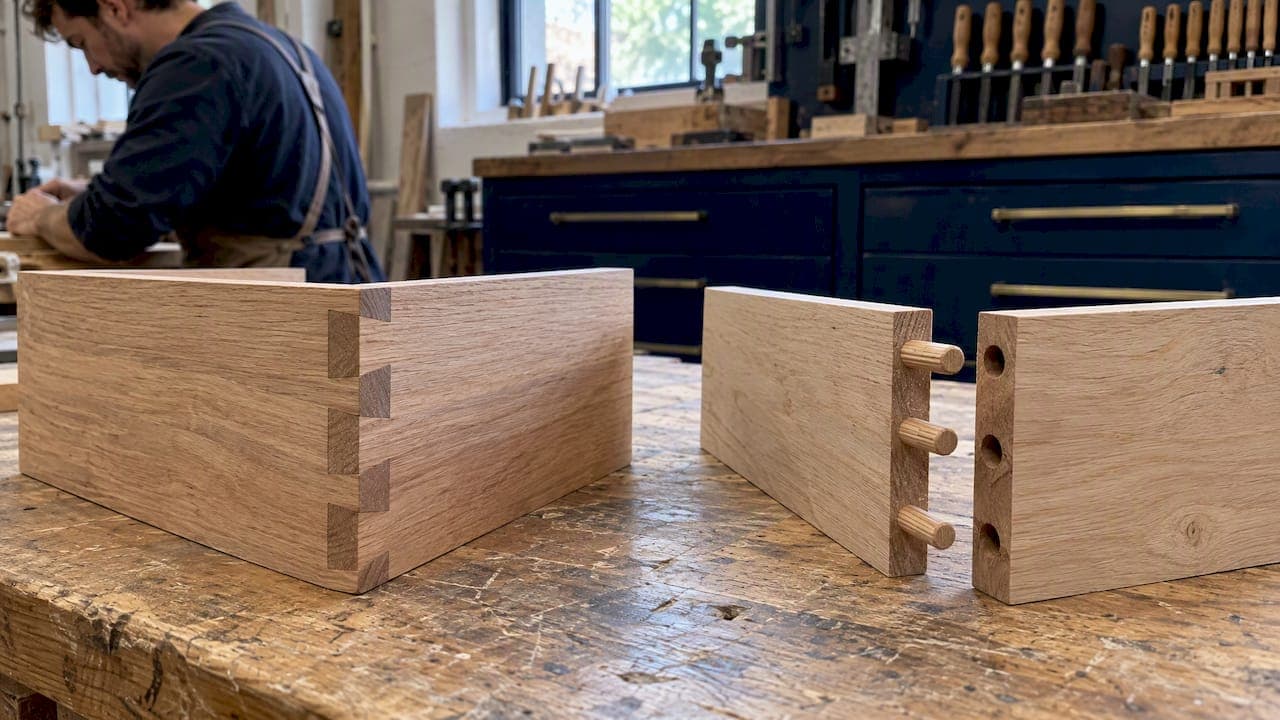
A dovetail is a mechanical lock: wedge-shaped pins and tails that resist being pulled apart. A dowel is a glued cylindrical peg that aligns and pins two pieces together. Neither is simply "stronger". The dovetail excels where a joint is pulled in one direction, as in a drawer. A well-made dowel joint is quicker, cleaner to produce and perfectly sound in many carcasses and frames. What matters is the load, the timber and the maker's care.
Below, we set out how each joint works, where each belongs, how mortise and tenon and box joints fit into the picture, and what to ask when you commission a piece.
TL;DR
- Dovetails lock mechanically against pulling forces, which is why they are the classic choice for drawers and for showing off craftsmanship.
- Dowels are faster and more economical to produce, and perform well when they are accurately sized, spaced and glued.
- Mortise and tenon usually outperforms both where a frame is racked or twisted, such as table and chair frames.
- In British homes, seasonal humidity does more damage to joints than the joint type itself, so timber selection and acclimatisation matter as much as the joint.
- For a bespoke commission, choose the joint for the load and the look, and ask your maker to explain why.
Table of Contents
- How each joint actually works
- Dovetail vs dowel at a glance
- Where the strength question gets more nuanced
- The real enemy of joints: humidity
- Getting dowels right
- Drawer joint types: a quick guide
- Our perspective
- How to choose: a short decision guide
- Commissioning a piece built the way you want it
- FAQ
- Sources
How each joint actually works
The dovetail: geometry doing the work
A dovetail joins two boards, usually at a right angle, with interlocking trapezoidal pins and tails. According to Wikipedia's entry on the dovetail joint, it is a mechanical connection that resists tension, specifically pulling apart in the direction perpendicular to the slope of the tails. The same entry gives the customary slopes as 1:6 for softwoods and 1:8 for hardwoods.
That shape is the reason dovetails sit at the heart of drawer making. When you pull a drawer open, the force tries to tear the front from the sides. The tails, locked behind the pins, simply will not let it. Even if the glue were to weaken over the decades, the geometry would still hold the box together. Woodworking Authority describes the dovetail as the canonical example of a joint that resists movement without relying solely on adhesive or a fastener.
Fit matters. As Woodworkers Institute explains, a dovetail needs to be a tight fit, with the pin under very slight compression, which helps prevent shear along the tail. A sloppy dovetail is a decoration; a well-fitted one is structure.
The dowel: a quiet, efficient fastener
A dowel joint relies on cylindrical rods, glued into drilled holes in both mating pieces, to hold alignment and resist shear between the faces. Traditionally the diameter is around 30 to 40 per cent of the stock thickness, again per the dovetail joint reference.
The appeal is speed and repeatability. Line-boring machinery can produce a dowel joint in under two minutes, where a hand-cut dovetail can take 20 to 40 minutes, according to the figures gathered in our research. That difference is the whole economic story of modern cabinetry.
Dowels are also stronger than their reputation suggests. The same Canadian Woodworking piece notes that tested dowel joints can hold well over 650 lbs in solid oak, and that failure is most often in the surrounding wood fibres rather than in the dowel itself. Comparative bending tests found that half-inch dowels gave the best resistance in both solid timber and particleboard.
Dovetail vs dowel at a glance
| Criterion | Dovetail | Dowel |
|---|---|---|
| Resists | Pulling apart in one direction | Shear and misalignment |
| Mechanical lock | Yes, built into the geometry | No, depends on glue and fit |
| Production time | Slow by hand, faster by machine | Very fast |
| Visible craftsmanship | Yes, often a deliberate feature | Hidden |
| Best for | Drawers, boxes, carcass corners | Panel joints, frames, carcass assembly, alignment |
| Weak point | Needs precise fit | Glue line if the wood moves |
| Cost to produce | Higher | Lower |
Where the strength question gets more nuanced
Dovetails are strong in one direction only
It is tempting to treat "dovetail" as shorthand for "strongest". Practitioners will tell you otherwise. A dovetail is optimised for tension in a single direction. In racking or twisting, common in larger table frames, a well-fitted mortise and tenon is often superior, and a multiple-dowel joint can hold its own against a traditional tenon if the dowels are sized and spaced correctly. That conclusion comes from Matthias Wandel's testing of dowels against mortise and tenon joints, where dowel joints needed more force to crack open initially but slightly less to separate fully afterwards.
In short, the strongest joint is the one best executed for the direction of the load.
Mortise and tenon vs dowel
A mortise and tenon is, in effect, a dowel's larger and more generous cousin: a tongue cut from the end of one member, seated in a pocket in the other. It offers more long-grain glue surface, and a shoulder that resists twisting. For the frame of a dining table, a chair or a bed, it remains our first thought. A dowel is a respectable alternative where the joint is small, the load modest, or where a machine-made frame has to be repeatable across a run of pieces. Dowel joints are generally rated a step above basic butt joints and below traditional joints in general joinery guides, which squares with what we see in practice.
If you want a fuller tour, our guide to furniture joinery types covers fifteen of the essentials.

Box joint vs dovetail
A box joint, or finger joint, interlocks square fingers rather than angled tails. It is simpler to cut accurately, offers plenty of long-grain glue surface and looks crisp and geometric. What it lacks is the dovetail's wedge: it does not lock against pulling in the same way, so it relies more heavily on glue. For a toolbox or a modern, graphic drawer, it can be an excellent choice. For a drawer front that will be opened thousands of times, the dovetail's mechanical resistance is hard to beat. Forum comparisons often favour one or the other depending on how the test is loaded, which is rather the point: the answer depends on the direction of force.
The real enemy of joints: humidity
Most people ask which joint is stronger. The more useful question is which joint stays tight in a centrally heated British home.
Wood moves with moisture. Fine Woodworking's article on dowel joints, drawing on R. Bruce Hoadley's work, explains that when restrained wood swells inside a joint it crushes its own surface cells against the wall of the hole. When it dries again it shrinks to less than its original size, leaving a permanently loose fit. That is the familiar wobble of a chair rung.

A glued dowel is particularly exposed to this because it is a small cylinder in a tight hole, with cross-grain forces acting on it. A dovetail is not immune to movement, but its locking geometry means a slight loosening does not become a failure.
Three practical consequences follow:
- Acclimatise the timber. Wood should settle to the moisture content of its final home. For interiors, typical guidance puts acceptable moisture content at roughly 6 to 8 per cent.
- Err towards slightly drier, not wetter. A little swelling inside a joint is benign, whereas shrinkage opens gaps. Woodworkers Institute notes that makers often prefer to over-dry slightly rather than under-dry.
- Mind the grain. Tangential movement is two to three times greater than radial movement, so careful grain orientation and radial boring reduce the stress on a joint.
The room matters too. Keeping a piece away from radiators and holding indoor humidity steady is as kind to a dining table as it is to a framed print. If you are weighing how a board will behave across a wide top, our note on quarter sawn vs plain sawn timber goes into it in detail.
Getting dowels right
If a piece is to be dowelled, the details separate a joint that lasts from one that creaks.
- Species. Beech is the industry standard for dowels thanks to its strength and workability, oak offers more density for heavy loads, and ash brings toughness and impact resistance, according to the DIN 68150 dowel specification. The same source cites research in which oak dowel joints bonded with PVA adhesive were on average 17 per cent stiffer than Scots pine dowel joints bonded with PUR.
- Fit. Research on dowel connections in beech recommends a pre-drilled hole just 0.1 mm larger than the dowel, since looser holes risk a starved glue line and a dry joint, as the academic study on beech dowel connections describes. Note that this paper concerns steel dowels in beech, so treat it as a guide to precision rather than a rule for wooden dowels.
- Number and spacing. Several well-spaced dowels resist twisting; a single dowel mostly aligns.
- Size. Aim for the traditional 30 to 40 per cent of the thickness of the stock.
For choices of timber more broadly, our wood species selection guide and the comparison of oak and walnut furniture are good companions.
Drawer joint types: a quick guide
Since drawers are where this debate is most often settled, here is how the common options compare.
| Joint | Look | Character |
|---|---|---|
| Through dovetail | Tails and pins visible on both faces | Classic, honest, strongest against pulling |
| Half-blind dovetail | Visible from the side only, clean front | The traditional drawer-front joint |
| Box joint | Square interlocking fingers | Crisp and graphic, relies more on glue |
| Dowelled butt joint | Invisible | Economical and quick, adequate for light use |
| Rebate or butt with fixings | Plain | Suited to budget carcasses |
A half-blind dovetail is often the sensible choice for a fine drawer: the front stays unbroken, while the joint still locks against the pull of the handle.
Our perspective
We make bespoke furniture, handcrafted to order with the artisans we work with, and we are often asked whether a dovetail is the mark of a better piece. Our answer is a measured one.
A dovetail is a statement of care. Where a drawer will be opened daily for decades, or where the joint is meant to be seen and admired, it is the quintessential choice, and it signals the kind of craftsmanship that mass production seldom reproduces. Master woodworkers describe the dovetail as a badge of honour in bespoke work, and the dowel as a triumph of industrial efficiency; we think both descriptions are fair.
But a bespoke piece is more than its corners. The finest joint will not rescue a table made from poorly seasoned timber, and a carefully executed dowel or tenon in well-acclimatised oak will outlast a hurried dovetail in damp wood. So when we discuss a commission with a designer, architect or homeowner, we begin with how the piece will be used, where it will live and what the room's atmosphere is like, then choose the construction that serves that. Size, finish and timber can all be tailored, and the joinery should be too.
If you are specifying for a hotel, where furniture is used hard and often, we would talk through load, access and finish early. For a private dining room, the conversation is as much about the way the piece will look as how it is built. In both cases, we are always happy to work with you on the detail.
— Luke
How to choose: a short decision guide
- Is the joint pulled in one direction, as in a drawer or a case corner? Choose a dovetail, half-blind if you want a clean front.
- Is it a frame that will be racked or twisted, such as a table, chair or bed? Choose mortise and tenon, or well-spaced multiple dowels if economy matters.
- Is it a panel or carcass that needs alignment and moderate strength? Dowels are sensible and sound.
- Do you want visible craft? A dovetail, or a box joint for a more contemporary look.
- Will the piece sit near heating or in a hotel with swinging humidity? Prioritise seasoned timber, grain orientation and a joint with mechanical resistance.
For a table with extending leaves, the mechanism and its fixings add their own demands, which we explore in our piece on extendable table mechanisms. And the finish you choose affects how a piece handles moisture, as set out in our guide to furniture finish types.
Commissioning a piece built the way you want it
If you are an interior designer, architect, hospitality buyer or homeowner with a particular piece in mind, we can make it to your size and finish, handcrafted to order. You can see the range of our work in the gallery or start from our bespoke furniture collection. Bring us your drawings or your idea, and we will talk through the construction with you. If you need drawings first, our guide to custom furniture CAD drawings explains how UK trade commissions usually work.
FAQ
Is a dovetail joint stronger than a dowel joint?
Against pulling apart in one direction, yes: the interlocking tails lock mechanically. Against twisting or racking, a dowel joint, and better still a mortise and tenon, can match or beat it. Strength depends on the load direction and the quality of the work.
Are dovetail drawers more expensive?
Generally, yes. Hand-cut dovetails take far longer than dowelling, with figures of 20 to 40 minutes per joint against under two minutes for a machine-bored dowel joint. Machine-cut dovetails narrow the gap, but the joint still demands more precision and time.
What are the advantages and disadvantages of a dowel joint?
Dowels are quick, repeatable, hidden and economical, and they align parts accurately. Their disadvantage is that they rely on the glue line and a precise fit, and can loosen if the wood shrinks after humidity cycles.
Which wood makes the best dowels?
Beech is the standard choice for its strength and ease of processing. Oak is denser for heavy loads, and ash is valued for toughness and impact resistance.
Is a box joint better than a dovetail?
Not for drawers pulled open repeatedly. A box joint is easy to cut and has plenty of glue area, but it lacks the dovetail's mechanical lock against pulling. It suits boxes and contemporary designs well.
Sources
- Dovetail joint, Wikipedia
- Wood Joinery Techniques, Woodworking Authority
- How Strong is a Dowel Joint?, Canadian Woodworking
- Mastering Joinery: Blind Tenons and Dovetail Joints Explained, Woodworkers Institute
- Dowel vs. mortise and tenon revisited, woodgears.ca
- 18 Types of Wood Joinery and When to Use Them, The Spruce
- The Dowel Joint, Fine Woodworking
- Acceptable Moisture Levels in Wood, Wagner Meters
- DIN 68150-1:2016 Wooden dowels
- Steel dowel type connections in Beech hardwood