
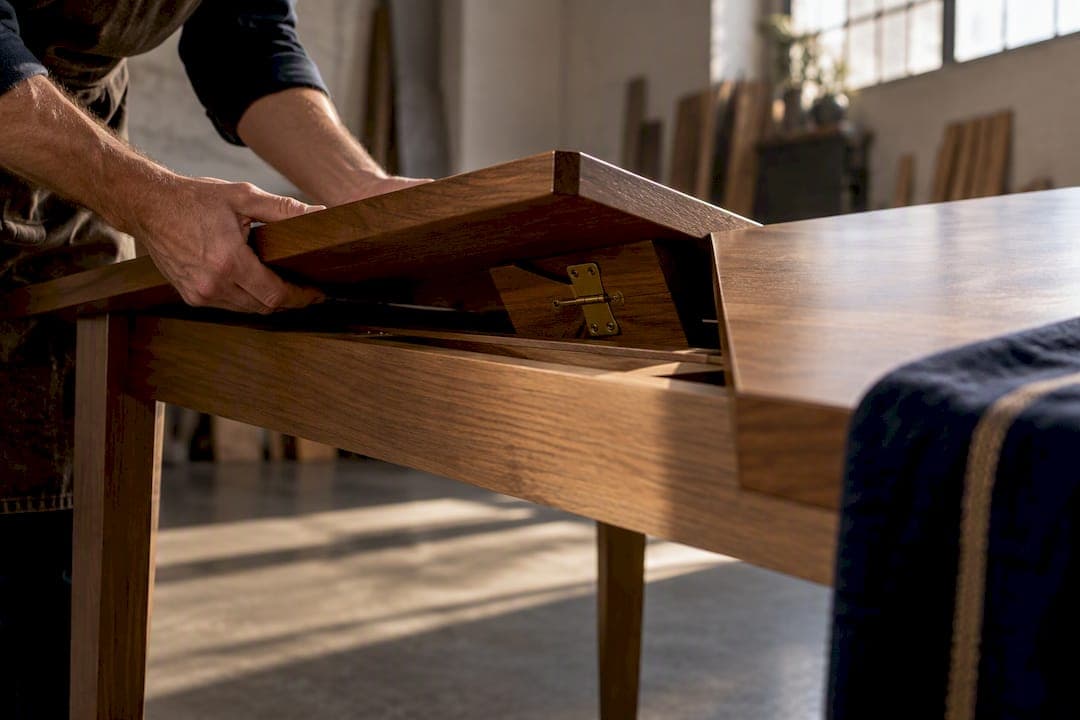
Five mechanism families cover almost every extendable table on the market: butterfly leaf for compact elegance, draw and hidden leaf systems for concealed storage, telescopic ball bearing slides for heavy daily use, removable leaves with locking tabs for occasional entertaining, and telescopic lifting columns for height conversion. Each suits a different rhythm of use, and the sections below explain how they work, where they excel, and what to check before you commit.
TL;DR:
- Heavy daily use tables benefit from telescopic ball bearing rails that resist twisting and facilitate smooth, synchronized extension.
- Draw and hidden leaf systems are ideal for those who prefer concealed storage, but they may require more maintenance and tighter tolerances.
- Removable leaf tables with locking tabs are simple and serviceable, yet often reveal visible seams and need nearby storage space for the leaves.
- The material quality, including steel gauge and bearing type, directly impacts the durability and smooth operation of extension mechanisms.
- Bespoke manufacturing allows customization to specific space and usage needs, ensuring hardware compatibility, ease of maintenance, and longer-lasting performance.
Table of Contents
- Types of extendable table mechanisms and how they operate
- Pros and cons of each mechanism family in everyday use
- Materials and hardware quality: what specifications to look for
- How to choose the right mechanism for your needs
- Maintenance and troubleshooting: craftspeople tips and when to call a maker
- Maker's perspective on mechanism selection and bespoke benefits
- How Simmons Interior Supply can help with bespoke mechanisms
- Sources
- FAQ
Types of extendable table mechanisms and how they operate
A butterfly leaf lives folded beneath the tabletop, hinged so that pulling the two halves apart lets the panel swing up and lock flush into the gap. It is elegant in a small dining room because nothing needs storing elsewhere, though the hinge is also its weak point: repeated heavy use can loosen the pivot over years.
Draw leaf and hidden leaf tables store their extra panels on runners tucked directly beneath the main top. Pulling the ends apart drags the leaves out along these under-top runners, and pushing back slides them home again, which suits anyone who dislikes hunting for spare boards in a cupboard.
Telescopic, ball bearing rail systems use multi stage slides, often synchronised so both halves move evenly when you pull just one end. The Woodworkers Institute build shows the non-mechanical ancestor of this idea: grooved bearers and hand fitted slider frames that let a tabletop glide on timber alone, a technique still used by makers who prefer joinery over metal hardware.
Removable leaf with locking tabs relies on a simple mechanical principle: a first locking part fixed to the table rail engages a second part on the leaf, so the leaf cannot lift once seated. A recent extension table patent describes exactly this arrangement, with a tab sliding beneath another to resist upward force, a low tech solution that has stayed popular precisely because there is little to go wrong.
Telescopic lifting columns solve a different problem: height rather than length. A patented lifting column design pairs a toothed rack with a gear motor, using guide pins and plastic slides to steady the column and reduce bending stress as the top rises. These mechanisms convert a coffee table into a dining height surface, or adjust a desk through the working day.
- Butterfly leaves fold away invisibly but concentrate stress on a single hinge.
- Draw leaf systems store panels under the top, reducing the need for separate storage.
- Telescopic ball bearing rails suit frequent, heavier extension cycles.
- Locking tab leaves are simple, removable, and easy to service.
- Lifting columns use geared racks to change table height rather than length.
Pros and cons of each mechanism family in everyday use
Stability under load separates these systems more than anything else. Telescopic ball bearing rails and heavier locking tab hardware resist twist well, which matters if you seat eight people and lean on the edge reaching for the salt. Butterfly hinges are fine for occasional use but can develop play sooner under daily heavy loading.
- Ease of operation: draw leaf and synchronised telescopic rails glide smoothly with one motion, while separate removable leaves need lifting and aligning by hand.
- Storage: hidden and draw leaf designs keep everything self contained; removable leaves need a nearby cupboard or wall space.
- Aesthetics: butterfly and draw leaf tops show no visible seam when closed, whereas removable leaf tables often reveal a join line even when locked.
- Repairability: locking tab hardware and telescopic rails are usually bolt on parts, easier to replace than an integrated butterfly hinge built into the apron.
Occasional entertainers can live happily with a butterfly or removable leaf table. Households that extend the table weekly, or businesses furnishing a private dining room, tend to feel the difference in a heavier rail system within the first year.
Materials and hardware quality: what specifications to look for
The steel gauge of a slide rail determines how much flex it tolerates before binding, and thicker, cold rolled steel outperforms thin stamped alternatives under repeated cycling. Bearing quality matters just as much: a ball bearing slide with sealed races runs smoother for longer than a bare metal to metal glide, and you can often see the bearing housings in close up product photography before you buy.
- Check the rail profile: look for a boxed or channel section rather than a flat stamped strip, since the shape resists twisting under load.
- Look for anti lift locking tabs: designs following the locking part principle prevent a leaf rising when someone leans on it.
- Consider timber movement: solid wood tops expand and contract across the grain with humidity, and a well fitted mechanism allows a little seasonal play without binding; our wood species selection guide covers how species choice affects this.
- Confirm access for lubrication: a mechanism with an exposed rail underside is far easier to maintain than one boxed in completely.
- Ask about spare part availability: proprietary hardware that only the original maker stocks can leave you stranded if a slide fails in year six.
How to choose the right mechanism for your needs
Match the mechanism to how the table actually gets used, not to how it looks in a showroom. Occasional entertaining suits a butterfly or removable leaf table; heavy daily use in a family kitchen or a hotel dining room favours telescopic ball bearing rails, a point covered in more depth in our hotel furniture durability guide; tight storage rooms suit draw leaf designs; and any table that needs to change height as well as length points towards a telescopic lifting column.
- Operate the extension yourself before buying: it should move with even, moderate effort, not a jerk followed by resistance.
- Check that both sides of a synchronised slide move together, since uneven action signals a misaligned rail, as seen in the design of the folding rectangular table which showcases practical folding and multi-use solutions.
- Ask how and where the leaves store, and measure that space before delivery day.
- Confirm the underframe support gains extra bracing once the table is open, not just at the closed length.
- Ask directly about warranty terms and whether hardware is replaceable without sending the whole table away.
Our dining table size guide is worth checking alongside these questions, particularly for clearance and legroom once a table is fully extended.
Pro Tip: Ask the seller for the steel gauge and bearing type in writing; a vague answer here is often the clearest warning sign of thin, stamped hardware.
Watch for red flags: sellers who cannot describe the hardware beyond "smooth glide," no mention of servicing or spare parts, and rails that look thin or lightweight in photographs.

Maintenance and troubleshooting: craftspeople tips and when to call a maker
Binding is the most common complaint, and it is rarely the mechanism's fault. Seasonal humidity swells timber slightly, and an oil based spray attracts dust that makes the problem worse over time. Dry PTFE lubricant applied along the rail keeps the slide moving without building up grime, a habit favoured by furniture makers over household oils.
- Check parallelism first: if one side drags, the rail may have shifted slightly out of true and can often be re-shimmed rather than replaced.
- Tighten mounting screws before assuming hardware has failed, since loose fixings are the usual cause of a wobble.
- Replace hardware only when a rail is visibly bent or a bearing has seized; a rebuild with fresh lubricant fixes most other cases.
- Fit felt bumpers where leaves meet to prevent the sharp "leaf slap" that loosens joints over years of use.
Bespoke makers often fit heavier gauge rails than mass production allows, and build in access panels for servicing, something worth asking about if a mass market table has already let you down.
Maker's perspective on mechanism selection and bespoke benefits
Marketing copy loves the word "smooth," but fit and tolerance matter more than any label on a box. A rail cut to the wrong clearance will bind regardless of how many bearings it has, and serviceability, being able to reach the mechanism years later, often separates a table that lasts a decade from one that does not. Bespoke commissioning removes most of these compromises by matching hardware to the piece from the start.
— Luke
How Simmons Interior Supply can help with bespoke mechanisms
Every extendable table is handcrafted to order, so the mechanism is specified to suit the size, finish, and intended use rather than fitted from a generic parts bin. There is collaboration with artisans on rail gauge, locking hardware, and fit, with support offered through spare part guidance and project consultation for designers and trade clients.

- Custom sizes and finishes can be built around your space rather than a standard run.
- Hardware can be specified for the piece, with service support after delivery.
- Consultation services are offered for designers, architects, and hospitality projects.
Browse the bespoke furniture collection to see current work or start a conversation about a table built around your own clearances and daily use.
Sources
- US8001909B2 - Telescopic lifting column for height adjustment of elevatable tables - Google Patents
- Patents
- Extending dining table — Woodworkers Institute
FAQ
What are the different types of table extension mechanisms?
The main families are butterfly leaf, draw or hidden leaf, telescopic ball bearing rails, removable leaves with locking tabs, and telescopic lifting columns for height adjustment. Each stores or operates differently, so the right choice depends on how often you extend the table and where you can store any separate leaves.
What are the disadvantages of using an expandable table?
Mechanisms can bind with seasonal wood movement, and cheaper stamped rails flex under heavy loads over time. Visible seams are common on removable leaf designs, and repairs depend on whether the seller stocks spare hardware, so it is worth checking that before buying.
What are the different types of dining table extenders?
Dining tables typically extend using butterfly leaves hidden beneath the top, draw leaves stored on under top runners, or separate leaves that slot in and lock with anti lift tabs. Heavier tables, especially those used daily, often use synchronised telescopic ball bearing rails for smoother, more even extension.
What is a butterfly extension table?
A butterfly extension table stores its extra leaf folded beneath the main top on a hinge, so pulling the two halves apart lets the panel swing up and lock flush into the gap. It needs no separate storage space, which makes it a popular choice for smaller dining rooms.