
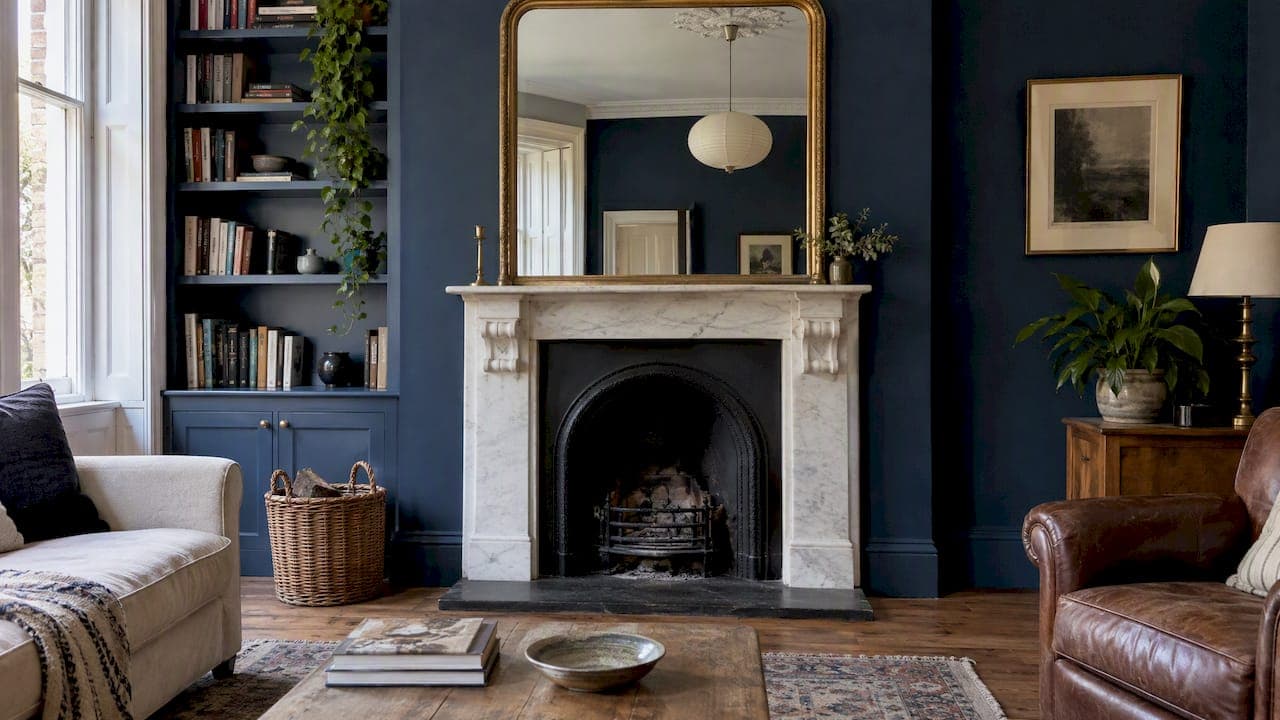
The mirror above a fireplace should be roughly two-thirds to three-quarters of the width of the mantel shelf, never wider than the shelf, and hung so that it feels attached to the fireplace rather than floating above it. That is the short answer. The longer one depends on your surround, your ceiling height and what the fire itself requires, and it is where a good room is separated from a merely tidy one.
Below, we take you through the width, the height, the gap above the mantel, the safety question, and the point at which a made-to-measure mirror is simply the better answer than an off-the-shelf one.
TL;DR
- Width: aim for about 60 to 75 per cent of the mantel shelf width, and never wider than the shelf itself.
- Height: leave a modest gap above the mantel (a hand's width is a useful guide), and keep clear space below any cornice or picture rail so the frame does not look wedged in.
- Alignment: where you can, line up the sides of the mirror with the uprights or opening of the fireplace so it reads as part of the architecture.
- Safety: check your fire or stove manufacturer's installation guide for clearances before you fix anything above the appliance.
- Awkward opening? If no standard size fits, a mirror made to your exact dimensions solves it in one go.
Table of Contents
- Start with the mantel, not the mirror
- How wide should a fireplace mirror be?
- How high should the mirror sit above the mantel?
- Shape matters as much as size
- Aligning with the fireplace itself
- Safety first: heat above the fire
- Our perspective: when the standard sizes do not fit
- Finishing touches that change the proportions
- Choosing a mirror for a trade project
- Made to measure with Simmons Interior Supply
- FAQ
- Sources
Start with the mantel, not the mirror
Most people begin by looking at mirrors and hoping one will fit. Reverse the process. Take three measurements before you look at a single frame:
- The width of the mantel shelf, end to end, including any overhang.
- The distance from the top of the mantel shelf to the ceiling, or to the underside of the cornice or picture rail if you have one.
- The width of the fireplace opening and surround, meaning the uprights (the vertical sides, sometimes called jambs or pilasters) and the aperture between them.
Write them down in millimetres. British trade suppliers, glaziers and framers work in millimetres, and a mirror quoted in inches will need converting anyway. These three numbers give you a width range, a height ceiling and an alignment target, and between them they rule out most of the mirrors you were about to fall for.
How wide should a fireplace mirror be?

The most repeated rule of thumb is that a mirror over a mantel should be at least two-thirds the length of the mantel, and The Spruce gives the same two-thirds guidance. A slightly more generous reading, 60 to 75 per cent of the mantel width, gives you a range rather than a single number. In that source's example, a 60-inch mantel (1,524 mm) takes a mirror between 36 and 45 inches wide (roughly 914 to 1,143 mm). Go smaller and the mirror looks accidental; go wider and it crushes the surround.
Here is how that works on typical British mantel widths. The figures are our own arithmetic from the 60 to 75 per cent range:
| Mantel shelf width | 60% (minimum) | 75% (generous) |
|---|---|---|
| 1,000 mm | 600 mm | 750 mm |
| 1,200 mm | 720 mm | 900 mm |
| 1,400 mm | 840 mm | 1,050 mm |
| 1,600 mm | 960 mm | 1,200 mm |
| 1,800 mm | 1,080 mm | 1,350 mm |
Treat the table as a corridor, not a target. Within it, the right choice is the one that lines up with something. If the opening of the fireplace is 900 mm wide and your range runs from 720 to 900 mm, a mirror close to 900 mm will visually continue the lines of the fireplace below.
The hard limit: never wider than the shelf
If there is one rule that is close to non-negotiable, it is this one. The mirror frame, including any feet or decorative flourishes, should stay within the ends of the mantel shelf. A mirror that overhangs looks unstable and disconnected from what supports it. Underneath, the aim is for the frame's sides to sit comfortably inside the shelf, ideally echoing the uprights of the surround.

When to break the rule
Proportion guidance is a starting point, not a law. Alguacil & Perkoff, a London mirror maker, is among those who note that contemporary interiors may play with deliberately oversized pieces for drama. The test is whether the result looks intended. A very large mirror that clearly dominates the wall and is centred with care reads as confident. A large mirror that merely fills a gap reads as a mistake.
If you are weighing a mirror against a piece of art, the same scale logic applies, and choosing art size for a wall or furniture piece follows many of the same proportions. We have also looked at the equivalent question one piece of furniture down in our guide to scale rules for a mirror or art over a console.
How high should the mirror sit above the mantel?
Width is only half the proportion. The vertical position decides whether the mirror and fireplace read as one composition.
Our working guidance, which is a design convention rather than a regulation, runs like this:
- Gap above the mantel shelf: a few inches, so that the mirror is clearly connected to the fireplace. If you like to style the shelf with candlesticks, a vase or a small stack of books, allow enough room for the tallest of them to sit in front of the glass without touching the frame.
- Space at the top: leave breathing room below a cornice or picture rail. A frame that touches or nearly touches the ceiling line looks squeezed.
- Centre of the glass: if the mirror is going to reflect anything, think about where its middle falls, not only its edges.
On that last point, the reflection matters as much as the dimensions. Better Homes & Gardens makes the practical case: a mirror hung too high will reflect only the ceiling or upper wall and fail to engage with the room. Stand where you normally sit, look at the wall, and note what you would like to see doubled: a window, a chandelier, a favourite painting. That reflection should land in the middle of the glass.
Designers also treat the space above a fireplace as a chance to ignore eye-level hanging rules. Houzz UK describes it as a distinct focal point, with the condition that the link between mantel and mirror stays visually secure through deliberate spacing. In practice, that means the gap should look consistent and chosen, not accidental.
A worked example
Imagine a Victorian terrace in south London with a 1,300 mm mantel shelf, a 950 mm wide opening, and 1,250 mm of wall between the top of the shelf and the cornice.
- Width range at 60 to 75 per cent: 780 to 975 mm. A mirror around 950 mm wide echoes the opening.
- Height: with 1,250 mm available, a frame about 800 to 900 mm tall leaves a gap above the mantel and clear wall below the cornice. A landscape rectangle or a round mirror about 900 mm across both fit this logic.
- Shape: the tall wall and modest width favour a round or arched shape, which softens the vertical.
The numbers are illustrative, but the method is the one we would use on any real job.
Shape matters as much as size
Two mirrors with identical widths can feel very different above a mantel.
- Rectangular landscape frames echo the horizontal line of the shelf and suit wide, low walls.
- Portrait or tall rectangular frames add height to rooms with generous ceilings, but need enough wall to avoid the squeezed look.
- Round mirrors offer a counterpoint to the straight lines of a surround and are useful when the wall above the mantel is tall and narrow. Check that the diameter fits within your width range, since a circle only touches its full width at one point and can look smaller than a rectangle of the same measurement.
- Arched mirrors have a gentle architectural quality that sits comfortably above both period and contemporary fireplaces.
If the shape you have in mind is unusual, our guide to custom mirror shapes covers what is possible when a mirror is made to order.
Aligning with the fireplace itself
The subtlest way to make a mirror look right is to align it to something below it. Two options work well:
- Match the uprights. Where the surround has distinct vertical sides, bring the mirror's frame sides in line with them. When these lines meet, the mirror appears integrated into the structure.
- Match the aperture. For a true overmantel look, the width of the glass can relate to the opening of the fireplace rather than the shelf. The mirror then feels like an extension of the fireplace itself, not a picture hung on a wall.
This is also why standard sizes sometimes frustrate. Stock mirrors come in a limited set of widths, and your surround almost certainly was not built around any of them.
Safety first: heat above the fire
This is where the advice shifts from taste to practicality. A mirror above a working fire is exposed to heat, and glass, backing and frame finishes can all suffer. The advice we would give, and the advice we would want from any specialist, is to start with the documents for your own appliance.
- Read the installer and owner guide for your fire or stove. Manufacturers set out specific clearances above the appliance, and they differ between gas, electric, and solid fuel. One example is the installer and owner guide for a slimline gas fire, which shows the sort of technical detail these manuals contain. Your own model's manual is the authority, not a general rule of thumb.
- Know the regulations for solid fuel and gas. In England, Approved Document J is the official guidance on combustion appliances and fuel storage. If you are installing or altering a stove, speak to the registered installer about the clearances to combustible materials on your wall.
- Choose the right fixing for the glass. A large mirror is heavy, and wall fixings above a hearth need to be chosen for the wall construction and weight. See our guides on mirror mounting systems and how to install a large mirror safely.
- Ask about the backing. If the mirror will sit in a room where the fire is regularly lit, ask your maker about the backing and edge protection; our overview of mirror safety backing explains what to look for.
If your fire is in constant use and the wall above gets noticeably warm, a gas engineer or HETAS-registered installer for solid fuel is the right person to advise on whether a mirror belongs there at all.
Our perspective: when the standard sizes do not fit
We work mostly with interior designers, architects and trade clients, and the fireplace is one of the places where we see the same problem repeatedly: a beautiful mirror that is 100 mm too wide, or a surround that is not quite symmetrical, or a ceiling that is lower than the plan suggested.
Our view is that the size of a mirror above a fireplace should be decided by the room, not by a catalogue. Every piece we make is handcrafted to order, with the size and finish adapted to the space, and that is as relevant to an overmantel as to any piece of furniture. The brief we find most useful is simple: give us the mantel width, the opening, the height to the cornice and a photograph of the wall. From there, a mirror can be proportioned to line up with the uprights, sit at the right height and reflect what you most want to see.
For a hospitality project, the same thinking scales up. A hotel lounge or dining room often has a run of fireplaces, and consistency matters: matching proportions and finishes across several openings is far easier to achieve when each mirror is made to order than when you hunt for stock pieces that happen to be close.
We are always happy to work with you on the details, whether that is a frame finish that picks up the metalwork of the grate or a size that suits a surround with a story to it. Our guide to custom mirror sizing in London sets out how that process typically runs.
— Luke
Finishing touches that change the proportions
Once the size is settled, a few small decisions affect how big the mirror appears.
- Frame width. A slim frame makes the glass feel larger and more contemporary; a deep, ornate frame adds visual weight, so you may want to reduce the overall width slightly to compensate.
- Lighting. Picture lights or wall lights either side can widen the composition. Count them in your width measurement if they are going to sit within the mantel's span.
- Styling on the shelf. Keep objects in odd numbers and vary the heights, with the tallest slightly off centre. Avoid placing anything so tall that it hides a third of the glass.
- Symmetry. If the fireplace is off-centre on the wall, centre the mirror on the fireplace, not on the wall. The eye reads the mirror against the fire first.
Choosing a mirror for a trade project
If you are specifying for a client, a few extra points save time.
- Measure on site. Period surrounds are rarely square, so take the width at both the top and the base of the mantel.
- Record the reflected view. A quick photograph from the main seating position, with the wall marked, helps the maker place the glass.
- Agree finish and sample early. Antiqued, bevelled or plain glass changes how light moves; approving a sample before manufacture avoids delays.
- Plan the installation. Confirm wall type, weight and fixings before delivery, and check who will hang it. Our custom mirror installation guide for the City of London outlines the steps.
Made to measure with Simmons Interior Supply
Our trade collections include made-to-order mirrors and rugs from partner brands, tailored in design and dimensions for interior designers, architects, homeowners and luxury hotels, alongside our own handcrafted bespoke furniture. If you have a fireplace that refuses to cooperate with standard sizes, explore our collections or browse the gallery for a sense of what handcrafted, made-to-order pieces look like in situ. Our story explains how we work with artisans.
FAQ
What size mirror should go over a fireplace?
Choose a mirror about 60 to 75 per cent of the mantel shelf's width, and no wider than the shelf. On a 1,200 mm mantel, that means roughly 720 to 900 mm. Then check that the height leaves a gap above the mantel and clear wall below any cornice.
Can a mirror be wider than the mantelpiece?
It is best avoided. A mirror that overhangs the shelf looks unsupported and can overwhelm the surround. Contemporary schemes sometimes use deliberately oversized pieces, but that works only when the choice clearly looks intentional.
How high above the fireplace should I hang a mirror?
Leave a modest gap above the mantel so the two read as one composition, allowing for any objects you will place on the shelf. Make sure the middle of the glass reflects something worth seeing, not just the ceiling. Always check your appliance's installation guide for clearances above a fire.
Is it safe to hang a mirror above a working fire?
It depends on the appliance, the clearance and the wall. Follow the manufacturer's installation guide for your fire or stove, and ask a registered gas or solid fuel installer if you are unsure how much heat reaches the wall.
Is a round or rectangular mirror better over a fireplace?
Neither is better in every room. Rectangular landscape mirrors echo the shelf, while round and arched shapes soften a tall wall. Choose by the proportions of the wall above your mantel.
Sources
- Mirror Over Fireplace: How to Choose, Size and Install One, DG Floors
- 10 Tips for Hanging a Mirror Over the Fireplace, Better Homes & Gardens
- Design Guide to Putting a Mirror Over the Fireplace, The Spruce
- Rules for Hanging Mirrors or Art Above a Fireplace, Houzz UK
- Installer and Owner Guide, Model 341 Black Beauty Slimline
- Approved Document J: Combustion appliances and fuel storage systems, GOV.UK