
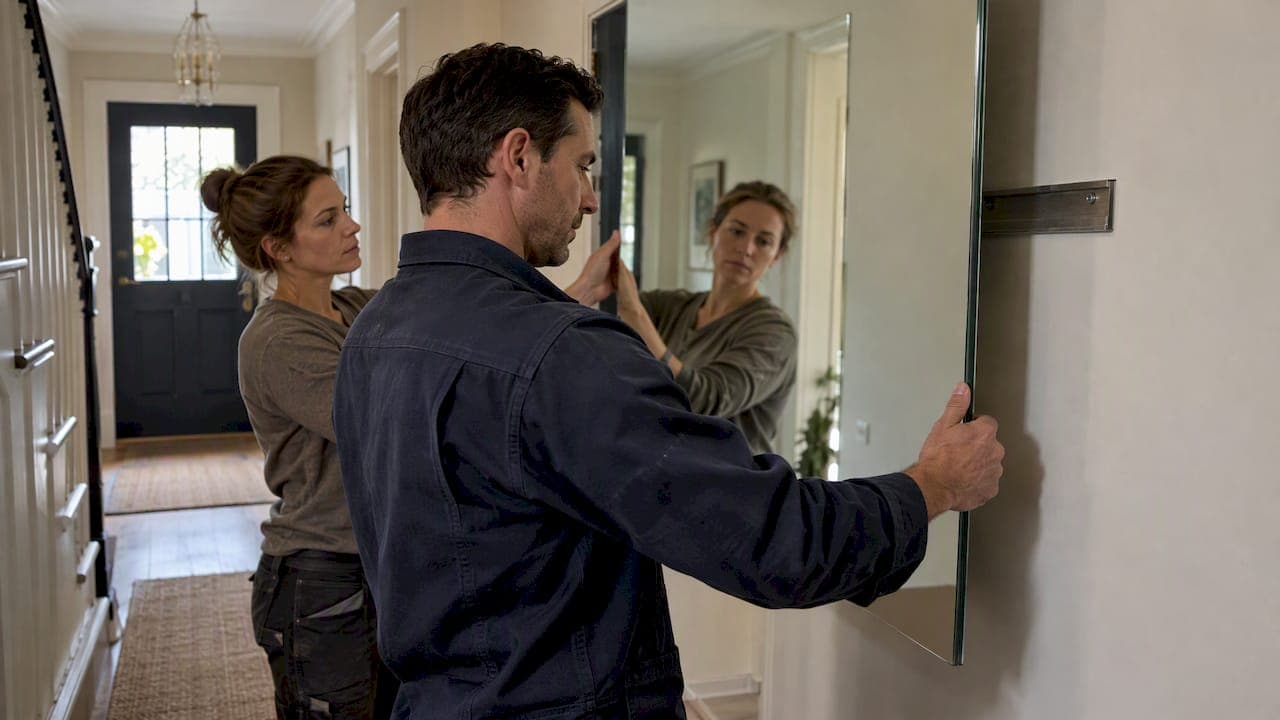
The right mirror mounting system depends on three things: the weight of the glass, what the wall is made of, and how much of the hardware you want the eye to see. For a large, frameless or statement mirror, a concealed French cleat or Z-bar fixed into masonry or timber is usually the most elegant answer. Clips and a supporting channel suit frameless glass. Adhesive works only as a partner to mechanical support, never alone on a heavy piece.
Below, we compare the main systems, set out the weight thresholds, and explain where each one earns its place in a residential or hospitality scheme.
TL;DR
- Match the system to the wall first, then the weight: plasterboard is usually the limiting factor, not the hardware.
- French cleats and Z-bars spread load along a wide horizontal line and give a flush, floating look; they need a flat wall or shims.
- Clips and J-channels suit frameless glass and let you carry the dead weight at the base.
- Adhesive alone is not a safe choice for a large mirror; combine it with a mechanical support.
- Anything 6 mm or thicker is a two-person lift, so plan handling and access before the glass arrives.
Table of Contents
- Start with weight and wall, not the hardware
- The main mirror mounting systems compared
- Which system for which job
- Making a flush, hidden fixing look effortless
- Residential versus commercial: documentation matters
- A step-by-step approach for a large mirror
- Our perspective
- Specifying mirrors with us
- FAQ
- Sources
Start with weight and wall, not the hardware
Most failed mirror installations are not failures of the bracket. They are failures of the wall. UK guidance on heavy mirrors and plasterboard sets out sensible tiers:
| Mirror weight | Typical fixing approach |
|---|---|
| Under 5 kg | Standard plugs or fixings suited to the wall |
| 5 kg to 20 kg | Hollow wall (cavity) anchors on plasterboard |
| 20 kg to 50 kg | Heavy-duty cavity fixings, or ideally timber stud or masonry |
| Over 50 kg | Direct fixing into structural studs or masonry only |
The same source notes that installers commonly apply a 50% safety margin to a fixing's stated load rating, because the substrate, especially plasterboard, tends to be the weak link. For mirrors over 25 kg, the practice is to reach at least one timber stud or masonry support.
Before choosing anything, find out what is behind the finish. A tapped wall, a stud finder and, in older City of London buildings, a quick look at whether you are dealing with lath and plaster, solid brick or a dry-lined partition will save a great deal of trouble. If you cannot confirm what is behind the surface, treat the wall as plasterboard and design the fixing accordingly.
Glass thickness changes the arithmetic
A 6 mm mirror weighs roughly 15 kg per square metre, so a 1.2 m by 2 m panel is already a serious lift. Trade guidance suggests mirrors of 6 mm and above call for heavy-duty metal anchors rated above 25 kg per fixing point, and that they often need two people because they exceed the 25 kg single-person manual handling figure. If you are specifying thickness at the same time, our note on bronze mirror glass at 5 mm to 6 mm with safety backing covers what changes in the fixing.
The main mirror mounting systems compared
French cleat and Z-bar: the concealed standard
A French cleat is a pair of interlocking rails, one fixed to the wall and one to the mirror back, each cut at an angle (or, in the Z-bar version, formed as a metal profile) so the mirror hooks down onto the wall rail. The load is carried along the full length of the rail rather than at two or four points, which is why it suits large, heavy pieces and gives that flush, floating effect.
On capacity, be careful with headline numbers. A 1000 mm aluminium Z-bar listed by a UK supplier is described as supporting around 40 kg when fixed into solid substrates, with shorter 50 mm segments rated to about 25 kg. That rating assumes the wall is sound. The rail never makes a weak wall stronger.
Strengths
- Weight spread across a wide horizontal line.
- Mirror sits tight to the wall with no visible hardware.
- The mirror can be lifted off for cleaning, repainting or relocation.
- Lateral adjustment is simple, so alignment with a feature or joint is easy.
Limits
- The wall must be flat. If it is not, thin shims behind the wall rail stop the mirror rocking or loading the cleat unevenly.
- Needs clear access to lift the mirror above the rail and drop it down, so ceiling height and top clearance matter.
- The mirror needs a rigid backing or frame to take the fixing, which is why it is usually specified for framed or backed mirrors rather than bare, thin glass.
Z-clip versus French cleat versus Z-bar
These terms overlap, and readers often ask how they differ. In practice:
- French cleat usually means a two-part angled rail, traditionally timber, now often aluminium.
- Z-bar is the metal version of the same principle, formed as a Z-shaped profile that interlocks.
- Z-clips are short individual segments of the same profile, used in pairs or sets where a continuous rail is not needed or would be visible.
The choice comes down to the length of support you need. A continuous rail spreads the load further and is more forgiving of a slightly imperfect fixing position. Short Z-clips are neater on a lightweight frame and easier to hide, but each one carries a smaller share, so you need more of them as the mirror grows.
Mirror clips and brackets
Clips grip the edges of a frameless mirror, usually two at the bottom and two at the top, with the lower pair carrying the weight. They are the common hardware-shop answer and the right one for modest bathroom and cloakroom mirrors. Plastic clips suit light glass; stainless steel with a soft liner is better for heavier panels. Two cautions: clips show, so they set the visual character of the piece, and they concentrate load at a few points, so the wall at each point must hold.
Adhesive
Mirror-safe adhesive has a place, but not as the sole support. Ordinary adhesives can attack the silvering, and a bond to a painted or poorly prepared wall is only as good as the paint. Our guide to mirror desilvering prevention explains why the chemistry matters. For anything large, think of adhesive as a means of stopping movement, not carrying weight.
J-channel plus restraint: the hospitality method
For large-format mirrors in public spaces, the method practitioners describe is a combination: a supporting J-channel at the base carries the dead weight, structural adhesive on a backing tape holds the panel flat, and the top clips act purely as restraint. Glass specialists describe this dual approach as a way to prevent twisting or peeling as buildings move and temperatures change. It is also a sound logic for a hotel corridor or restaurant wall where the mirror will be touched, leaned on and cleaned for years.
Which system for which job
| Situation | Suggested system | Why |
|---|---|---|
| Framed statement mirror over a console or fireplace | French cleat or Z-bar | Flush finish, spreads weight, easy to remove |
| Large floor-standing or leaning mirror | Wall restraint plus a fixed base | Weight on the floor, wall only prevents tipping |
| Frameless bathroom mirror | Clips with a base channel | Visible but tidy, resists moisture issues |
| Full-wall mirror in a gym, restaurant or lobby | J-channel, adhesive, top restraint clips | Base carries load; movement is controlled |
| Mirror on a plasterboard partition | Cleat fixed through to studs, or heavy cavity fixings with a lower rating assumption | Substrate is the limiting factor |
| Lightweight decorative mirror | Hook or plugs rated for the weight | No need for a full rail |
If the mirror is part of a bathroom scheme, the position matters as much as the fixing; see our notes on bathroom mirror height and IP ratings for bathroom mirrors when lighting is built in.
Making a flush, hidden fixing look effortless
The most architectural installations hide everything. That means the rail is set accurately, the wall is shimmed where needed, and the mirror hangs without a shadow line. It also means planning the services early. A backlit or illuminated mirror needs its cable routed behind the glass and out through the wall, and the detail is best settled before plastering. Although the context is Australian and the regulations differ, this guide to concealing wiring cleanly behind a wall-mounted screen shows the same thinking about routes, access and neat finishing. In the UK, electrical work in a bathroom or other special location must follow the relevant Building Regulations, so use a qualified electrician.
Walls that are not flat
Older walls rarely are. Measure with a long straight edge, mark high and low spots, and pack the wall rail with thin shims at each fixing so the rail plane is true. Fix the rail first, check it with a level, then offer the mirror up. A mirror that rocks on its cleat is under uneven stress, and glass does not forgive that.
Residential versus commercial: documentation matters
At home, the question is mainly one of safety and appearance. In hospitality and commercial work, it becomes one of record. Specification guidance for luxury lobbies notes that high-traffic projects often need tamper-resistant fixings and formal safety certification for procurement files. Glazing recommendations, including fixing techniques and handling on site, are set out in BS 6262, the code of practice for glazing in buildings.

Safety backing is the other half. Mirrors in public areas are commonly specified as safety-backed to limit dangerous fragmentation if broken, and trade guidance points to BS EN 12600 and BS 6206 classifications. We cover the practicalities in our guide to mirror safety backing. For the sequence on site, from template to lift to final fixing, read how to install a large mirror safely, and for City projects specifically, our custom mirror installation trade guide.
A step-by-step approach for a large mirror
- Weigh it. Get the glass weight from the maker, including backing or frame.
- Identify the wall. Brick, block, timber stud or plasterboard, and what lies behind.
- Choose the system. Cleat or Z-bar for framed, concealed hanging; channel and clips for frameless.
- Apply a margin. Assume the fixing delivers well under its stated rating, in line with the 50% practice above.
- Mark and fix the wall rail. Level, shim, and fix into studs or masonry wherever possible.
- Fix the mirror rail. Use the manufacturer's screws or an appropriate bond, with the hook facing downward.
- Lift with two people. Hang from the top, check the seat along the full length, then check for rocking.
- Inspect. Return after a few weeks to check for movement, especially in new-build or newly plastered walls.
Our perspective
We make and supply bespoke furniture and made-to-order mirrors, so we see the same mistake again and again: the mirror is designed beautifully and the fixing is an afterthought. A hand-finished piece can be undone by a poorly chosen bracket or a wall nobody checked.

Our view is that the mounting system should be decided when the size and finish are decided, not when the mirror arrives. A custom size changes the weight, the weight changes the fixing, and the fixing changes how the back of the piece is built. That is why we like to talk to interior designers, architects and contractors early, ideally with a wall note or a sketch of the substrate. We would always rather lose a day to a conversation about studs than see a good piece come off the wall.
For most framed statement mirrors, we lean towards a concealed cleat or Z-bar fixed into solid structure, with shims where the wall asks for them. For large frameless glass in public rooms, we prefer to carry the weight at the base and let the top fixings simply keep the glass in place.
— Luke
Specifying mirrors with us
Our trade-only collections include made-to-order mirrors and rugs from partner brands, with tailored designs and dimensions, alongside our handcrafted bespoke furniture, made to your size and finish. If you are scheduling a mirror into a residential or hospitality scheme, explore the collections at Simmons Interior Supply and tell us the wall type, the weight and the finish you have in mind. For sizes and shapes, our notes on custom mirror sizing and custom mirror shapes are a good place to start.
FAQ
What is the best way to hang a large mirror?
For a framed or backed mirror, a concealed French cleat or Z-bar fixed into masonry or timber studs is usually best, because it spreads the load and sits flush. For frameless glass, support the base in a channel and use clips at the top for restraint. Whatever you choose, plan for two people and fix into solid structure above about 25 kg.
How much weight can a French cleat hold?
It depends on the rail and, above all, the wall. One UK supplier rates a 1000 mm aluminium Z-bar at roughly 40 kg when fixed into solid substrates. On plasterboard, the fixings, not the rail, set the limit, so use a safety margin and hit studs or masonry.
Is a Z-clip better than a French cleat?
Neither is better in general. A continuous cleat or Z-bar carries more weight and forgives small positioning errors, while short Z-clips are neater on lighter frames but need more units as the weight rises. For a heavy mirror, choose the continuous rail.
Can I use adhesive instead of clips?
Only for light mirrors on a flat, sound, properly prepared wall, and only with a mirror-safe product. For larger mirrors, use adhesive alongside mechanical support such as a base channel, not as the only means of holding the glass.
Do I need a professional to fit a heavy mirror?
For anything over about 25 kg, over a bathroom or in a public space, yes. Use an experienced installer, and an electrician if the mirror is illuminated, so the wall, fixings and handling are all checked.
Sources
- How to Hang a Heavy Mirror on Plasterboard Walls UK
- Z Bar Heavy Duty French Cleat 1000mm Floating Hanging System
- Bespoke mirrors and feature walls
- Hand-Framed Giclée Art for Luxury Lobbies: Specification Guide
- BS 6262: code of practice for glazing for buildings