
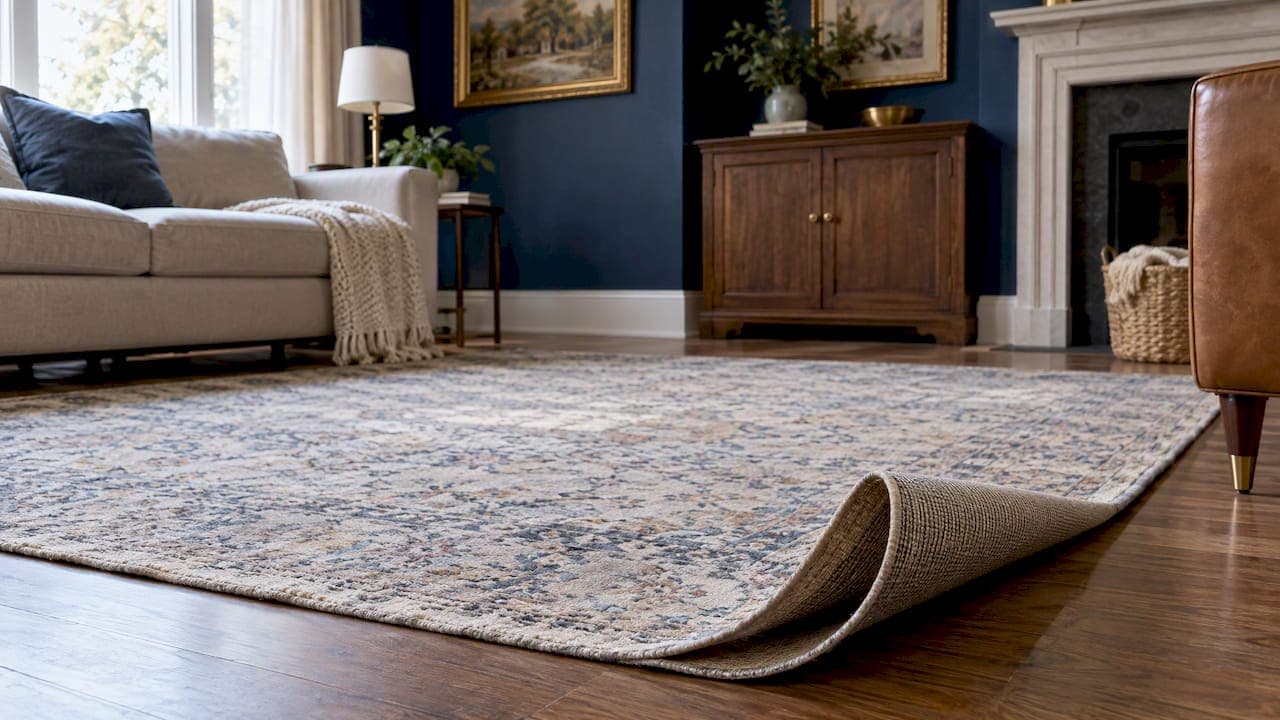
A curled rug corner is rarely a sign of a poor rug. Most of the time it is a memory: the rug was rolled tightly for shipping or stored folded, and the fibres and backing still remember the shape. The fix is usually gentle and slow: reverse the curl, add a little weight, give it time, and then stop the corner lifting again with the right pad and a quick check of what is pushing it up.
Below, we take you through the methods that work, the ones to avoid for wool, viscose and synthetic rugs, and the small decisions that keep a rug lying flat for years.
TL;DR
- Most curls come from tight rolling, storage, foot traffic or humidity, and ease with time and a reverse roll rather than force.
- Reverse-roll a new rug face down for 24 to 48 hours, or weight a minor curl with something clean, dry and broad overnight or for several days.
- Avoid irons, steam, strong tape and direct sun on delicate, synthetic or colour-sensitive rugs: heat can melt synthetic fibres and sun can bleach.
- Prevent a repeat with a suitable rug pad, a check for radiators, thresholds and furniture legs, and a correctly sized rug.
- If a rug is old, cracked on the back, fraying or damp-smelling, ask a professional rug cleaner rather than experimenting.
Table of Contents
- Why rugs curl in the first place
- Fix a new rug that has just come out of its packaging
- Flatten a curled corner on a rug already in use
- What suits which fibre
- When to call a professional
- Keep it flat: pads, placement and size
- Our perspective
- Specify a rug that suits your space from the start
- A quick routine to follow
- FAQ
- Sources
Why rugs curl in the first place
Understanding the cause saves you from treating the symptom again and again. The usual culprits are:
- Tight shipping or storage. A rug that has spent weeks rolled or folded wants to return to that shape. Rugs often keep their packaging creases after unrolling and can take longer to settle than clothing or curtains.
- Foot traffic. A corner that sits in a walking route is nudged, scuffed and dragged upwards by shoes, vacuum cleaners and chair legs.
- Humidity and cleaning. The IICRC tip sheet on area rugs notes that woven rug edges can curl after cleaning or in high humidity, and that they often correct themselves within a few days.
- Something pushing from above or beside. A radiator, a door threshold, a skirting board or a sofa leg can force a corner upwards. No amount of ironing out will help while the obstruction remains.
That last one is worth checking first, before you try anything else. Unroll the rug fully, smooth it from the centre outwards with your hands, and look at whether any edge is trapped against furniture or a fixed feature. If it is, nudge the rug or the furniture and watch whether the curl relaxes by itself.
Fix a new rug that has just come out of its packaging
A new rug is the easiest case, because the curl is only a few days or weeks old and the fibres have not set.
The reverse roll
This is the method every rug specialist reaches for first, and it works on the logic of undoing what the packaging did.
- Unroll the rug as soon as it arrives and take off all wrapping and ties.
- Turn it face down on a clean, dry floor.
- Roll it firmly in the opposite direction to how it was packed, so the pile is on the outside of the roll.
- Leave it for 24 to 48 hours. A heavier or thicker rug may need longer.
- Unroll it in its final position and let it rest for a few days before judging the result.
Keep the roll firm but never tie it tightly. The IICRC warns that tying too tightly can damage backing components, crush fibres and distort the rug. A loose loop of soft cotton tape, or simply the weight of the roll, is enough.
Give it time
Where the curl is mild, patience may be the whole treatment. Lay the rug in place, smooth it, and leave it. Packaging creases soften as the fibres relax and as the room's temperature and humidity act on them. Rugs that have travelled a long way often need a week or two. If you are curious about why shipping and storage creases linger and how to help them settle, this explanation of why area rugs behave differently from carpet is a helpful companion.
Flatten a curled corner on a rug already in use
Older curls need slightly more persuasion, but the principle is the same: gentle, sustained pressure, applied against the direction of the curl.
Weight it
Smooth the corner flat by hand, then place a clean, dry, broad weight on top. A stack of heavy books wrapped in a clean towel or cloth, or a flat, wide piece of furniture foot, will do. Narrow weights can leave marks in the pile, so choose something that spreads the load. Leave it overnight for a mild curl, or for several days for a stubborn one.

This suits many wool, cotton, synthetic and flatwoven rugs, provided the rug is dry and undamaged.
Bend and tuck
For a corner that keeps springing back, gently bend it in the opposite direction until it lies flat against the floor, tuck it under the rug and leave it for 24 hours, as Real Simple suggests. Be careful not to crease the fold: you want a soft turn, not a sharp line.
Reverse-roll a whole rug
If more than one edge curls, treat it as you would a new rug. Place it face down, roll it against the curl, and leave it for several days. The IICRC recommends this for persistent curling, with the same warning about loose rather than tight tying.
Ice cubes, hair dryers and irons: proceed with caution
You will find plenty of tips online involving ice cubes, hair dryers, damp cloths and irons. Treat them as last resorts for sturdy rugs, not first moves. The reasons are practical:
- Heat and moisture together can mark, shrink or distort delicate fibres.
- The IICRC specifically warns that irons are too hot and can quickly melt synthetic fibres.
- Damp patches on a backing that is not fully dry can leave water marks or encourage mildew.
If you decide to try a gentle warm-air or damp approach on a durable rug, test a hidden corner first, keep the heat low and distant, and allow the rug to dry completely under weight.
What suits which fibre
The right fix depends on what the rug is made of. The table below sets out sensible first steps and the cautions we would apply.
| Rug type | Best first step | Avoid |
|---|---|---|
| Wool (hand-knotted, hand-tufted, loomed) | Time, gentle weights, careful reverse roll | Harsh heat, excess moisture, direct sun that may fade colour |
| Synthetic (polypropylene, polyester) | Weighting or reverse roll | Irons and hot hair dryers, which can melt fibres |
| Viscose and silk-like blends | Lay flat, face down if needed, allow 24 to 48 hours | Water, steam, beating and heat, which can yellow, bleed or shrink fibres |
| Flatwoven and kilim | Smooth by hand, light weights | Strong adhesive tapes, heat and excess moisture |
| Old or delicate rugs (cracked backing, fraying, damp smell) | Stop and consult a specialist | Heat, steam and heavy pressure |
Two further points. Direct sunlight is sometimes suggested as a way to relax a rug, but it can bleach or shift colours, so we would not recommend it for anything you value. And the floor under any rug should be completely dry before you lay it down; a damp floor is a common hidden cause of distortion and odour.
When to call a professional
Some rugs should not be coaxed at home. If the backing is cracked, the edges are fraying, there is a damp or musty smell, or the curl appeared after a flood or a deep clean, seek advice from a specialist rug cleaner and restorer. The IICRC notes that rugs prone to shrinkage are best cleaned in a controlled facility by trained technicians, and that on-site cleaning should only be carried out by an IICRC-certified rug-cleaning technician. A professional can relax the foundation of a rug in a controlled way that is far safer than improvising with an iron.
Keep it flat: pads, placement and size
Once a rug lies flat, the aim is to keep it there. Three things do most of the work.
A suitable rug pad
A good pad limits movement, adds stability and reduces the bunching that leads to recurring curls. It also adds cushioning and protects the floor beneath. Choose one made for your floor type: hard floors and carpet need different grips. If you want a primer on how padding types differ and why they matter, this guide to carpet padding types explains the principles of density and support.
On carpet, a rug can creep and ruck because two soft surfaces slide against each other. Choose a pad designed for carpet and be sure the rug is smoothed from the centre outwards when you lay it. Our own guide to layering rugs on carpet covers border widths and trade tips for a result that stays put.
If you have underfloor heating, pad choice matters again, as thickness affects heat transfer. Our note on rugs for underfloor heating sets out what to look for.
Corner grippers
For a corner that persistently lifts even with a pad, a corner gripper can hold it down without covering the whole underside. Fit it so that it supports the corner without creating a ridge, and avoid strong adhesive tapes on flatwoven and kilim rugs, which can leave residue.
Placement and rotation
Check for the obstructions we mentioned earlier: radiators, thresholds, skirting boards and furniture legs. Turn the rug now and then so wear is even, and vacuum with suitable suction. Rotation also helps prevent shading and uneven wear, both of which can make edges behave differently from the centre.
Size plays a part too. A rug that is too small for a seating group, with just the front legs resting on it, tends to tilt and lift at the corners. Where a room has an awkward footprint, an alcove or a curved wall, a made-to-measure piece sits better than a near-fit; see how to measure, tape and commission irregular rug shapes.
Our perspective
We make and supply furnishings to order, and we see curling from both sides: the designer who unrolls a made-to-measure rug for a client, and the homeowner living with the result. Our experience is that most curl complaints are about handling and fit rather than quality. A rug that has been rolled for transit will always want a day or two of reverse-rolling and a week to settle, and it is far kinder to plan for that than to be surprised by it.

For trade projects, we would build that time into the schedule: unroll the rugs in the room before the client arrives, not on the morning of a reveal. We would also choose the rug size and border alongside the furniture plan, so legs sit squarely on the rug rather than half on, half off. If you are specifying for a busy hotel corridor or lobby, construction and pile density matter too; our guide to hotel rug durability sets out the specifications procurement teams should ask about.
And should a corner refuse to cooperate, we are always happy to talk it through with you and the artisans who made the piece.
— Luke
Specify a rug that suits your space from the start
The best cure for a curling rug is a rug that is the right size, with the right edge finish, for its room. Our trade-only rug collections include the Signature rug collection from Colbourns and the Ready to Hang collection from Simpsons London, and our handcrafted furniture can be customised in size and finish so that rug and furniture are planned together. Designers, architects, hospitality buyers and homeowners can start a conversation on our home page.

If you are designing something truly one-off, read how we approach the custom rug design process and the border options available, since edge finishing influences how a rug lies.
A quick routine to follow
If you want a simple sequence, this is the one we would follow:
- Unroll, smooth from the centre out and check for obstructions.
- Reverse-roll face down, loosely, for 24 to 48 hours.
- Lay it in place and weight any lifting corner with a clean, dry, broad weight.
- Wait several days before deciding whether it needs more.
- Add a pad suited to your floor, and a corner gripper only if needed.
- If the rug is old, delicate or damp, stop and ask a specialist.
FAQ
How do I stop a rug curling at the corners?
Smooth the corner flat, weight it with something clean, dry and broad overnight or for several days, and check that nothing is forcing it up, such as a radiator or furniture leg. If it keeps lifting, add a suitable rug pad or corner gripper to hold the rug steady.
How do I flatten a rolled rug?
Turn the rug face down and roll it firmly in the opposite direction to how it arrived, then leave it for 24 to 48 hours. Unroll it in place and give it a few days to settle. Do not tie the roll tightly, as that can distort the rug and crush the fibres.
Can I use an iron or hair dryer on curled edges?
We would avoid them on most rugs. Irons can quickly melt synthetic fibres, and heat or moisture can damage wool, viscose and delicate backings. If you do try gentle warmth on a sturdy rug, test a hidden corner first and let the rug dry completely under weight.
How do I flatten a rug on carpet?
Lay the rug flat, smooth it from the centre outwards and place clean, dry weights on any raised areas. Use a rug pad designed for carpet to reduce movement, which is what usually causes ruckling and curling on a soft surface.
How long does it take for a curl to go away?
A mild curl often eases in a few days, and a new rug typically needs 24 to 48 hours of reverse-rolling plus some settling time. Older, set curls can take longer. If there is no improvement after a week or two of gentle treatment, seek professional advice.
Sources
- IICRC tip sheet: shrinkage, edge curl and on-location cleaning of area rugs
- Real Simple: how to stop your rugs from curling up at the corners