
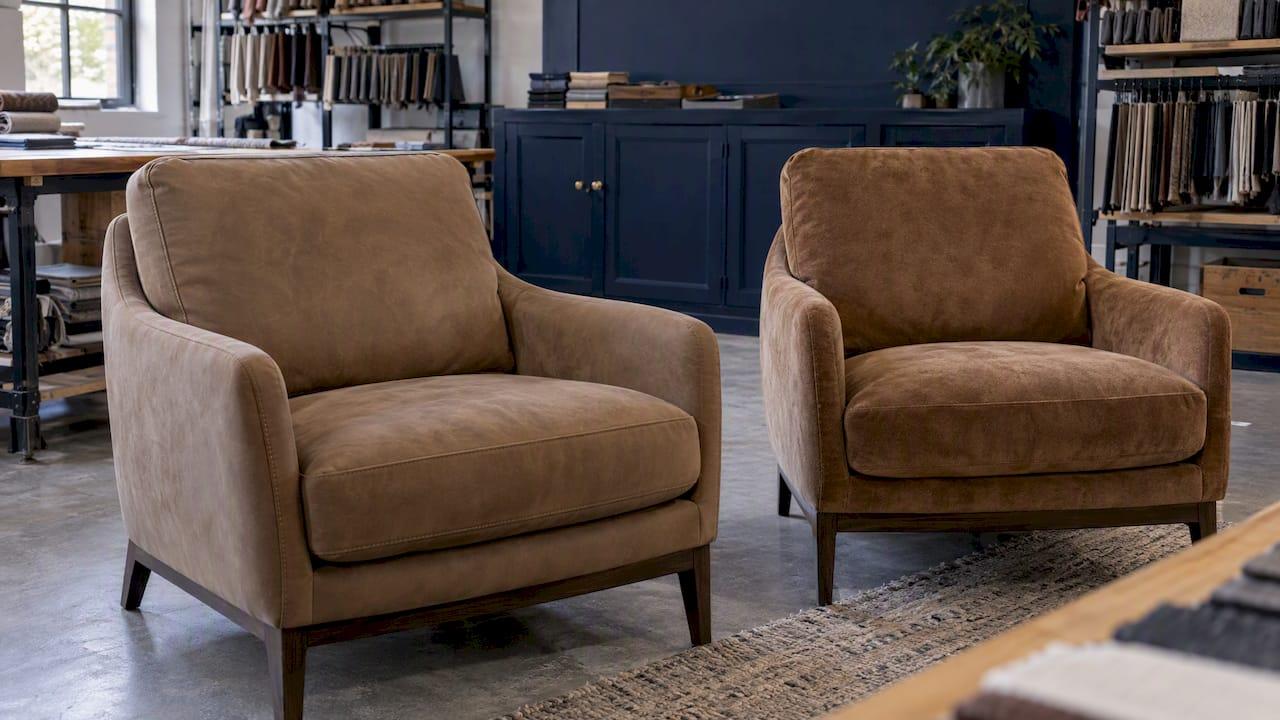
Nubuck is the more sensible of these two velvety leathers for upholstery. It is cut from the outer, grain side of the hide and lightly abraded, so it keeps most of the hide's strength. Suede comes from the flesh side, which is softer, weaker and far less common on genuine furniture. Both are absorbent and unforgiving of spills, so either is best for considered, adult seating rather than a busy family sofa.
The rest of this guide explains why, how to tell the two apart (and tell both from the imitations), how to look after nubuck, and how to decide for a particular room or project.
TL;DR
- Nubuck is grain-side leather sanded to a fine, velvety nap. Suede is the flesh side, with a longer, looser nap and less mechanical strength.
- Nubuck is the stronger of the two, yet both absorb liquids and oils quickly. Neither suits heavy family use.
- Much furniture sold as "suede" is really nubuck, microsuede or a flock fabric that imitates it, so ask what you are buying.
- Care is dry: soft brush, vacuum with a soft attachment, patch-test everything, and keep the piece out of direct sun.
- For a bespoke piece, we recommend nubuck for a bedroom chair, a library or a quiet hotel suite, and a different cover for hard-working seating.
Table of Contents
- What actually separates nubuck from suede
- How to tell nubuck from suede
- Is suede suitable for upholstery?
- Is nubuck leather good for furniture?
- Durability, comfort and spills compared
- Caring for nubuck furniture
- Choosing between nubuck, suede and the alternatives
- Our perspective
- Commission a piece made for your space
- FAQ
- Sources
What actually separates nubuck from suede
Both leathers have a soft, brushed surface, which is why they are so often confused. The difference lies in which side of the hide is brushed.
According to FIRA, the UK furniture industry research body, suede is the flesh side of leather, while nubuck is grain-side leather lightly abraded to give a velvet finish. The grain side is the outer surface of the animal's skin, where the fibres are densest and tightest. The flesh side faces inwards and is looser and more open.
That single fact explains almost everything else:
- Strength. Leather restorers The Leather Restorators note that nubuck retains nearly all of the hide's strength, whereas the corium layer used for suede is less structurally coherent and has significantly less mechanical strength.
- Nap. Nubuck has a fine, uniform, short nap. Suede has a longer, shaggier, looser one.
- Absorbency. Neither has a protective coating in its natural state. FIRA describes nubuck as absorbent, soft and susceptible to liquid spillage and contamination.
If you are used to hearing the two discussed in the context of shoes, bear in mind that upholstery asks a good deal more. A sofa is sat on, leant against, rubbed by clothing and exposed to light for years. A pair of shoes is not.
A quick comparison
| Nubuck | Suede | |
|---|---|---|
| Side of the hide | Outer grain side, lightly abraded | Inner flesh side (or a split) |
| Nap | Fine, short, even | Longer, looser, shaggier |
| Strength | Close to full-grain leather | Noticeably weaker |
| Spills and oils | Absorbs quickly | Absorbs quickly |
| Feel | Velvety, dense | Very soft, fluffy |
| Typical use in furniture | Occasional chairs, considered sofas, headboards | Rare; light-duty accents and cushions |
How to tell nubuck from suede
On a showroom floor, or on a piece you have inherited, three simple checks help.
1. Look at the nap. Nubuck has a fine, uniform nap. Suede's is longer and looser. The Leather Restorators explain that under 5x magnification, or at a cut edge, nubuck shows a two-layer structure while suede shows a single, uniform fibre structure.
2. Drag a fingertip across it. Run your finger across the surface and watch the shading. Nubuck's tight nap springs back quickly and the contrast is subtle. Suede's longer nap holds the pattern for longer and shows a more dramatic contrast.

3. Ask what it is. A drop of water is sometimes used as a test. Aramsco's guide to identifying leathers notes that nubuck darkens and stays dark until the nap is raised by brushing, whereas protected leather repels water. We would not run this on a client's sofa, though: you are testing the very weakness you want to avoid. If you must, try a hidden spot, and ask the maker first.
Is it genuine at all?
This matters more than most guides admit. Aldiss, a UK leather care specialist, observes that most people who believe they own a suede suite actually have a flock fabric that mimics suede. The Leather Restorators go further and say that furniture labelled suede is usually mislabelled nubuck, microsuede or low-cost suede.
Imitations are not necessarily bad. Many microsuedes and flocks are easier to live with than the real thing. But Leather Naturally, the UK leather industry's consumer body, cautions that nearly all imitation leather requires different care from leather and is not as durable or repairable. So the cleaning advice in this guide applies to genuine nubuck and suede only. If the label says "suede", ask whether it is leather, a split, a microfibre or a flocked textile.
Is suede suitable for upholstery?
Genuine suede is rarely the right choice for a seat. The Leather Restorators describe real suede furniture as rare, because its structural weakness and vulnerability to staining make it impractical for daily use. Aldiss adds that real suede and nubuck are both highly absorbent and soil very easily.
Where suede does make sense is in places that bear little load:
- scatter cushions and bolsters
- the inside of a cabinet or drawer
- an accent panel on a headboard or screen
- trims and piping combined with a sturdier cover
If your heart is set on the look of suede on a sofa, the realistic options are nubuck, or a textile engineered to resemble it. One UK supplier, for example, lists a suede-effect fabric for lightweight upholstery, curtains and cushions, stating that it complies with BS 476 Part 7, Class 0 and 1. That is a flame-spread classification, not a wear rating, so it tells you about fire behaviour and nothing about how the cover will cope with years of sitting.
Is nubuck leather good for furniture?
Yes, with conditions. Nubuck is used for furnishings, but the leather manufacturer Urad advises that it should be avoided in busy or public areas and in homes with young children or pets. The same source calls its soft, velvet-like touch its Achilles heel: without a protective finishing coating, it is one of the most vulnerable leathers.
That is an honest summary. Nubuck is beautiful, tactile and has the underlying strength of top-grain leather. It also marks, darkens under oils, and shows where hands and heads rest.
It suits:
- a reading chair or an occasional chair in a study
- a bedroom bench or upholstered headboard
- a sofa in a formal sitting room used by adults
- a hotel suite lounge chair, where housekeeping can be briefed on its care
It is a poorer match for:
- a family kitchen-diner banquette
- a restaurant or bar, where food and drink are constantly in the air
- a sofa under a sunny window
- a home with a dog that climbs on everything
The Leather Restorators put the decision in terms of room use: nubuck works for considered seating used by adults where spills are rare and stricter care is accepted.
Durability, comfort and spills compared
For furniture, three questions decide the matter.
Will it last? Nubuck wins. Because the dense grain layer is retained, it tolerates the repeated flexing of a seat far better than suede. But the abrasion that creates the nap also removes the surface that normally protects leather, which is why it is absorbent.
Will it stay clean? Neither does well. Both soak up liquids and oils quickly, and body oils and hand grease gradually darken the high-contact areas such as arms and headrests. Expect a patina rather than an immaculate finish. Some people love that; clients who want a pristine look for years generally do not.
Is it comfortable? Both are warm to the touch and soft, which is much of their appeal. Comfort in a sofa depends equally on what is under the cover, so it is worth reading our guide to sofa foam density alongside any decision on the outer material.
What to ask for when specifying
If you are specifying leather for a project, FIRA's guidance on specifying leather for furniture says upholstery leather must be reasonably durable and fit for purpose, and recommends evaluating it before use. The properties it lists as relevant are tear strength, flexing endurance, finish adhesion, colour fastness to wet and dry rubbing, and colour fastness to light. Ask your supplier for results on these, and request a full-size sample to test on a hidden area.
If you usually work with textile ratings, our guide to the Martindale rub count explains how abrasion testing applies to fabrics. Leather is assessed differently, so do not expect a like-for-like number.
Caring for nubuck furniture
Good care is mostly gentle and dry. The sequence below combines advice from FIRA, Leather Naturally and a UK-based leather care guide.
- Dust regularly. FIRA advises a soft, lint-free cloth, and vacuuming with a soft brush attachment. For nubuck specifically, Leather Naturally recommends a medium-hard brush to lift dust from the nap.
- Brush in one direction to keep the nap even, and to revive a flattened patch. Aramsco notes that brushing raises the nap again after it has darkened.
- Act on spills at once. Blot, never rub. FIRA's general leather advice is to wipe spills with a soft, moist cloth and, if needed, a mild soap solution, without soaking the upholstery. With nubuck, keep any moisture to a minimum and test first.
- Patch-test everything. Leather Naturally's care guide says any protective spray or cleaning application should first be tried on a hidden area, because it may mark or change the colour.
- Avoid the wrong products. According to FIRA, household detergents, wax, spray polish, proprietary fluids and abrasive cleaners will damage leather's surface.
- Keep it out of strong sunlight. Leather care guidance consistently warns that direct sun can cause leather to fade and crack.
For a stubborn grease mark, a professional is the safer route. Contact the maker, or a specialist leather cleaner who works on nubuck, before you try home remedies. Such a mark can be made worse by the wrong treatment, and some finishes will not tolerate moisture at all.
Those of you who already look after bouclé or other textured covers will find the habits familiar: brush, blot, test, and keep sun and heat away. Our bouclé care guide covers the textile side of that routine.
Choosing between nubuck, suede and the alternatives
A practical way to decide is to start with the room and the people, not the material.
| Situation | Our suggestion |
|---|---|
| Adult bedroom, dressing room or library chair | Nubuck is a lovely choice |
| Formal sitting room, occasional use | Nubuck, with a care plan agreed at handover |
| Family sofa with children or pets | A tougher cover; see the textile options below |
| Hotel lounge, bar or restaurant | Not nubuck; choose a commercial-grade cover |
| Cushions, bolsters, trims | Suede is fine here, where load is low |
| Sunny, south-facing window seat | Consider a more light-stable cover |
If the velvet touch is what draws you, but practicality rules out nubuck, a high-quality textile can deliver much of the same softness. Our notes on mohair and velvet and on bouclé durability set out the questions worth asking before you commit.
For commercial projects, there is also compliance to think about. Public and contract seating has its own fire-safety requirements, covered in our guide to Crib 5 upholstery.
Our perspective
We make furniture to order, and that gives us a particular view of this debate. Most of the disappointment around velvety leathers comes not from the material but from a mismatch between the material and its life.
A nubuck chair in a quiet corner, loved and brushed, can look wonderful for years. The same hide on a sofa where supper is eaten and a dog sleeps will be a source of constant worry. So when a designer or homeowner brings us a project, the first thing we ask is how the piece will be used, not which finish is fashionable.

Because each piece is handcrafted with our artisans, we can adjust size, finish and cover to suit the setting. That might mean nubuck on the seat back of a sculptural armchair and a more forgiving material on the surfaces that take the wear, or a hospitality-grade cover for a lounge where nubuck would be unkind. We are always happy to talk through the trade-offs before anything is cut, and we would rather advise a different cover than see a beautiful piece struggle.
Our advice, in short: be honest about spills, sun and small hands, and treat nubuck as a material to cherish rather than to test.
— Luke
Commission a piece made for your space
If you are planning a chair, banquette or headboard and want to see how a particular cover would behave, we are happy to help you think it through. Our bespoke collection is made to order in the size and finish you need, and we work with interior designers, architects, homeowners and hotel teams on projects large and small.

Browse the bespoke furniture collection and tell us about the room, and we will take it from there.
FAQ
Is nubuck better than suede?
For furniture, generally yes. Nubuck comes from the strong outer grain of the hide, so it keeps nearly all its mechanical strength, while suede is cut from the weaker flesh side. Both absorb liquids quickly, though, so nubuck is better rather than robust.
How can I tell whether my sofa is suede or nubuck?
Check the nap. Nubuck is fine and uniform; suede is longer and looser. Drag a fingertip across it: nubuck's shading recovers quickly, while suede holds the marks. Also check whether it is leather at all, since many so-called suede sofas are flock or microfibre.
Can I clean a nubuck sofa myself?
For routine upkeep, yes: dust with a soft cloth, vacuum with a soft brush attachment and brush the nap gently. Avoid liquid cleaners, household detergents and polishes. For grease marks or deep stains, call the maker or a specialist leather cleaner, and patch-test any product first.
Is nubuck suitable for a family home?
Usually not for the main sofa. Manufacturers advise avoiding nubuck in busy areas and homes with young children or pets, because spills and oils soak in. It works well for adult spaces such as a bedroom or study.
Does sunlight damage nubuck?
Yes, like other leathers. Strong direct sunlight can fade and crack leather furniture, so position pieces away from south-facing windows or use blinds during the brightest hours.
Sources
- FIRA: Leather types, characteristics and maintenance
- FIRA: Specifying leather for furniture
- The Leather Restorators: Nubuck vs Suede
- Aramsco: Identifying Leather Types
- Aldiss: Looking after Leather Upholstery, Part 3
- Leather Naturally: How to care for leather
- Urad: Nubuck leather, how to clean and condition
- EU Fabrics: Fire retardant suede fabric