
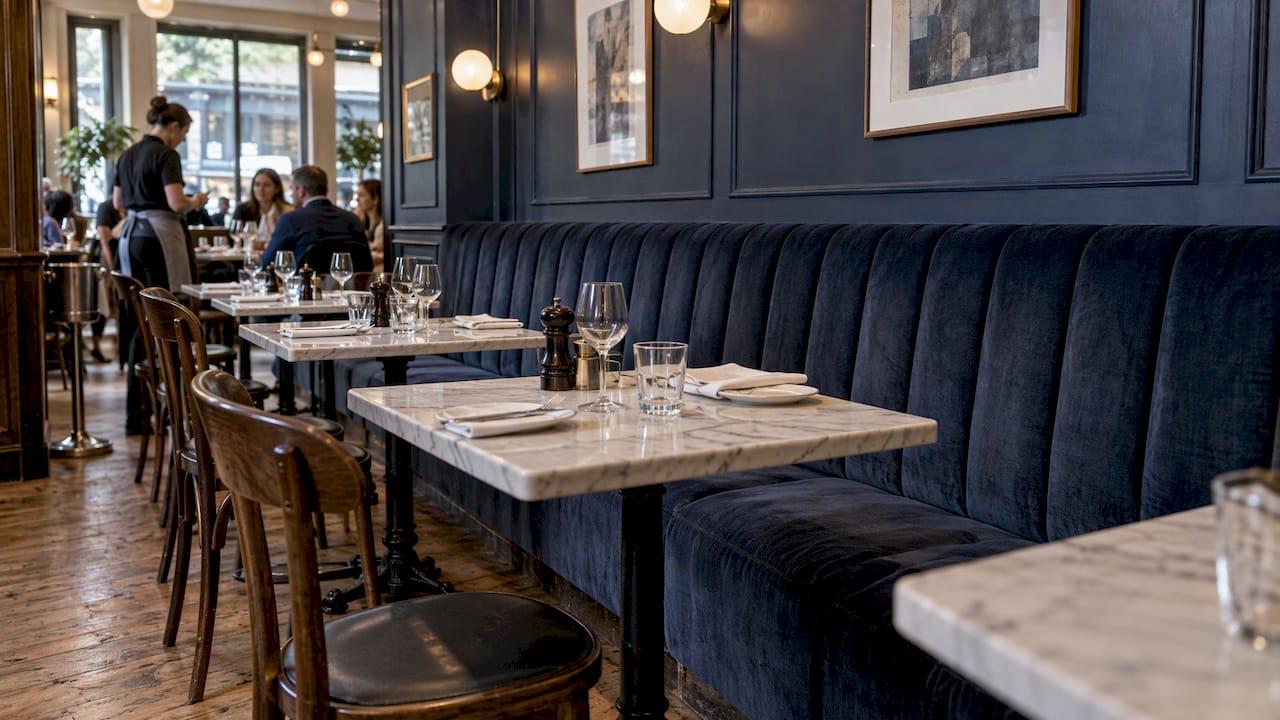
A restaurant banquette is the hardest-working piece of furniture in the room. It is sat on for hours, wiped down between services, scuffed by handbags and tested by every spilled glass. The upholstery that survives this is chosen against three measures: how many rubs it withstands, how it behaves in a fire, and how it copes with commercial cleaning. It also has to be cut and built to the exact shape of your room, which is why the best banquettes are made to order. At Simmons Interior Supply, every piece of our bespoke furniture is handcrafted to order in custom sizes and finishes, so the upholstery is specified around your space and not the other way round.
TL;DR
- Specify the cover for the work it does: look for a rub count at or above the severe contract threshold, and a surface your staff can clean without damaging it.
- In most UK restaurants, bars and hotels, the seating needs to pass BS 5852 Crib 5, and the certificate should cover the fabric and foam together.
- Ask for written confirmation that the cover tolerates your actual cleaning products, not just a cleaning code.
- Seat shape, seam placement and cushion build are decided at design stage, so a made-to-order banquette fitted to your plan avoids awkward gaps and stretched seams.
- Settle the specification before you commission, because changing fabric or foam after the frame is built is expensive.
Table of Contents
- What a restaurant banquette asks of its upholstery
- Choosing the cover: durability first
- Fire safety: what UK restaurant seating must meet
- Comfort, construction and shape
- Cleaning and maintenance without damage
- A specification checklist for your banquette
- Our perspective
- Commissioning your banquette with us
- FAQ
- Sources
What a restaurant banquette asks of its upholstery
A domestic sofa is used for a few hours a day by the same household. A banquette may take several sittings every evening, from guests in coats, with bags, buttons, belts and rivets rubbing the cover as they slide in and out. Spills are routine, and staff clean the surface daily, often with disinfectant.
That is why contract specifications exist. A fabric that looks right on a mood board can wear shiny within a season or discolour with the first bleach wipe. The three questions below settle most of the decision, and each can be answered with a number or a certificate before anything is cut.
Choosing the cover: durability first
Understanding rub counts
Durability is measured with a rub test, usually Martindale in the UK, where a sample is abraded under set pressure until the weave shows wear. The result is a number of cycles, or rubs. Under BS 2543, classifications run from Light Domestic at 15,000 cycles up to Severe Contract at 30,000 cycles, and anything above roughly 30,000 rubs is considered suitable for heavy-demand areas such as hospitality seating.
Some suppliers set the bar higher. One commercial upholstery guide describes 30,000 Martindale rubs as the minimum for general contract grade and 40,000 or more for severe contract use. For a banquette that seats a full dining room every evening, treat the higher figure as the sensible target and use the lower one as the floor. Our own guide to the Martindale rub count for UK specifiers explains how to read a test result and what to ask for on the data sheet.

Vinyl, silicone and woven fabrics
For the greatest protection in hospitality settings, fabric makers point to vinyl or silicone-coated fabrics that are waterproof, bleach-cleanable and quick to wipe. Woven polyester collections can add a performance backcoat and a stain-repellent finish, which suits restaurants that want a textile look with less maintenance.
The choice usually follows the concept:
| Setting | What the seating needs | Typical direction |
|---|---|---|
| Busy all-day café or brasserie | Fast wipe-down, high abrasion resistance | Vinyl or silicone, or a high-rub performance weave |
| Fine-dining room | Tactile warmth, long evenings, careful cleaning | Dense velvet or woven cover with a performance finish |
| Hotel restaurant | Fire certification, infection-control cleaning, consistency across rooms | Contract-grade cover with full certificates |
| Private home dining room | Comfort and appearance, lighter wear | Wider choice, including natural and textured fabrics |
Velvet and mohair are perennial favourites for restaurant banquettes because they catch the light and feel generous. If you are weighing them, our piece on four questions to ask before choosing mohair or velvet sets out what to confirm with the cover's supplier. For bouclé, the sculptural texture that suits curved banquettes, the bouclé durability checklist covers the same ground.
Fire safety: what UK restaurant seating must meet
Fire performance is not a style choice. It is a legal and licensing matter, and the paperwork should be in hand before the seating is made.
The legal baseline
The Furniture and Furnishings (Fire) (Safety) Regulations 1988, as amended on 30 October 2025, require covered furniture, subject to exceptions, not to include upholstery that fails the cigarette test or filling material that fails the relevant ignitability test. Applicable furniture and covers must also carry permanent labels.
Crib 5 and the hazard categories
For contract seating, the benchmark most licensing authorities and specifiers refer to is BS 5852. BS 7176 sorts contract furniture by hazard level and names the ignition source it must resist: medium hazard, which covers most restaurants, bars and hotels, calls for BS 5852 Crib 5, and high hazard calls for Crib 7.
In plain terms, the Crib 5 test builds the seat as it will really be made, with the cover, filling and any interliner. A small wooden crib and alcohol-soaked lint are then placed where the seat meets the back. Failure is flaming for more than 10 minutes, smouldering 60 minutes after ignition, or smouldering through the full thickness of the seat. Local authority premises licence conditions often write this in directly. One council's sample conditions, for instance, require upholstered seating to continuously meet the smouldering ignition source 1 and crib ignition source 5 criteria under BS 5852:1990, and require untreated polyurethane foam to be removed and replaced during repair or refurbishment. Your own licensing authority will state its own conditions.
For the full picture of what to request and how to read the paperwork, see our Crib 5 upholstery guide for UK trade.

What the certificate must say
A common trap is a certificate that covers the fabric alone. A specification checklist for hospitality fabrics asks for BS 7176 medium hazard confirmed as the right category, a certificate covering the fabric and foam combination, a full independent test certificate rather than a generic compliance statement, and the foam type documented. The reason is simple: a cover that passes over one foam can fail over another. Foam and cover are tested as a pair, so they should be specified as a pair.
Building regulations
If the banquette is part of a fit-out in a building other than a dwelling, it is worth knowing that the amendments to Approved Document B, volumes 1 and 2, took effect in England on 2 March 2025. Your fire engineer or building control body will confirm what that means for the project; upholstery certification sits alongside it.
Comfort, construction and shape
Upholstery is more than the cover. Comfort and longevity come from the foam, the frame and the way the pieces are cut and joined, and here a made-to-order banquette has a clear advantage over a stock unit.
Fit to the room. Restaurants are rarely square. A curved bay window, a pillar or a wall that runs slightly off true all defeat standard modules. A banquette made to your measurements runs wall to wall without filler pieces, and its length can be planned against your table layout. Our banquette seating dimensions guide walks through seat height, depth, back height and spacing so that the drawings are right before the frame is made.
Foam density. Foam that is too soft bottoms out within months and the cover wrinkles. Density is the number to ask for, and our foam density checklist explains how to read it. Remember that the foam you choose must also be the foam named on the fire certificate.
Seams and panelling. Channels, buttoning and piping look wonderful, but each is a stress point and a place where crumbs and liquid collect. Decide at design stage where seams fall, and keep the most heavily used edges simple. A curved back with vertical channels gives the elegant, sculptural line many restaurants want while keeping horizontal seams, where guests lean, to a minimum.
Contract grade as a whole. The cover is only one part of a contract-grade piece. If you want the wider picture, we explain what contract grade furniture means and when to specify it.
Cleaning and maintenance without damage
A banquette that cannot be cleaned properly will not stay looking good. Restaurant staff clean often and quickly, so the cover needs to withstand the products they actually use.
Two points from specification guidance are worth building into your brief:
- Cleaning codes describe method, not chemical resistance. Typical hotel housekeeping cleaners sit at around pH 8 to 11, and a cleaning code does not guarantee a fabric will resist them. Water-based cleaning (W or WS) fabrics are preferred for public-area seating, while solvent-cleaned (S) fabrics need a confirmed specialist cleaning contract, according to the hospitality fabric checklist. Ask for written confirmation of compatibility with your cleaning regime.
- Sealed, wipe-clean surfaces need alcohol and bleach resistance. A restaurant fabric specification should check cleanability and cleaning-agent resistance alongside abrasion, so that staff can disinfect without damaging the finish.
For textile covers, a routine of regular vacuuming and prompt spot treatment keeps the pile in order, with periodic deep cleaning on a schedule. This overview of commercial upholstery cleaning methods and schedules shows how professional cleaning is typically planned for commercial seating.
Where hygiene is a priority, such as a hotel dining room, you may also want to read about antimicrobial upholstery fabrics and how specifiers assess the claims made for them.
A specification checklist for your banquette
Before you approve a design, you should be able to put a tick against each of these:
- A rub count at or above the severe contract threshold for the chosen cover.
- A BS 7176 hazard category confirmed for the premises, normally medium hazard for a restaurant.
- A Crib 5 certificate covering the fabric and foam combination, with the foam type recorded.
- Written confirmation that the cover tolerates your cleaning products.
- Dimensions drawn to your plan: seat height, depth, back height and linear length per diner.
- Agreed seam, piping and panel positions.
- Your licensing authority's seating conditions checked.
This is the part of the process where made-to-order work pays for itself, because the cover, foam and shape are decided together and recorded in one specification.
Our perspective
We make bespoke furniture by hand, and banquettes are where craftsmanship and practicality meet most clearly. A restaurant needs a seat that looks like part of the architecture and still stands up to a thousand covers a week.
That is why we start with the room and not the catalogue. Every piece we make is handcrafted to order, with the size and finish tailored to the space, and we work closely with our artisans and with you to balance artistry, function and exceptional materials. For interior designers, architects and hotel teams, that means a banquette that runs exactly where the plan says it should, with the specification agreed before making begins.
Our trade access and project experience are there for the complex jobs: multiple rooms, repeat orders, tight programmes. We are always happy to work with you on the details.
Luke
Commissioning your banquette with us
If you are designing a restaurant, hotel dining room or a generous home dining space, our bespoke furniture collection is made to order, with custom sizes and finishes, for residential and hospitality interiors. We work with interior designers, architects, trade professionals, luxury hotel teams and homeowners, and trade customers can access our made-to-order rugs and mirrors from partner brands alongside the furniture.
To discuss a banquette for your scheme, start at Simmons Interior Supply, where you can see the collections, or read about how we work.
FAQ
What is the best fabric for a restaurant banquette?
The best fabric is the one that meets your rub-count target, carries the right fire certification with its foam, and tolerates your cleaning products. For busy rooms, vinyl or silicone-coated covers are the most wipe-clean option, while performance weaves and velvets suit rooms where texture matters.
How many Martindale rubs does restaurant seating need?
Under BS 2543, severe contract use starts at 30,000 cycles, and some specifiers set 40,000 or more for the most demanding seating. For a banquette in constant use, aim for the higher end and check the figure on the test data sheet for the exact cover.
Does restaurant banquette upholstery have to be Crib 5?
For most UK restaurants, bars and hotels, which fall into the medium hazard category under BS 7176, Crib 5 is the reference test. Premises licence conditions often name it directly, so confirm the requirement with your licensing authority and ask for a certificate covering the fabric and foam together.
Can a banquette be made to fit a curved or awkward wall?
Yes. Made-to-order seating is built to your measurements, so curves, bays, pillars and uneven walls can be accommodated in the design, with seam positions and panel layouts planned from the outset.
Sources
- Camira Fabrics: upholstery fabrics
- Linwood Fabric: commercial upholstery fabrics
- The Furniture and Furnishings (Fire) (Safety) Regulations 1988, legislation.gov.uk
- The Furniture and Furnishings (Fire) (Safety) Regulations 1988, summary
- Monteiro: how to choose restaurant upholstery fabric
- UK fire test standards and certificates explained
- Sample conditions for premises licences
- 2025 amendments to Approved Document B, volumes 1 and 2
- Hotel and hospitality fabric specification checklist
- Commercial upholstery cleaning methods and schedules