
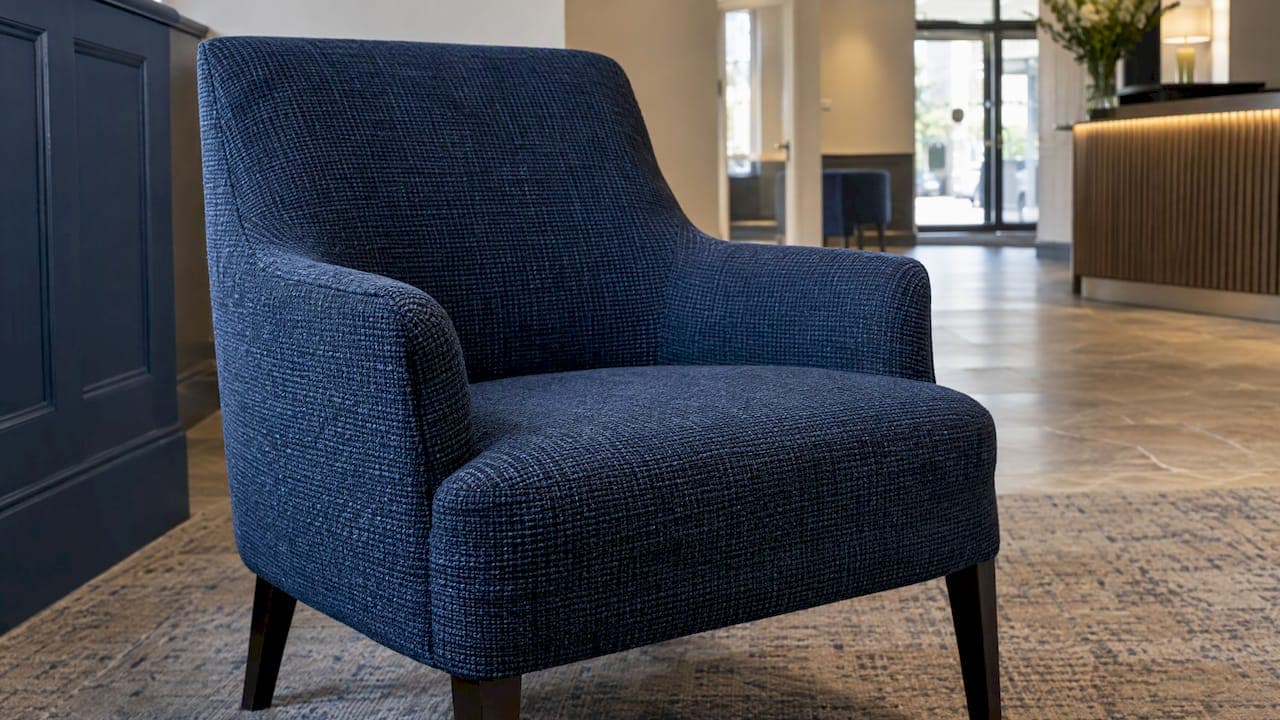
An antimicrobial upholstery fabric carries a treatment that kills or inhibits bacteria on the cloth itself. It is a useful addition to a well-specified seat in a hotel, restaurant, clinic or busy family home. It is not a force field. The treatment protects the fabric and supports good hygiene, but it works alongside cleaning and never replaces it. Below, we explain how the treatments work, how performance is tested, how to care for the cloth and which questions to put to a supplier before you commit.
TL;DR
- Antimicrobial textiles contain a chemical, added to the yarn or applied as a finish, that kills or inhibits bacteria.
- Claims are specific to the tested organisms. One mill states that its range has not been tested against COVID-19, so regular cleaning and hand hygiene still matter.
- Ask for written cleaning instructions: bleach can damage coatings that were not made to withstand it.
- In UK contract settings, check fire performance (often Crib 5 under BS 5852) for the whole composite, not just the cover.
- Biocidal treatments fall under UK and EU biocide rules, so request conformity declarations in writing.
Table of Contents
- What antimicrobial upholstery fabric actually is
- Treatments you will come across
- What the treatment does, and what it does not do
- How performance is tested
- Cleaning and caring for antimicrobial upholstery
- UK rules on biocidal treatments
- Specifying for hospitality and contract interiors
- A quick specification checklist
- Our perspective
- Bring your specification to us
- FAQ
- Sources
What antimicrobial upholstery fabric actually is
The phrase sounds like a fabric type, but it is better understood as a fabric with an added function. According to a technical guide from a UK fabric mill, an antimicrobial textile contains a chemical that kills or inhibits bacteria. That chemical can be introduced in one of two ways: added to the yarn before weaving, or applied to the finished cloth by wet finishing.
The difference matters when you specify. A treatment built into the yarn is part of the fibre, while a finish sits on the surface of the woven cloth. Neither changes how a sofa or banquette looks, but your supplier should be able to tell you which route they use and what that means for the fabric's handle, colour range and cleaning.
It also helps to separate three ideas that are often blurred together:
- Antibacterial treatments act on bacteria.
- Antifungal treatments act on moulds and mildew.
- Antimicrobial is the umbrella term, covering the lot, though the actual claim depends on which organisms were tested.
The label alone therefore tells you very little. The test report behind it tells you a great deal.
Treatments you will come across
The same technical guide lists examples of antimicrobial chemicals used on textiles: silver, zinc and ammonium chloride. You will meet silver ions most often in marketing, sometimes alongside copper. Commentary on the growing category notes that fabrics are treated with agents including copper, silver ions and other natural compounds to repel micro-organisms.
There is also a research thread worth knowing about. Academic work on textile finishing describes plant-derived antimicrobials as an alternative strategy, prompted by concern about antibiotic resistance. For a specifier, the practical takeaway is simple: the active substance is a design decision made by the mill, and it is reasonable to ask which one has been used and where it sits within the product's compliance paperwork.
What the treatment does, and what it does not do
Honest specification starts with realistic expectations. The mill guide says its antimicrobial products protect against a range of harmful bacteria and offer enhanced hygiene benefits, but that they have not been tested against COVID-19. It adds that increased sanitation and hand hygiene remain effective protection methods.
There is a second, subtler point. A US coated-fabric manufacturer explains in a healthcare upholstery white paper that antimicrobial additives in upholstery do not safeguard against contamination or claim a health benefit; they protect the product from microbial degradation. In other words, in some products the additive exists to keep the material itself in good condition, which is a valuable benefit in a well-used piece, but a different one from protecting the person sitting on it.
So when you read a product page, look for:
- Which organisms were tested, named precisely.
- What the claim covers: the fabric's own protection, or a hygiene benefit.
- What it does not claim, which a careful supplier will state plainly.
A well-specified antimicrobial cloth, cleaned properly, is a sensible choice for dining chairs, hotel headboards, waiting-area seating and children's rooms. It simply works best as one part of a hygiene routine.
How performance is tested
If a supplier tells you a fabric is antimicrobial, the next question is: tested how? One UK mill describes testing to AATCC 147 using Staphylococcus aureus and Klebsiella pneumoniae. After 24 hours, the zone of inhibition is assessed, meaning the clear area around the sample where bacteria have not grown.
That is a useful model of what a good report looks like: a named standard, named organisms, a defined contact time and a measurable result. When you request documentation, ask for:
- the test standard and the organisms used;
- whether the cloth was tested new or after laundering or cleaning cycles;
- the date of the report and which colourways it covers.
The second point is the one most often missed. A fabric that performs well on the day it leaves the mill matters less than one that still performs after a year of wipe-downs, so ask the question explicitly and keep the answer in your project file.
Cleaning and caring for antimicrobial upholstery
The good news is that care is not complicated. A UK healthcare cleaning guide from a fabric mill sets out a straightforward routine:
- Vacuum regularly.
- Absorb spills promptly with a dry cloth.
- Treat persistent stains with a damp cloth or upholstery shampoo.
- Where disinfection is necessary, use a 10% bleach solution.
That last step needs care. A technical article on healthcare fabrics advises that specifiers should confirm cleaning protocols are compatible with the fabric, because bleach can discolour, embrittle or damage coatings not formulated to withstand it. Always use the cleaning method the supplier has put in writing for that specific cloth, and apply it consistently across a hospitality team so that no one improvises.
For a homeowner with mixed materials in one room, it is also worth understanding the more fragile end of the upholstery spectrum. This overview of protecting delicate upholstery fabrics is a helpful companion when a bespoke piece sits next to silk, mohair or other fibres that need a gentler hand than a bleach-cleanable contract weave.
UK rules on biocidal treatments
Because an antimicrobial finish is a biocidal function, it sits within a regulatory framework. A guide to European biocidal products explains that under the EU Biocidal Products Regulation, active substances must be approved and biocidal products authorised, and that the Health and Safety Executive (HSE) is the UK's enforcement authority for biocides. The guide dates from 2019, so check the HSE's current position for Great Britain when you specify a project.
For trade buyers the sensible, low-effort approach is to ask the supplier to confirm in writing that the antimicrobial treatment complies with the biocide rules applicable to where the furniture will be used. A reputable mill will have that paperwork to hand.
Specifying for hospitality and contract interiors
Antimicrobial performance is only one line on a specification. For contract seating, the others carry just as much weight.
Fire performance
The same healthcare fabrics article notes that in UK healthcare, contract seating typically needs a severe-hazard rating under BS 5852, such as Crib 5, and that fire performance depends on the cover fabric, filling and interliner together. That last phrase is the crucial one: a compliant cover on its own does not make a compliant chair. Our own specifier's guide to Crib 5 upholstery goes further into how to document it.

Some mills offer antimicrobial weaves that also meet Crib 5; one UK supplier lists antimicrobial Crib 5 upholstery weaves that are waterproof and soil resistant. That combination is exactly what busy commercial interiors tend to look for.
Paperwork to request
The healthcare article recommends that specifiers request written cleaning instructions, fire-test evidence for the intended composite, and declarations of REACH conformity and phthalate-free construction. Add the antimicrobial test report from the previous section and you have a complete, defensible file.
Durability and finish
An antimicrobial treatment does not tell you how long the cloth will wear. Pair it with a Martindale rub count suited to the use, and read our notes on hospitality grade finishes and what contract grade furniture means. If a project involves your own cloth, our guide to COM fabric rules explains why ordering extra matters. Where emissions are a concern, see our piece on low VOC furniture finishes, and agree the terms of cover in writing using our warranty clauses for contract orders.
A quick specification checklist
| Question for the supplier | Why it matters |
|---|---|
| Which antimicrobial agent, and is it in the yarn or a finish? | Tells you how the treatment is built into the cloth |
| Which standard and which organisms were tested? | Defines what the claim really covers |
| Is performance reported after cleaning? | Shows whether it lasts in real use |
| What cleaning method is approved, in writing? | Prevents coating damage from unsuitable disinfectants |
| Fire evidence for the full composite? | Cover, filling and interliner work together |
| Biocide, REACH and phthalate declarations? | Supports compliance on commercial projects |
Our perspective
We are often asked whether a bespoke piece can also be a hard-working one, and our answer is always yes. Handcrafted furniture and practical performance are not opposites; the best commissions are those where the artistry and the brief are considered together from the very first conversation.
When a client mentions antimicrobial cloth, we treat it as part of the wider specification rather than a headline. We would ask how the piece will be used, how it will be cleaned and by whom, and what the project's fire and durability requirements are. Those answers shape the size, the construction and the finish far more than any single buzzword does.
That is where working with skilled artisans and made-to-order production pays off. Every piece we make is built to your dimensions and finish, so the seating, the table or the headboard can be considered in relation to the room, the guests and the cleaning routine. We are always happy to work with designers, architects and hospitality teams to get that balance right.
Luke
Bring your specification to us
If you are planning a residential or hospitality scheme, we would love to hear about it. Our bespoke furniture collection is handcrafted to order, with size and finish tailored to your space. Trade customers can also explore made-to-order rugs from our Signature collection from Colbourns and the Ready to Hang mirror collection from Simpsons London, both offered with tailored designs and dimensions.
Tell us about the room, the way it will be used and any performance requirements your project carries, and we will talk you through the options with you.
FAQ
Is antimicrobial upholstery fabric safe for homes?
Antimicrobial treatments are regulated as biocidal functions in the UK, with the HSE as the enforcement authority, so a supplier should be able to confirm compliance in writing. If someone in the household has a particular health condition or sensitivity, ask your GP or pharmacist for advice about specific treatments. Always follow the cleaning guidance supplied with the cloth.
Does antimicrobial fabric protect against viruses?
Not as a rule. One UK mill states that its antimicrobial products have not been tested against COVID-19 and that sanitation and hand hygiene remain effective protection methods. The treatment is best seen as an added hygiene benefit for the fabric, alongside regular cleaning.
Can I use bleach on antimicrobial upholstery?
Only if the supplier says so for that specific fabric. Some mills give a 10% bleach solution as a disinfection method for their healthcare cloths, while others warn that bleach can discolour, embrittle or damage coatings not formulated for it. Get the instruction in writing and follow it.
How is antimicrobial performance verified?
By a named laboratory test. One example is AATCC 147, which uses Staphylococcus aureus and Klebsiella pneumoniae and assesses the zone of inhibition after 24 hours. Ask for the report, the organisms tested and whether the result holds after cleaning.
Does antimicrobial fabric also meet fire regulations?
Not automatically. Fire performance depends on the cover fabric, filling and interliner together, and UK contract seating often needs a severe-hazard rating such as Crib 5 under BS 5852. Request test evidence for the complete composite.
Sources
- Anti-microbial and bleach cleanable fabrics and vinyls
- Healthcare technical cleaning guide
- Antimicrobial approaches for textiles: from research to market
- Coated fabric upholstery materials for healthcare settings
- How to choose fabrics for healthcare environments
- Guide to European biocidal products
- Antimicrobial fabrics, Crib 5 weaves
- Delicate upholstery fabrics: how to identify and protect them