
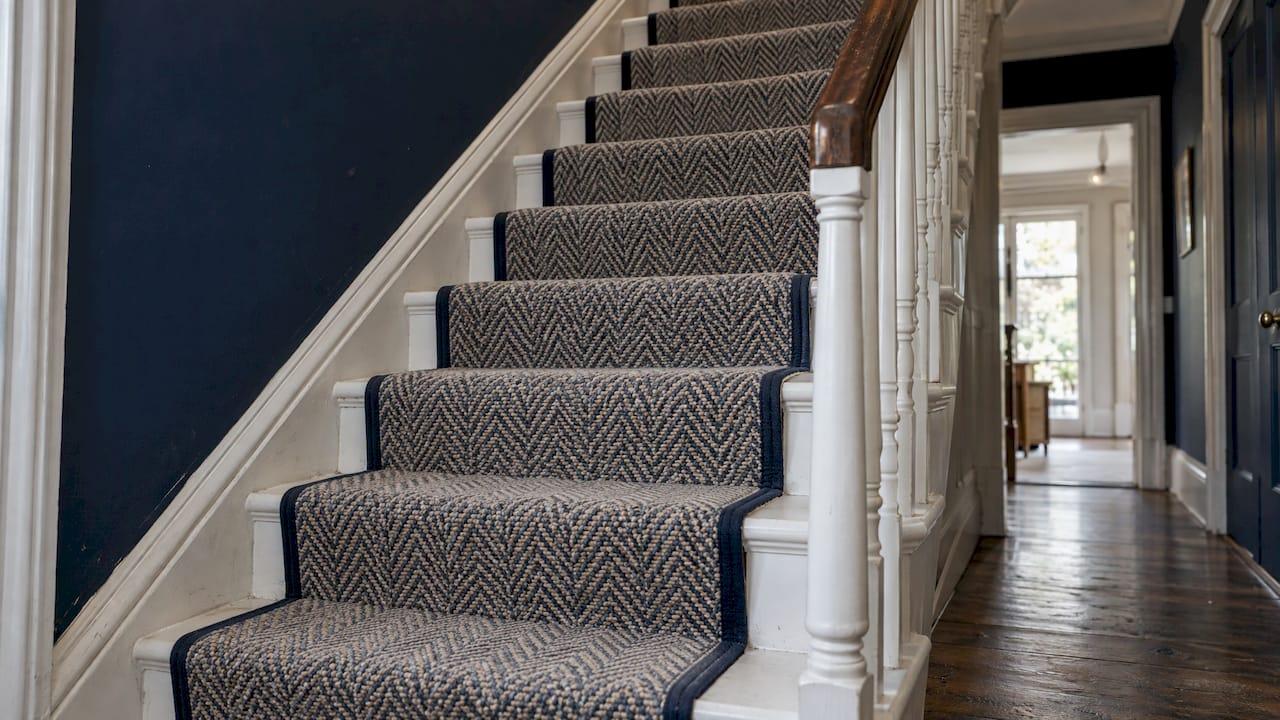
The best stair runner material for most homes is wool, or an 80/20 wool-nylon blend if the stairs are busy. Nylon and polypropylene suit households with young children and pets, while sisal and jute bring texture and a natural look at the cost of easy cleaning. What follows is how each fibre behaves underfoot, in a busy hallway and in the long run, so you can specify with confidence.
TL;DR
- Wool is the benchmark for durability, comfort and appearance retention, and it carries a higher price.
- An 80/20 wool-nylon blend gives most of wool's resilience with added abrasion resistance, which is why it suits busy family stairs.
- Nylon and polypropylene are the practical, stain-resistant choices for children, pets and tighter budgets.
- Sisal and jute look beautiful and wear well, but they are firmer underfoot and hard to clean.
- Construction matters as much as fibre: a low, dense pile or a tight flatweave will outlast a deep, fluffy one on the same staircase.
Table of Contents
- Stair runner materials at a glance
- Wool: the classic choice
- Wool blends: the pragmatist's answer
- Synthetics: nylon, polypropylene and polyester
- Natural fibres: sisal, jute and seagrass
- Construction matters as much as the fibre
- Matching the material to your household
- Cleaning and maintenance by material
- Grip, underlay and fitting
- How texture and colour shape the staircase
- Our perspective
- Finishing the scheme with Simmons Interior Supply
- FAQ
- Sources
Stair runner materials at a glance
Stairs are the hardest-working floor in a house. Every step concentrates weight, friction and grit on a small area, and the nosing (the front edge of each tread) takes the worst of it. That is why a material that feels lovely in a bedroom can look tired on a staircase within a few years.
The table below summarises the ratings published by stairrunnercalculator.com in July 2026, with our own plain-language reading of them.
| Material | Durability | Comfort | Cleaning | Price level |
|---|---|---|---|---|
| Wool | Excellent | Excellent | Good | High |
| Sisal | Very good | Firm, can feel scratchy | Poor with liquids | Medium |
| Jute | Moderate | Soft for a natural fibre | Poor | Low to medium |
| Nylon / polypropylene | Very good | Good | Excellent | Low |
Wool-nylon blends sit between the first and last rows, which is exactly why they are so widely specified.
Wool: the classic choice
Wool is the fibre most designers reach for first, and with good reason. Its fibres spring back to their original shape when compressed, which helps a runner keep crisp pattern definition and colour. The same source notes that wool is naturally flame retardant and dirt resistant, because microscopic scales on the fibre stop dust from working deep into the weave.
In use, wool is described as the benchmark for appearance retention and comfort, and it hides soil well. Its typical failure is slow and graceful rather than sudden: gradual thinning of the pile at the nosing, long after a cheaper fibre would have crushed or shone.
The trade-off is price and stain behaviour. Wool does not have the legendary resistance to stains and water damage of polypropylene, so spills want attending to promptly, with cool water and no bleach. For a hallway that will be seen by guests every day, or a hotel staircase where appearance is part of the brief, that is a fair exchange.

Wool blends: the pragmatist's answer
An 80/20 wool-nylon blend is, in the words of stairrunnercalculator.com, the pragmatist's answer: most of wool's resilience, extra abrasion resistance and a lower price. Oaknwool likewise describes a typical 80% wool, 20% nylon runner as an excellent choice for busy family homes.
If you are specifying for a client who wants the warmth and depth of colour of wool but has three children and a spaniel, this is usually where the conversation lands.
Synthetics: nylon, polypropylene and polyester
Modern synthetic fibres have come a long way. Oaknwool notes that polypropylene and nylon runners are the most affordable option, offer excellent stain resistance and have improved significantly in appearance and feel.
The three behave quite differently from one another:
- Nylon is the most abrasion-resistant synthetic and practical for heavy traffic and spills, though its typical failure is colour change.
- Polypropylene is the budget option that cleans easily. Homebuilding calls it the most popular synthetic carpet fibre thanks to its affordability and practicality, and notes that most can be cleaned with bleach-mix solutions. The trade-off is that it can crush sooner and may show a sheen in the traffic lane.
- Polyester has a softer, silkier hand and tends to be used in cut-pile and saxony styles. Its usual failure is matting.
For homes with young children or pets, a synthetic runner is hard to argue with. Water-based spills tend to sit on the surface rather than soaking in, which gives you time to blot them away.
Natural fibres: sisal, jute and seagrass
Natural plant fibres give a staircase texture that no synthetic quite matches. They work in both traditional and contemporary interiors, and Oaknwool describes them as hardwearing and sustainable, though less soft underfoot than wool.
Sisal
Sisal is the strongest of the group. Alternative Flooring describes it as the most versatile natural plant fibre, with the highest durability and a good fit for stairs and hallways. It begins life as a naturally white fibre, so it takes dye beautifully, allowing intricate textures and a wide range of colours, even subtle metallic hues.
The cautions are practical ones. Sisal is firm and can feel scratchy, it copes poorly with liquids, and sisal weaves such as boucle are best installed by a professional. Over time, sisal and jute tend to fail by fraying and breaking fibres at the nosing edge, so edge treatment and a good underlay matter.
Jute
Jute is the softest of the natural plant fibres underfoot, but with lower durability it is better suited to low-traffic stairs than to the main staircase of a busy household. Its palette of soft golds, warm creams and earthy tones works with virtually any scheme, and that source also credits it with a natural grip that feels secure on stairs.
Seagrass
Seagrass is often hand-spun and hand-woven, so irregularities in the weave are part of its character. It is, however, not suitable for stairs or high-moisture areas, so we would keep it for other rooms.
Construction matters as much as the fibre
Two runners in the same wool can perform very differently. As stairrunner.co points out, a low, dense pile is important whatever the fibre, because construction affects stair performance as much as the fibre does.
- Loop or Berber: a low, dense looped pile does not flatten easily, and the texture and colour variation stop dirt from showing as readily.
- Saxony: deliciously soft and cloud-like, but more prone to flattening on stairs because of the longer pile.
- Twist pile: short twisted fibres make it soft, durable and easy to clean, a practical choice for a busy family staircase.
- Woven and flatweave: woven carpet is considered gold-star quality and is often used in hotels. A tight flatweave is low and smooth, with very little to snag.
For guidance on how cut and loop constructions fail in the long run, our piece on cut versus loop pile sets out the specifier's rules. When an old carpet comes up during a refit, it is also worth reading about carpet recycling routes before the old material is skipped.
Matching the material to your household
There is no single best fibre, only a best fit. A few common situations:
- Busy family home with children and pets. An 80/20 wool blend, or nylon or polypropylene if budget and stain resistance lead. Homebuilding quotes advice that a tightly woven wool such as a boucle is easy to clean, and that a fleck in the carpet helps hide dirt.
- Formal hallway, townhouse or period property. Pure wool in a flatweave or fine stripe, held with stair rods if you want the traditional look.
- Contemporary or country interior. Sisal, in a boucle or herringbone weave, for texture and a natural palette.
- Hotel or hospitality staircase. A woven wool or wool-nylon blend, chosen for abrasion resistance and appearance retention under constant footfall.
- Quiet secondary stairs. Jute or a natural blend can work where traffic is light.
When you are weighing price against longevity, think in cost per year, not cost per metre. A wool-blend runner that keeps its shape for a decade will often be better value than a cheaper one that is replaced twice.
Cleaning and maintenance by material
The easiest materials to clean are the synthetics, then wool, then the natural fibres. In practice:
- Polypropylene: stain-resistant and, on most ranges, bleach-cleanable. Always check the manufacturer's guidance first.
- Wool: cool water, gentle detergent and no bleach. Blot, never rub.
- Sisal and jute: keep liquids away. Vacuum regularly and call a professional for anything more than a minor mark.
- All stair carpet: Best4Flooring recommends vacuuming at least twice a week with a motorised brush head, a no-shoes policy to limit abrasive grit, spot cleaning with mild detergent and a professional deep clean once a year.
A small practical tip: if your runner is wool or sisal and you have spare length, shifting it slightly at the next clean spreads wear away from the nosing. This is only possible if it was fitted with extra length in mind, so raise it at the planning stage.
Grip, underlay and fitting
The material you choose is only half the equation. Homebuilding lists the priorities for stair carpet as durability under heavy footfall, non-slip grip, easy cleaning, good dirt-hiding and a thick underlay to reduce noise.
A few points specifiers should keep in mind:
- Backing: a natural-fibre runner with a latex backing is far more stable on a staircase than an unbacked one, and much less likely to creep.
- Rods and grippers: brass, chrome, antique bronze or painted stair rods hold the runner at the base of each riser and make it easy to lift and clean, which is why they are popular in period homes. A gripper rod and underlay system gives a tighter, more fitted finish preferred for modern interiors.
- Rods are not a safety fixing: Stair Runners Direct states that stair rods are purely decorative and a runner should be fitted using gripper rods, with a good quality underlay over the nose of each stair to extend the life of the runner.
- Pile direction: lay the pile so it runs smoothly down the riser, which looks better and catches less dirt, according to the same guide.
Because stairs are a safety-critical surface, have the runner fitted by an experienced fitter, and ask them to confirm the underlay depth suits the gripper system they are using.
How texture and colour shape the staircase
Material changes how a staircase reads from the hall. Wool offers a depth of colour that synthetics struggle to match, so a deep blue or a soft heather stripe keeps its richness. Sisal has an organic, slightly irregular surface that suits a plain, calm stair. Jute is the most relaxed of all, and can make a staircase feel part of the architecture rather than a separate design element.

Pattern is the practical question. Flecks, tweeds, stripes and herringbones forgive daily life far better than a plain pale cut pile. Keep the runner's border narrow enough to show the wood on either side, and consider how the colour meets the landing flooring and any rugs you plan to place there. If the landing sits above underfloor heating, our guide to rug specifications for underfloor heating is worth a look, and our note on layering rugs on carpet helps with the landing.
Our perspective
We have spent years working with artisans and trade clients, and one lesson holds across every floor and every piece of furniture: the fibre and the construction decide how a thing looks in year ten, not year one.
For a staircase, that means choosing wool or a wool-rich blend wherever appearance matters, and being honest about traffic. A beautifully woven wool in a dense, low construction will give an interior designer, an architect or a hotel procurement team the look they have specified for far longer than a fashionable but fragile alternative.
This is the thinking behind our own made-to-order work. Every piece we make is designed around the client's space, with sizes and finishes tailored to fit, and we are always happy to work with you to match the material to the way the room is really used.
Luke
Finishing the scheme with Simmons Interior Supply
A staircase rarely stands alone. The landing, the hall and the rooms leading off it all need to speak the same language, and that is where we can help. Our trade-only collections include made-to-order rugs and mirrors from partner brands, with tailored designs and dimensions, alongside our handcrafted bespoke furniture, customisable in size and finish for residential and hospitality interiors.
If you are planning a hall, landing or hotel corridor, explore the Signature rug collection and bespoke furniture and talk to us about what your project needs.
FAQ
What is the most durable stair runner material?
Wool and nylon are the strongest all-rounders. Wool keeps its appearance and comfort, while nylon is the most abrasion-resistant synthetic. Sisal is also very durable, though it is firmer underfoot and harder to clean.
What is the best stair runner material for children and pets?
Synthetic runners in nylon or polypropylene are usually recommended because of their stain resistance and lower price. An 80/20 wool-nylon blend is a good alternative if you prefer the feel and colour of wool.
Is sisal or jute better for stairs?
Sisal is the better choice for a main staircase because it is more durable. Jute is softer underfoot but suits low-traffic stairs better. Both are hard to clean if liquids are spilled.
Do stair runners need underlay?
Yes. A good quality underlay over the nose of each stair helps extend the life of the runner, and it also reduces noise. Ask your fitter to match the underlay depth to the gripper system.
Sources
- Wool vs Sisal vs Jute Stair Runners, stairrunnercalculator.com
- Stair runners guide for London homes, Oaknwool
- Stair runner buying guide, Tapi
- What is a stair runner, Tapi
- Stair runner materials, stairrunner.co
- The best material for stair runners, Sophie Cooney
- Help and advice FAQs, Alternative Flooring
- What is the best carpet for stairs, Homebuilding
- What is the best carpet for stairs, Best4Flooring
- How to fit a stair runner, Stair Runners Direct