
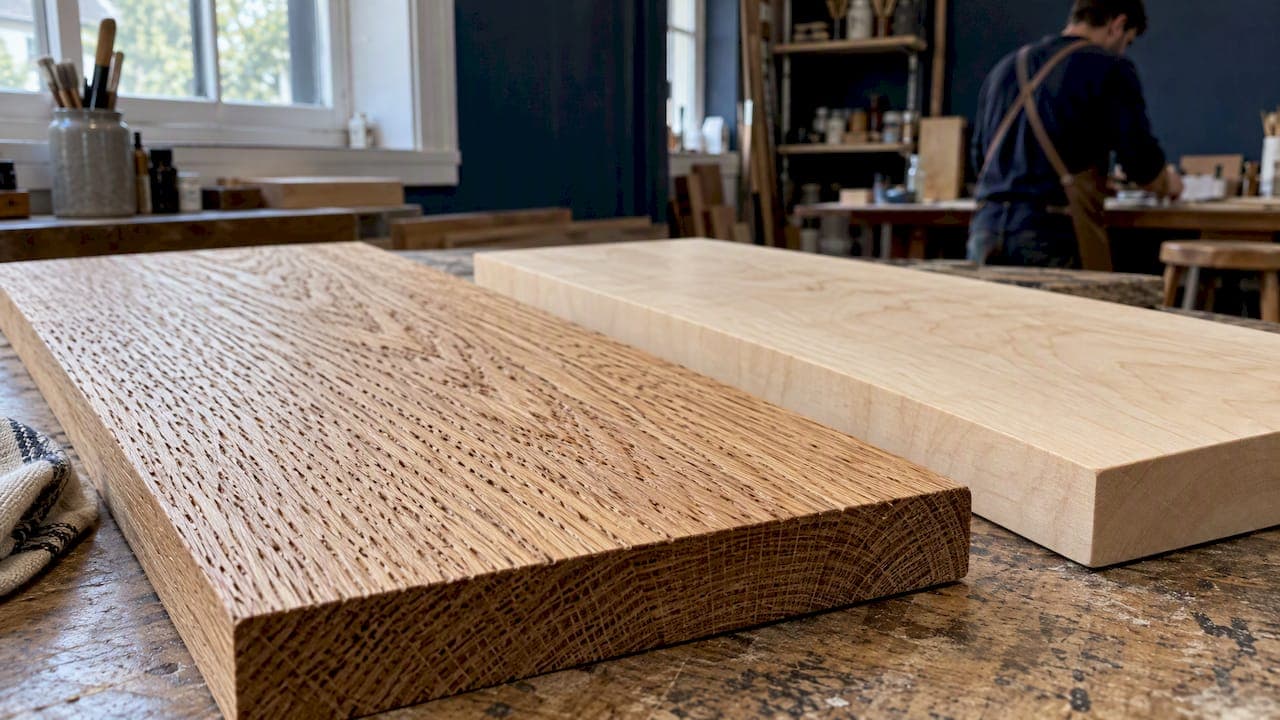
Open-grain woods, such as oak, ash and hickory, have large pores you can see and feel on the surface. Closed-grain woods, such as maple, cherry and birch, have pores so fine that they sand to a smooth, even finish. Neither is better. The difference is one of character, and it shapes how a piece looks, how it takes a finish and how it is made.
Below, we set out what the terms mean, which species fall on which side, how each behaves under stain, oil and lacquer, and how to specify the right texture when you commission a piece.
TL;DR
- Open grain (ring-porous) means large, visible pores: oak, ash, hickory. Closed grain (diffuse-porous) means pores too fine to see: maple, cherry, birch.
- Pore size is called texture. It is separate from grain direction, which describes how the fibres run and governs strength and movement.
- Open grain gives a tactile, natural look and needs pore filling for a glass-smooth gloss. Closed grain gives a sleek, uniform look but can blotch when stained.
- Closed grain is not a synonym for easy, and open grain is not a synonym for lower quality. Both are deliberate design choices.
- For a bespoke commission, decide texture, finish and sheen together, because each one affects the other two.
Table of Contents
- What open grain and closed grain actually mean
- Which species fall on which side
- How the two behave under a finish
- How grain affects the making
- Choosing between them for a project
- Our perspective
- Bring it to a bespoke commission
- FAQ
- Sources
What open grain and closed grain actually mean
Every timber is built from the same basic cells. What differs is how the water-carrying vessels in hardwoods are arranged and how large they are. When a board is cut, those vessels are sliced open and leave tiny depressions on the surface: the pores. As Workshop Companion explains, woods with large pores that are easily visible to the naked eye are described as open grain, and those with smaller pores as closed grain.
The technical terms are worth knowing, because specifiers and joiners use them interchangeably with the everyday ones:
- Open grain is ring-porous. Large vessels cluster in the earlywood, the growth formed in spring, and create the pronounced texture you see in oak.
- Closed grain is diffuse-porous. Smaller vessels are spread fairly evenly through the growth ring, so the surface reads as fine and uniform.
FineWoodworking's comparison puts it plainly: visible pores are found on open-grain woods like oak, ash and hickory, while closed-grain woods such as maple, walnut and cherry have pores that the naked eye cannot see. If you also see the phrase "open pore" or "closed pore", it means the same thing as open or closed grain. It can additionally describe a finish: an open-pore finish leaves the pores unfilled, so you can feel the texture.
Grain, texture and figure are not the same thing
People say "grain" for several different properties, and mixing them up is why many wood charts confuse more than they help. Wood Grain Comparison Chart separates them neatly. Grain direction is how the fibres run along the board, whether straight, wavy, interlocked or irregular. Texture is the pore size that this article is about. Figure is the pattern that the cut reveals.

The distinction matters for specification. The USDA Forest Products Laboratory treats pore structure and fibre direction as separate influences on how timber bonds and performs. In practical terms, direction governs strength and the way a board warps, while texture governs finishing and gluing behaviour. A table top can be open-grained and perfectly stable, or closed-grained and badly chosen for its cut. If movement is your concern, read our notes on why solid wood shifts and on quarter sawn versus plain sawn boards.
Which species fall on which side
The split is not perfectly tidy, but the common furniture timbers sort as follows.
| Texture | Typical species | What you see and feel |
|---|---|---|
| Open grain | Oak, ash, hickory | Visible pores, pronounced linear texture, a tactile surface |
| Closed grain | Maple, cherry, birch, walnut | Fine, even surface, smooth to the hand |
| Softwood (no true pores) | Pine and other conifers | Generally treated as closed grain for finishing |
Two notes on that table. First, The Wood Database divides hardwoods by the arrangement of their pores, and some species sit in between: semi-ring-porous timbers can look open in one cut and fine in another. Walnut is the one our clients ask about most, and it is usually treated as closed grain, though you may notice a little more texture than in maple. If you are weighing it against oak, our guide to oak versus walnut furniture goes through the choice.
Second, softwoods are a different case. Workshop Companion notes that they lack vessel elements in the same anatomical sense, and are built mainly from tracheids. For finishing they are usually grouped with the closed-grain woods, although resin canals can make stain absorb unevenly.
How the two behave under a finish
This is where the choice stops being theoretical. The surface you start with decides what the finish can do.
Open grain: texture you can keep or fill
Open-grain timbers soak up finish into their pores, and that gives you two honest options. You can leave the pores open, which produces a natural, tactile surface with a quiet sheen. Or you can fill them. FineWoodworking's guide to filling pores describes pore filling as an optional step that can create an elegant, glass-smooth surface on hardwoods.

Skip it when you want a high-gloss finish on oak, and the result will disappoint. The same guide explains that a film finish tends to sink into unfilled pores and leave tiny craters that break up the reflection. So a mirror-like lacquer on oak is really a three-part specification: the species, the filler and the topcoat.
Open grain also lends itself to treatments that celebrate the texture rather than hide it. Contrast finishes push pigment into the pores to emphasise them, as we describe in our piece on cerused oak. Wire brushing lifts the softer earlywood to deepen the relief, and we cover how to specify it in our guide to a wire brushed finish. If you are deciding whether to keep texture or move away from it, our article on open pore finishes walks through the steps.
Closed grain: smooth, but not simple
Closed-grain woods sand to a smooth, uniform surface without any need for pore filling, and that is what gives maple and cherry their refined, contemporary look. It is tempting to conclude that they are therefore the easy option. They are not.
As Hardwood Information points out for specifiers, species like cherry and maple can blotch when stained, and good finishers use pre-conditioners, gel stains or dyes to get an even colour. Fine pores do not make a timber maintenance-free. They simply move the challenge from texture to colour control.
If you are trying to match an existing colour on a closed-grain timber, allow for this. Our stain matching workflow shows how to approach it, and the wider question of oil, wax, lacquer and varnish is covered in our guide to furniture finish types. If air quality or compliance is a factor in a project, see also our note on low VOC furniture finishes.
How grain affects the making
Texture shapes more than the finish. It also influences how the piece is built.
Adhesives are a good example. Open vessels run along the grain like hollow tubes, and the USDA Forest Products Laboratory notes that end-grain surfaces are many times more porous than radial or tangential ones, so glue can penetrate so deeply that it over-penetrates under pressure. In open-grained species such as oak and ash, a skilled maker accounts for this at the joint so that the bond is neither starved nor weak. FineWoodworking also observes that some timbers carry particular character: the tylose cells in white oak block water passage, which is why it has long been used for barrels, while a concentration of pores in the earlywood makes other species easy to split.
You will rarely see any of this in the finished piece, which is rather the point. It is the sort of judgement that separates a bespoke commission from a mass-produced one. It also sits alongside decisions about moisture content and the choice of sawn cut, both of which affect long-term stability far more than pore size does. When you commission, ask your maker how the timber has been dried and how it will be acclimatised to the room.
Choosing between them for a project
There is no right answer in the abstract, only a right answer for the room. These are the questions we find most useful.
- What is the mood? Open grain reads as natural, warm and tactile, which suits rustic, organic or deliberately textural schemes. Closed grain reads as sleek and uniform, which suits contemporary or restrained interiors. FineWoodworking's finishing guide describes an open-pored finish as natural and unsophisticated, and a pore-filled surface as refined and elegant. Take those as descriptions of effect, not rankings of worth.
- How will the piece be touched? A dining table is handled, wiped and set with glassware every day. A tactile open-pore surface feels lovely, but crumbs and spills find the pores more readily. A filled or closed-grain surface wipes cleaner.
- What sheen do you want? Matt and satin sit comfortably on either. A high gloss asks for either a closed-grain species or a filled open-grain one.
- Is there a colour to match? Existing joinery or flooring may decide the species for you. Check how that species takes a stain before you commit.
- What does the commercial setting demand? In a hotel or restaurant, where surfaces are cleaned constantly and used hard, the finish system matters as much as the timber. Say so at the brief stage.
If you are still weighing species more broadly, our wood species selection guide for interior designers takes the comparison further.
Common misconceptions
- "Open grain means cheaper." It does not. Quality depends on the timber selection, the cut, the drying and the craftsmanship, not on pore size.
- "Closed grain is easier to finish." It sands smoothly, but it can blotch under stain and needs its own preparation.
- "Grain is grain." Direction, texture and figure are three separate things, and only one of them is pore size.
- "You must fill the pores." Filling is optional. Leaving them open is a legitimate choice, and often a beautiful one.
Our perspective
We make furniture to order, with sizes and finishes tailored to each space, so the open or closed question comes up in nearly every conversation we have with designers. Our view is that the texture of a timber should be chosen as deliberately as its colour. A refectory table in oak, with the pores left open and a soft oil that lets the earlywood catch the light, has a presence that no sheet of lacquered veneer can imitate. A sculptural console in maple or cherry, with a fine, even surface, asks to be read as a single clean form.
We would also say that the finish is where trade clients most often underspecify. A designer may settle on a species and a colour, but leave sheen and pore treatment open. That is the stage at which we like to talk, since it is far easier to adjust a sample than a finished piece. Because each piece is made from scratch with skilled artisans, we can adjust the size, the species and the finish together, rather than asking a project to fit a catalogue.
Our practical advice is simple. Ask to see the finish on the species you intend to use, in a size that is large enough to judge, and under the light of the room itself. Pores that look charming on a small sample can look very different across a two-metre table.
— Luke
Bring it to a bespoke commission
If you are a designer, architect, hotelier or homeowner with a particular timber and finish in mind, we would be glad to talk it through. Our bespoke furniture collection is handcrafted to order, with size and finish adapted to your space. You can also browse the gallery for a sense of the work, or look at the bespoke nest of coffee tables to see how a single design can be adapted.
FAQ
Is oak open grain or closed grain?
Oak is open grain. Its large vessels are visible to the naked eye, as FineWoodworking notes, and give it a pronounced texture. You can keep that texture with an open-pore finish, or fill the pores for a smoother, glossier surface.
Is maple open or closed grain?
Maple is closed grain. Its pores are fine and evenly distributed, so it sands to a smooth, uniform surface. It can blotch under stain, so a pre-conditioner, gel stain or dye is usually advised.
Do you have to fill the pores of open-grain wood?
No. Filling is an optional step. Leave the pores open for a natural, tactile feel, or fill them for a glass-smooth surface. If you want a high-gloss film finish on oak or ash, filling is strongly recommended, because otherwise the finish can sink into the pores.
Is pine open grain or closed grain?
Pine is a softwood and has no true pores, but for finishing purposes it is generally treated as closed grain. Resin canals can still make stain take unevenly, so test on an offcut first.
Is open grain wood lower quality than closed grain?
No. Pore size describes texture, not quality. Quality comes from the timber selection, the cut, the drying and the making. Open grain is simply a different look, and often a deliberate one.
Sources
- Open-grain vs. closed-grain wood, FineWoodworking
- Filling Pores, FineWoodworking
- Physical Properties of Wood, Workshop Companion
- Wood Grain Comparison Chart, Woodworking Advisor
- Wood Handbook, Chapter 10, USDA Forest Products Laboratory
- Basics of Hardwood Finishing, Hardwood Information
- Hardwood Anatomy, The Wood Database