
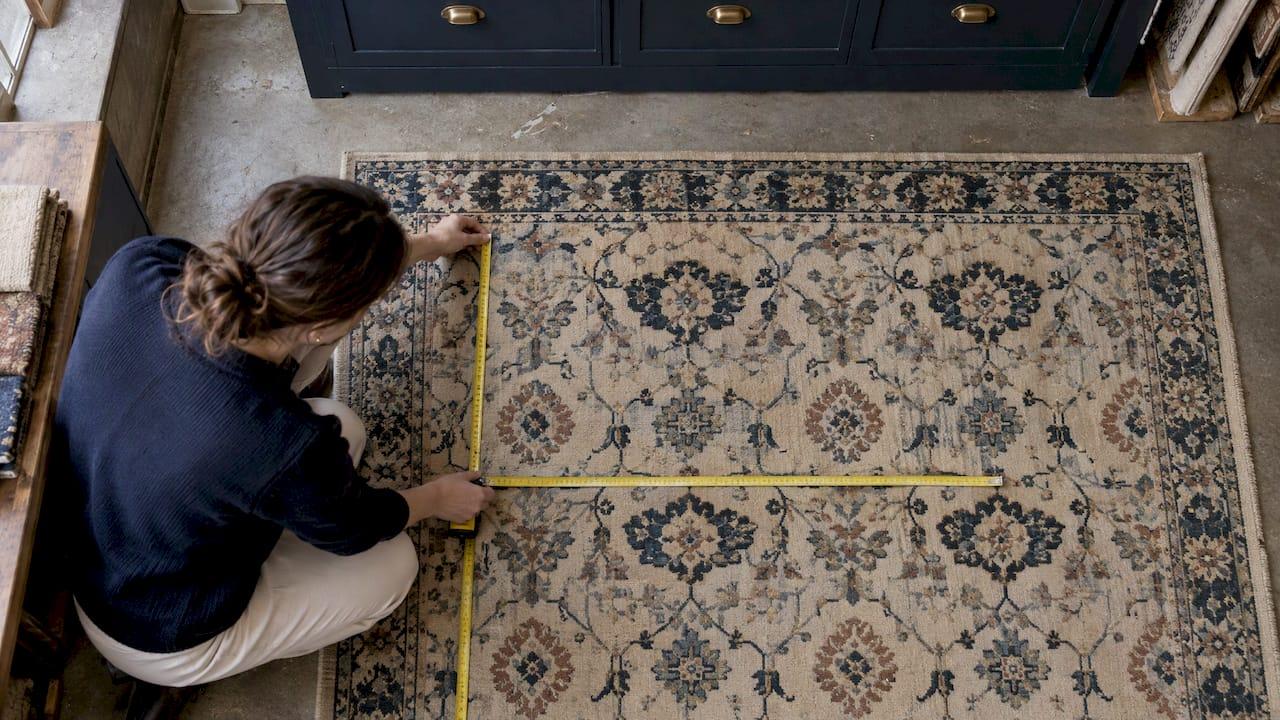
A rug pattern repeat is the distance at which a design begins again, measured across the width and down the length. It decides how a motif sits within the edges of the rug, how two widths meet at a seam, and how much extra material a made-to-order piece needs. Understand it early and a pattern looks intentional from every angle of the room. Ignore it and even the finest design can look slightly off.
TL;DR
- A repeat is the dimension of the basic pattern unit; the match describes how those units line up. Both are recorded in two directions: across and down.
- Straight (set) repeats line up side by side, while half-drop repeats shift every other column by half the repeat, so the design travels on the diagonal.
- Measure centre to centre, from one distinctive feature to the same feature in the same orientation, and write both figures down before you price anything.
- Large repeats, seams and half-drops all call for extra material, so allow for them at specification stage, not on delivery.
- For bespoke rugs, choose the finished size and the repeat together, so the pattern is complete at every edge.
Table of Contents
- What a pattern repeat actually is
- The main types of repeat
- How to measure a pattern repeat
- How repeat shapes size and proportion
- Seams, extra material and installation
- What designers should check before specifying
- A worked example
- Our perspective
- Commissioning a rug with the repeat in mind
- Explore our trade rug collections
- FAQ
- Sources
What a pattern repeat actually is
The trade's own vocabulary is useful here, because it keeps specifications unambiguous. The Carpet Council's glossary defines repeat as the dimensions of the basic pattern unit in any patterned carpet, and match as the arrangement and dimensions of the repeating units that make up the design. In plain terms: the repeat is the size of one complete "tile" of the design, and the match is the rule that governs how those tiles are laid next to one another.
It helps to hold two numbers in your head. The repeat across is how far the design travels from side to side before it starts again. The repeat down is how far it travels along the length. They need not be equal. A motif might be compact horizontally yet stretch generously along the length, which is why a single figure on a spec sheet is rarely enough.
Think of it as the rhythm of the rug. A small repeat creates a lively, fine-grained beat, with the same element returning again and again. A larger repeat gives a design room to develop: a branch can curve, a flourish can unfurl, a geometric figure can build before it resets. Neither is better; they simply suit different rooms and different intentions.
Why it matters for a rug rather than a wall
Pattern repeat is a concept borrowed from printed and woven textiles and wallcoverings, where it is a daily concern. On a rug it matters in three quite practical ways:
- Composition. The repeat determines whether the edges of the rug cut through motifs or finish on a complete one.
- Joins. Wider rugs and fitted pieces are often made in more than one width, and the repeat determines whether the pattern continues cleanly across the seam.
- Quantity. Matching a pattern uses more material than a plain surface of the same area.
The Carpet Council notes that repeat dimensions and match matter to specifiers and purchasing agents precisely because they influence the amount of excess carpet needed in multiple-width installations. That is the point of the whole exercise: a repeat is not only a design detail, it is a line in the budget.
The main types of repeat
When a designer asks, "What kind of match is it?", they usually mean one of the two arrangements below. A few other layouts appear in rug design, covered further down.
Straight (set) repeat
In a straight repeat the motif sits in evenly spaced rows and columns, so the same element appears at the same height on every column. The Carpet Council describes a set match as a pattern repeating straight across the width, perpendicular to the length. The CFI carpet installation binder puts it similarly: the pattern continues straight across the breadth at a right angle to the edge.
The effect is tailored and orderly. Straight repeats are the easiest to align at a seam, because whichever width you lay next to another, the same point of the design meets at the same height. They suit formal schemes, symmetrical rooms and anywhere you want a calm, architectural rhythm.
Half-drop repeat
In a half-drop, every other column is shifted down by half the repeat length, so the design travels diagonally rather than horizontally. Villa Nova explains that a half drop moves alternate horizontal repeats down by half their length, which means allowing extra material and cutting with care, as each cut starts at the half repeat. The Carpet Council's term is drop match, where each corresponding element drops by half a repeat in length. According to the CFI binder, a drop match generally gives a larger-scale effect that often enhances a diagonal alignment across the width.
Visually, a half-drop is softer and more fluid. Motifs no longer stack in obvious rows, which makes the pattern feel more organic and often hides the geometry of the grid altogether. It is a favourite for botanical and trellis designs.
Other layouts you will meet
Rug designers also talk about mirrored repeats, where a motif is reflected horizontally, vertically or diagonally, and tossed repeats, where motifs sit in a looser, less ordered arrangement. These are design descriptions rather than installation terms, but they raise the same practical question: where does one unit end and the next begin, and what happens at the edges?
| Repeat type | How it behaves | Typical effect | Planning note |
|---|---|---|---|
| Straight (set) | Same point of the design at the same height across the width | Tailored, structured | Simplest to match at a seam |
| Half-drop | Alternate columns shift by half the repeat | Fluid, diagonal movement | Allow extra length; cuts start at the half repeat |
| Mirrored | Motif reflected across an axis | Symmetrical, ornamental | Check where the mirror line falls in the finished size |
| Tossed | Motifs scattered without a strict grid | Relaxed, informal | Usually more forgiving at edges |
How to measure a pattern repeat
Whether you are looking at a sample, a photograph of an existing rug or a design proposal, the method is the same. Pick an anchor: a distinctive element that appears more than once, such as a flower head, a diamond or a particular knot of line work. Then:
- Place a flexible tape at the exact centre of the anchor.
- Follow the grid across until the identical feature reappears in the same orientation. That is your repeat across.
- Do the same along the length. That is your repeat down.
- Measure centre to centre, not edge to edge. Edges vary with the shape of the motif; centres do not.
If the design is a half-drop, find the next identical motif in the same column rather than the nearest similar one, and note separately that the neighbouring column is offset by half. It is a small detail that saves a good deal of confusion once a pattern is handed to a maker.
Record both figures, the type of match and the unit of measurement in the specification. Many disputes about a pattern "not lining up" begin with a number that was never written down.
How repeat shapes size and proportion
The happiest rugs are those where the size was chosen with the repeat in mind. A simple test: divide the finished width and length by the repeat across and repeat down. If the result is close to a whole number, the pattern will finish on a complete motif at the edges, which tends to look composed and deliberate. If it lands on a fraction, the edge will cut through a motif. That is not necessarily a flaw, since many all-over designs are meant to feel as though they continue beyond the border, but it should be a decision rather than a surprise.
Symmetry raises the stakes. If you want a centred medallion or a perfectly balanced field in a custom piece, the repeat must work with the total dimensions. For all-over designs, by contrast, the pattern repeats a motif across the entire surface with no dominant centre, which tends to feel calmer in a room and is more tolerant of an edge that falls mid-motif. Classic all-over patterns such as herati, boteh and mina-khani follow this logic, as Arsh's rug glossary describes.
Spacing matters just as much as the motif. Closely set elements produce a dense, decorative surface, while generous gaps make a design feel open and easy to coordinate with patterned upholstery and curtains. When you are balancing a rug against other patterns in a scheme, the scale of the repeat is usually a better guide than the colour.
For sizing the rug itself, our rug size guide covers how to relate a rug to furniture and walkways. Once you know the dimensions you want, compare them with the repeat before you commit. If the room is irregular, our notes on irregular rug shapes explain how to template the space, and the same thinking applies to where a motif falls on a curve.
Seams, extra material and installation
When a floor covering needs more than one width, matching the pattern across the join takes more material. Flat figures can hide this: two rooms with exactly the same floor area can need different quantities of patterned material, because the repeat and the layout drive the waste, not the area alone.
For wall-to-wall patterned carpet, the American Carpet Installation Standard (CRI) states that patterned carpet may require additional material for proper pattern matching and should be unrolled and left to relax for at least 24 hours before installation. The same standard also notes that carpet is a textile subject to processing variations, such as bow, skew and elongation, and that there is no industry-wide standard for pattern variation: individual manufacturers set the tolerances their patterned products must meet. The practical lesson for a specifier is to ask the maker for their stated tolerance rather than assuming one.
The CFI binder gives working limits that installers use as a guide: it advises not cutting or installing carpet if skew is greater than 1.5 inches in a 12-foot width, or bow greater than 1 inch in a 12-foot width, among other measures (CFI installation resource). These are US guidelines, quoted in imperial units, and are useful mainly as an indication of how tightly pattern alignment is judged.

Stairs, landings and adjoining rooms
Continuity gets harder when a pattern must travel. A staircase with winders is unlikely to keep a pattern lined up as it descends, whereas half or quarter landings give a better chance of a clean match. Where rooms open into one another, the way the pattern runs through a doorway needs deciding before cutting, not after. If you are testing how a run of stairs or an open-plan layout will read before anything is made, a 3D floor plan visualisation can help you see where pattern direction and joins will fall in the finished space.
For a hand-made rug, which is usually a single piece rather than a fitted covering, much of this anxiety falls away. The repeat becomes a design variable inside one object, which is where bespoke work comes into its own.
What designers should check before specifying
A short checklist, in the order it is best asked:
- Repeat across and down. Both figures, centre to centre, written on the specification.
- Type of match. Straight, half-drop, mirrored or tossed, so everyone reads the pattern the same way.
- Finished dimensions against the repeat. Does the pattern finish on a full motif, and does that matter for this room?
- Seams. If the rug or covering is made in more than one piece, how is the match handled, and what extra length does that need?
- Tolerance. What variation does the maker consider acceptable, and how is it measured?
- Construction. Fine, curved motifs need density to read cleanly. Pure Rug notes that stylised curved patterns need a higher knot density to look smooth rather than angular, while geometric patterns, built of straight lines, are common at lower densities. Our guide on cut versus loop pile shows how surface texture changes the way a pattern reads.
- Lead time. Larger or more complex repeats can mean more design and weaving time, so check custom rug lead times early.
The veneer world has a close cousin to this thinking. Matching grain across panels follows the same logic as matching a repeat across a seam, and our comparison of bookmatched and slip-matched veneer is a useful companion if your scheme combines furniture and rugs.
A worked example
Imagine a drawing room where you want a rug with a half-drop botanical design. The sample shows the motif repeating every 90 cm across and every 120 cm down, with alternate columns dropped by 60 cm. These figures are illustrative, not from any collection.
The room calls for a rug 360 cm wide. Divided by the repeat across, that is exactly four full repeats, so the pattern finishes on a complete motif at both side edges, and the composition feels symmetrical. For the length, 480 cm gives four repeats down, also whole. Both figures are tidy, but the half-drop means the columns are offset: the left edge shows one phase of the motif, and the neighbouring column shows the other.

If you chose 350 cm by 470 cm instead, the pattern would be cut slightly short at every edge. That may be perfectly acceptable for an all-over design that is meant to feel as though it continues, but you would want the border, if any, to be designed to cope. Either way, the choice is made on paper, with both figures to hand, rather than discovered when the rug is unrolled.
Our perspective
Most conversations about pattern repeat begin as a question about size and end as a conversation about composition. That tells you how closely the two are linked.
When we work with designers and architects on a commission, we like to settle the repeat and the finished dimensions together. A handcrafted piece is made to order, so there is no need to accept a size simply because a standard width demands it. The pattern can be scaled, the repeat adjusted and the proportions tuned until the motif sits in the room as though it had always belonged there.
For us, that is the real argument for bespoke. Mass-produced floorcoverings bend the design to the loom; a made-to-order rug lets the design lead. Our trade collections of made-to-order rugs and mirrors come with tailored designs and dimensions for exactly this reason, and we are always happy to talk through the repeat, the scale and the finish with you before anything is made.
Luke
Commissioning a rug with the repeat in mind
If you are planning something distinctive, the most helpful thing to bring to the first conversation is the room: its dimensions, its furniture plan and the other patterns already in play. From there, the repeat becomes a design decision. Our article on how to commission a bespoke piece and the more detailed custom rug design process set out what to expect, from first brief to finished rug.
It also helps to look at how others explain the choice of design. A well-written guide to choosing the perfect rug covers pattern, size and materials from the buyer's side, and gives a good grounding before you decide how bold the repeat should be.
Explore our trade rug collections
We offer trade-only collections of made-to-order rugs and mirrors from partner brands, including the Signature rug collection from Colbourns and the Ready to Hang collection from Simpsons London, with tailored designs and dimensions for interior designers, architects, homeowners and luxury hotels. Alongside them sits our handcrafted bespoke furniture, customisable in size and finish.
To discuss a pattern, a repeat or a set of dimensions for your next project, visit Simmons Interior Supply and speak to us about your brief.
FAQ
What is a repeat pattern called?
The trade term is simply the repeat: the dimensions of the basic pattern unit. How those units line up is called the match, as the Carpet Council glossary defines it. You will also hear "set match" for a straight arrangement and "drop match" for a diagonal one.
What is the difference between a straight and a half-drop repeat?
In a straight repeat, the same point of the design sits at the same height across the width. In a half-drop, every other column is dropped by half the repeat, so the design runs diagonally, as Villa Nova explains. Half-drops feel more fluid but call for extra material and careful cutting when pieces are joined.
How do I measure a rug's pattern repeat?
Choose a distinctive motif, then measure from its centre to the centre of the same motif in the same orientation, first across the width and then down the length. Always use centre-to-centre rather than edge-to-edge, and record both figures along with the type of match.
Does pattern repeat affect how much material a rug needs?
Yes, where pieces are joined or a pattern must be aligned, matching uses additional material. The CRI installation standard notes that patterned carpet may need extra for proper matching. A single made-to-order rug lets the repeat be planned inside the finished size.
Sources
- Glossary, The Carpet Council
- Frequently Asked Questions, Villa Nova
- CFI Carpet Installation Resource Binder
- CRI Carpet Installation Standard 2011
- Rug Encyclopedia: Persian and Oriental Rug Glossary, Arsh's Rugs
- Types and Designs of Rugs, Pure Rug
- 3D Floor Plans, Visualtrick
- The Art of Choosing the Perfect Rug, Silver Sydney