
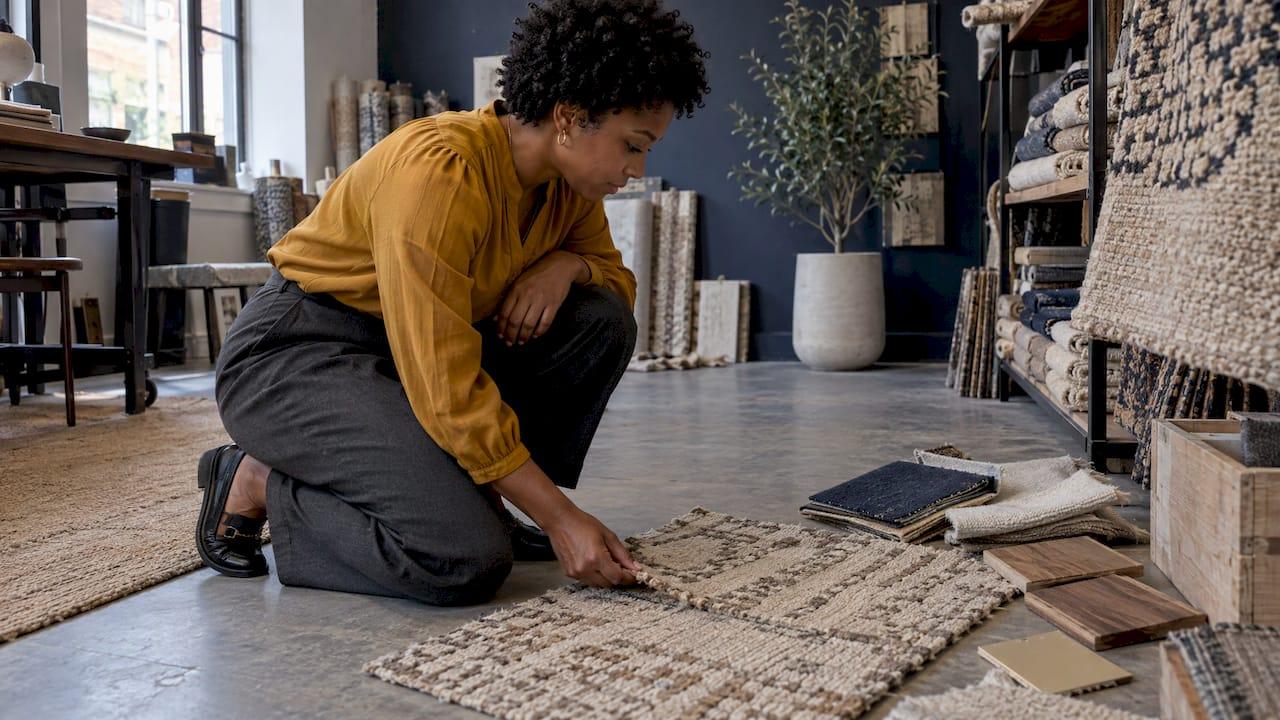
In interior design, a rug strike-off is a small sample of a custom rug, made by the method and in the yarns that will be used for the finished piece, so you can approve colour, pile and pattern before production begins. It is the point at which a rendering becomes a real object, and the point at which most of the risk in a bespoke rug is either removed or locked in. For designers, architects and hospitality buyers commissioning through our trade collections, understanding the strike-off is the difference between a rug that arrives exactly as imagined and one that is merely close.
A note on the search itself: if you arrived looking for the Companies House process, where a company is struck off the register, that is an entirely different matter, and GOV.UK explains how a limited company is struck off. The rest of this article is about rugs.
TL;DR
- A strike-off is a sample of a custom rug made in the real yarns and construction, approved before the full rug is made.
- It proves what a rendering cannot: how colour, pile height, texture and pattern scale behave in fibre and in your room's light.
- Judge it on site, beside your actual upholstery, stone, timber and curtains, in daylight and in the evening.
- Plan for at least one revision, and build the extra time into the programme before you promise a date to your client.
- Once you sign it, the finished rug is made to the strike-off, not to the rendering, so approve it with care.
Table of Contents
- What a strike-off actually is
- Why the rendering is not enough
- What to send before a strike-off is made
- How to review a strike-off, step by step
- Revisions are normal, and worth planning for
- Time and cost: what to build into the programme
- Multi-phase and hospitality projects
- Our perspective
- Bringing your rug brief to us
- FAQ
- Sources
What a strike-off actually is
The word comes from the trade. A strike-off is a physical sample, usually a modest square or a section showing a corner and border, produced in the same way as the final rug: hand-tufted, hand-knotted or woven, with the chosen yarns, pile heights and backing. Its purpose is narrow and valuable. It tests the decisions that a screen cannot settle.
Those decisions tend to be the following:
- Colour relationships. How one shade sits beside another once each is dyed into wool, silk or viscose, rather than printed on paper or glowing on a monitor.
- Pile and texture. Whether a cut pile reads plush or flat, whether carved or sculpted detail casts enough shadow, how a loop differs from a cut surface.
- Pattern scale. Whether a motif that looked graceful in the artwork feels too large or too timid at finished size.
- Technical details. Edge, border, density and how the piece lies on the floor.
Think of the stages as three separate proofs. The rendering proves the idea. The strike-off proves the execution. The finished rug is then made to the approved strike-off, which becomes the reference against which the bulk piece is inspected.
Why the rendering is not enough
Colour shifts at every step between concept and floor: from the pixels on your screen, to the printed proof, to dyed fibre. A rendering also cannot show pile depth, the way a lustrous yarn changes when viewed from the opposite direction, or how a texture breaks up light across a room.
This matters most in hospitality and high-end residential work, where a rug sits within a carefully balanced scheme. A grey that is a shade too cool against warm oak, or a feature colour that disappears at room scale, will be seen immediately by a client who has paid for a bespoke piece. Catching it on a small sample is far cheaper than catching it on a finished rug.
One honest limit is worth understanding too. A strike-off is a small area, so it cannot fully show how a large design reads across a whole room or how a repeat moves over distance. Approve it alongside the final artwork, dimensions, colour references and production notes, and treat the set as one decision.
What to send before a strike-off is made
The quality of a strike-off follows the quality of the brief. Whatever stage your design has reached, gather what exists:
- The artwork or drawing, ideally a CAD or vector file showing the intended finished size, with fixed elements such as border widths marked.
- Colour references. A fabric or paint swatch, a Pantone or NCS reference, or the yarn colours your scheme already uses. Colours are matched by eye and approved in the hand, so physical references beat digital ones.
- A physical cutting if you are matching an existing floor or finish. A photograph cannot carry colour reliably.
- The finished dimensions and room plan, including any irregular outline. Our guide to irregular rug shapes shows how to measure and template an unusual footprint.
- Border and edge intentions. Our rug border options guide covers the finishing choices worth deciding before sampling, since the border is often what the strike-off must prove.
If you are earlier in the process and still deciding what to commission, our guide to commissioning a bespoke piece sets out the stages from first idea onward, and our explanation of the custom rug design process shows where sampling sits within it.
How to review a strike-off, step by step
A good review is a short, disciplined exercise. Do it once, properly, rather than glancing at the sample in the studio and signing from memory.
Step 1: Decide what is still open
Before the sample arrives, write down the questions it must answer. Is it colour matching? Pile height? The softness of the fibre? Whether a feature colour shows at room scale? A sample that answers the questions most likely to affect your specification is more useful than a larger one that answers none of them. A clear brief stops sampling becoming a collection of attractive but inconclusive options.
Step 2: Take it to site
Hold the strike-off, flat on the floor if you can, beside the materials it will live with: upholstery, timber, stone, wallcovering, metalwork and curtains. Look at it in morning daylight, in the evening and under the room's own lamps. Some colours match under one light and drift apart under another, a phenomenon known as metamerism, so one viewing is never enough.
Step 3: Compare against the colour references
Hold the original yarn samples or swatches against the matching areas of the strike-off under neutral light. Check each colour in turn, then check how neighbouring colours influence one another, because a shade that is right alone can look wrong beside another.
Step 4: Check pile, texture and construction
Run a hand across the surface. Press and release to see how the pile recovers. Turn the sample 180 degrees and watch how a lustrous fibre changes its reflection. Look at carved or recessed detail, at the edge, and at whether the sample lies flat. For hospitality specifications, density and construction matter as much as appearance, and our guide to hotel rug durability specifications explains the figures procurement teams usually write into a brief.

Step 5: Judge scale
A motif that works on a small sample may feel different at final size. Look at the approved artwork at its true dimensions, perhaps taped out or printed at scale on the floor, and ask whether the sample's pattern will carry across the room. Our rug size guide helps you test proportions against furniture and walls.
Step 6: Decide, record and seal
Approve it, request a change, or ask for a second sample. Record exactly what you approved, with notes on any tolerances, and keep the signed sample. A handmade rug carries a small, accepted dimensional and tonal variation, and the aim of sampling is not to remove all natural variation but to confirm that the design is resolved enough for production and that everyone signing understands what the sample does and does not represent.
For a repeatable way of recording sign-off, our finish sample approval templates give designers a format for locking specifications at procurement.
Revisions are normal, and worth planning for
If a colour is a shade off, a motif too small or a pile too high, the sample is adjusted and made again. That is the process doing its job, not a failure. One revision is common and sensible to allow for. If you find yourself needing two or three, it usually means the rendering was approved too quickly, or that you are matching an existing colour, which tends to take more rounds than a fresh design.
Sometimes a single colour swap on an otherwise correct design can be approved from a yarn sample alone, saving a full re-make. Ask whether that is possible before assuming another round is needed.
Make revision decisions at the sample stage wherever you can. A colour that is too cool, a line that needs more contrast, or a texture that needs adjusting is quicker and cheaper to correct on a small sample than on a full-size rug.
Time and cost: what to build into the programme
Custom work should never be scheduled like an off-the-shelf accessory. The strike-off adds a stage, and each revision adds another. Construction matters: a loom-woven sample generally takes longer than a tufted one because equipment must be set up for the design, and any sample travelling internationally adds courier days.
On cost, digital layouts and yarn samples are commonly free, while a physical strike-off may carry a modest fee that is often credited against the order if the project proceeds. A second sample caused by a change of mind on the design side may be charged again. Confirm the terms in writing at the quotation stage rather than discovering them at invoicing.
We have written about both subjects in more detail. Our guide to custom rug lead times helps you plan the whole schedule, and our guide to custom rug prices and specifications for UK designers will help you avoid surprises at invoice. When several people must sign off on samples, a shared approval workflow for project teams keeps decisions from stalling between designer, client and procurement.

Multi-phase and hospitality projects
Hotels and large residential schemes raise one particular issue: rugs ordered in phases must match each other. The most reliable approach is to have the programme's yarn dyed in a single lot at the outset and stored for later phases. Where that is not possible, agree a sealed master standard held by both sides, set a numerical colour tolerance and the lighting under which it is judged, and plan installation so that rugs from different batches never meet in one space.
For these projects the strike-off becomes the contractual reference. Treat it with the same formality as a signed drawing.
Our perspective
We think of the strike-off as the most honest moment in a bespoke commission. Everything before it is intention; everything after it is consequence.
Our work is built around handcrafted pieces made to order, with sizes and finishes adjusted to the room, and a close collaboration between designer, client and artisan. That collaboration is at its best when the sample is treated as a conversation rather than a formality: hold it against the stone, the linen and the walnut, look at it as the light goes, and say plainly what you see.
For designers and architects we offer trade-only collections of made-to-order rugs with tailored designs and dimensions, and we are always happy to work with you on a brief. Our view is simple: a rug made to an approved sample, specified with care, is what lets a scheme feel resolved rather than approximate.
Luke
Bringing your rug brief to us
If you are specifying a rug for a residential scheme, a hotel or a project of your own, our trade collections include the Signature rug collection from Colbourns and the Ready to Hang collection from Simpsons London, both available as made-to-order pieces with tailored designs and dimensions. Alongside them we make bespoke furniture by hand, so rugs, mirrors and furniture for a single interior can be considered together. Trade customers can access the collections through an account. Begin at the Simmons Interior Supply website with your drawings, references and finished dimensions.
If you would like to know more about who we are and how we work with artisans, read our story.
FAQ
What does rug strike-off mean in interior design?
It is a small sample of a custom rug made in the actual yarns, colours and construction before the full rug is produced. You approve it to confirm that colour, pile, texture and pattern work as intended. The finished rug is then made to match the approved sample.
How big is a rug strike-off?
Sizes vary with the maker and the construction. Often it is a modest square or a section showing a corner and border, large enough to show pile and pattern repeat. For a small piece such as a runner or bedside rug, a full-size sample can sometimes be more useful because it also proves the finished dimensions and edge.
How many revisions should I expect?
One revision is common and worth allowing for in your programme. Matching an existing colour can take more. If you are repeatedly revising a fresh design, revisit the brief and the rendering before the next sample, since the cause usually lies there.
Is a strike-off the same as a yarn pom or a digital proof?
No. A digital proof shows the layout, and yarn poms (small bundles of dyed yarn) show individual colours. A strike-off combines the yarns, construction and pattern into one object, so it is the only stage that shows how everything behaves together.
Can I skip the strike-off to save time?
On a handmade, custom piece we would not advise it. The sample is what protects the rest of the schedule from a rug that needs to be remade. A faster route is a clear brief and a well-organised sign-off, rather than removing the proof.