
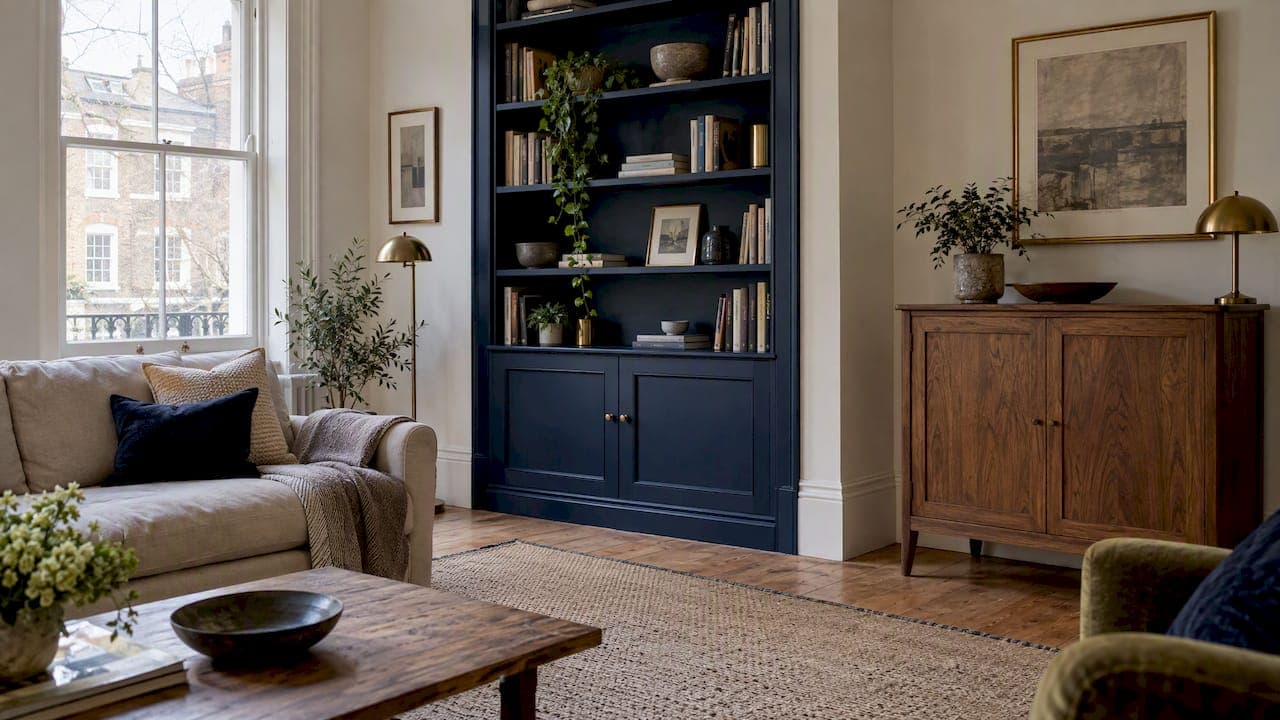
Built-in furniture is made for one room and stays there; freestanding furniture is made as an object in its own right and moves with you. Built-in pieces win on storage, fit and a seamless finish in awkward spaces. Freestanding pieces win on flexibility, character and the ability to change your mind. The right answer depends on the room, how long you will keep it and how much of the budget the piece deserves. This guide walks through each point, from the vocabulary to the cost, with a view from the workshop side.
TL;DR
- Built-in (or fitted) furniture is fixed to the room and uses alcoves, eaves and recesses that a standard piece cannot; the trade-off is permanence and a higher cost.
- Freestanding furniture can be moved, restyled and taken with you, and it can divide an open-plan room as well as fill it.
- Bespoke work can sit between the two: a made-to-order freestanding piece cut to your exact dimensions and finish, without fixing it to the building.
- Guide costs for custom-built joinery in the UK start at around £300 per square metre and can pass £1,200 per square metre for hardwood and special finishes.
- Choose built-in for irregular rooms you will stay in; choose freestanding or made-to-measure freestanding where flexibility, a rental or a changing scheme matters.
Table of Contents
- What the terms actually mean
- How they differ in appearance and use of space
- Weighing the advantages and drawbacks
- What it costs in the UK
- Which suits which project
- The middle path: made-to-order freestanding pieces
- Our perspective
- Bringing it to life with Simmons Interior Supply
- A short checklist before you decide
- A note on appliances
- FAQ
- Sources
What the terms actually mean
The vocabulary is used loosely, and that is the first source of confusion. Retailers, joiners and designers do not always draw the same lines, so it helps to think in terms of what physically happens to the piece.
Freestanding furniture stands on the floor, is not attached to the structure of the building and can be lifted out when you leave. A dining table, a sideboard, a console, a bookcase on its own legs: all freestanding.
Built-in furniture is constructed to suit a specific space, usually by a joiner working to measured drawings, and is fixed to the walls, floor or ceiling. Think of shelving that fills a chimney-breast alcove, a window seat with storage beneath, or a wall of cabinetry finished to match the panelling.
Fitted furniture is the term most often used for storage that is made to measure and installed floor to ceiling, particularly wardrobes. In everyday UK use, "fitted" and "built-in" often overlap. If someone quotes you for either, ask exactly what is being made, where it is made and how it will be fixed. The answer matters more than the label.
There is also a useful middle ground that the usual two-way debate misses. A made-to-measure freestanding piece is built to your dimensions, in your finish, but stands on its own. We cover that in detail below, and our guide to made-to-measure furniture meaning sets out how the term is used in practice.
How they differ in appearance and use of space
Built-in: the room appears to have been designed around it
Built-in furniture reads as architecture. Because there are no gaps at the sides or the top, the eye registers a clean plane rather than an object placed against a wall. Doors, skirting and cornice can be run through from the room into the joinery, and the piece takes on the proportions of the space instead of competing with them.
The practical gain is capacity. Fitted furniture makes use of awkward areas such as alcoves, sloping ceilings and recesses that would otherwise go to waste around standard-sized units. The same Homebuilding feature cites an average of around 40% more storage from fitted wardrobes than from one-size-fits-all freestanding designs, by working both vertical and horizontal dimensions. That is an average for wardrobes specifically, not a promise for every room, but it shows the scale of what a precise fit can recover.
The advantage is greatest in small or irregularly shaped rooms. Realtor.com's reporting on custom joinery makes the same point from the American market: built-ins are especially transformative in odd-shaped rooms, where they create high-end, functional storage in nooks that were previously unusable.
Freestanding: presence, character and flexibility
Freestanding furniture has a different strength. It is seen from all sides, it has legs, a silhouette and a shadow, and it can be the sculptural centrepiece of a room. A refectory table with an expressive base, a cabinet that stands proud of the wall, a pair of consoles flanking a doorway: these are pieces you look at, not through.
Freestanding furniture can also do structural work in a room without any building work. In open-plan spaces, a freestanding unit can act as a pseudo wall, marking out living, dining or working zones while leaving sightlines and light intact. A fixed built-in cannot be repositioned once the scheme changes; a freestanding piece can.
Weighing the advantages and drawbacks
| Consideration | Built-in / fitted | Freestanding |
|---|---|---|
| Storage in awkward spaces | Excellent: made for alcoves, eaves and recesses | Limited: standard sizes leave gaps |
| Visual effect | Seamless, architectural | Characterful, object-like |
| Moving it | Fixed; generally stays with the property | Moves with you |
| Changing the scheme | Difficult and often costly | Straightforward |
| Cost | Higher, because it is made for one space | Wider range, from mass-produced to bespoke |
| Installation | Measured, made and fitted on site | Delivered and placed |
| Best suited to | Long-term homes, period properties, fixed hotel layouts | Rentals, open-plan rooms, evolving schemes |
The permanence of built-in furniture is its single largest drawback. Once installed it is typically immovable and cannot come with you when you move home. If you plan to stay for a decade, that is hardly a cost at all, because the piece is doing its job every day. If you expect to move within a few years, you are paying for an asset you cannot take.
Freestanding furniture's drawback is the mirror image: it never quite belongs to the room unless it has been chosen or made with care. Standard dimensions leave gaps at the sides and above, dust-catching voids, and awkward corners that no off-the-shelf piece fills.
What it costs in the UK
Cost is where the comparison is easiest to get wrong, because the two options are rarely like for like. A mass-produced freestanding bookcase and a hand-finished hardwood built-in are different categories of object.
The broad pattern is clear. Bespoke furniture and fittings command a premium price for a unique design made to precise requirements. Grand Designs magazine's buyer's guide gives an indicative range for custom-built storage: a simple design in softwood or MDF may cost upwards of £300 per square metre, while hardwood, special lacquers and finishes can take that above £1,200 per square metre. Treat these as guide figures, not quotes: your final price will turn on the complexity of the design, the joinery details, the species and the finish.
Several factors move a price in either camp:
- Material. Painted MDF, veneered board and solid timber are very different budgets. Solid hardwood costs more to buy and more to work.
- Finish. Hand-applied lacquers, stains, metal details and bespoke colour matches add time. Our guide to custom finish options explains how to specify them without surprises.
- Complexity. Integrated lighting, concealed hinges, curved fronts and bespoke hardware all add hours in the workshop.
- Access and installation. Built-in work needs accurate site measurement, and walls in older buildings are rarely straight. That is allowed for in the making and the fitting.
For a deeper view of how bespoke is priced, see our bespoke furniture cost guide for the UK. If a scheme has to flex to a tighter number, value engineering can often protect the look while adjusting construction and materials.
Which suits which project
Homes
In a period house with chimney-breast alcoves, a sloping attic ceiling or an awkward stair landing, built-in joinery is hard to beat. Nothing off the shelf will sit comfortably in those spaces, and the best joinery makes the room look as though it was always meant to be that shape.
In a rented flat, a house you expect to leave in a few years, or a room that serves several functions over time, freestanding furniture is the sensible choice. The same applies to dining rooms, where the table is the heart of the room and you may want to rotate, extend or replace it as your household changes.
Ask yourself three questions:
- How long will I be here? Under five years points to freestanding; ten or more favours built-in.
- Is the room regular? Square rooms with straight walls are well served by freestanding pieces. Irregular ones are where built-in earns its cost.
- What does the piece have to do? Storage-heavy needs, such as wardrobes, media walls and boot rooms, reward fitting. Display and gathering pieces, such as tables, consoles and sideboards, usually reward freestanding design.
Hotels and hospitality
Hospitality changes the calculation. A guest room is a fixed-layout environment, repeated across many rooms, used hard and refurbished on a cycle. Built-in headboard walls, luggage units and desk-and-wardrobe runs make sense where the layout will not change and cleaning access, durability and consistency matter. Freestanding pieces make sense in lobbies, lounges, restaurants and suites, where the layout has to adapt to events, seasons and re-planning.
Specifiers weighing the two will find our guide to making hotel furniture design last ten years helpful, particularly on construction, finishes and maintenance. Accessibility also shapes the decision: clear floor space, reachable storage and circulation widths are easier to plan in fixed joinery but need care in freestanding layouts. Our piece on accessible furniture design covers this.
Architects and designers
For trade professionals, the choice is often about coordination. Built-in work needs early drawings, site dimensions and a clear interface with the building trades. Freestanding work needs less coordination but still benefits from precise specification. In both cases, good CAD drawings are the document that stops a project drifting.
The middle path: made-to-order freestanding pieces
The debate is usually framed as a binary, but the most useful option for many projects is neither. A freestanding piece made to order, to your exact size and finish, gives you much of the fit of built-in furniture without the permanence.
Consider a sideboard that must span a wall between two windows. A standard model leaves a gap at each end; a made-to-order piece is cut to the width, set at the right height for the sill and finished to match the room. Or a dining table that has to seat a specific number in a room of a specific length. Or a sofa sized to the exact depth of a bay. When you move, these pieces go with you. When the scheme changes, they can be repositioned.

This is the territory we work in. Handcrafted pieces, produced with skilled artisans and tailored in size and finish, let a designer solve a spatial problem without committing the building. Our guides to commissioning bespoke furniture and bespoke sofas show how that process runs from brief to delivery.
Our perspective
We are asked this question regularly, and our answer is seldom one or the other. In our experience, built-in joinery is right when the room itself is the problem: the alcove that wastes a metre, the eaves that swallow a bedroom. Freestanding is right when the object itself is the point: a table you will gather around, a cabinet with presence, a piece with a sculptural base that deserves to be seen from every angle.

What we try to do is remove the compromise that comes with standard sizes. Every piece we make is handcrafted to order, and because size and finish are adjustable, a freestanding piece can be made to belong to a room as convincingly as fitted work does. We work with designers, architects, hospitality teams and homeowners, and the most successful projects begin with a conversation about how the room is used, long before anyone chooses a finish.
We would also say this plainly: if a fixed built-in is the right answer for your space, we would rather you chose it than force a freestanding piece into a role it does not suit. And if you are unsure, bring us the drawings, the dimensions and the problem, and we will say honestly which route we think serves the room.
— Luke
Bringing it to life with Simmons Interior Supply
If your project calls for a piece that fits precisely but travels with you, our bespoke furniture collection is made to order in the size and finish you specify, with trade access for designers, architects and hospitality buyers. Browse the bespoke furniture collection to see the range, or look at the gallery for examples of finished work.
Alongside furniture, we offer trade collections of made-to-order rugs and mirrors from partner brands, which help finish a room whose joinery is already fixed. A bespoke piece such as our nest of coffee tables shows how a small freestanding design can flex around a seating layout. For rugs cut to a particular room, see our guide to custom rug design.
A short checklist before you decide
- Measure the room, then measure it again. Note any out-of-square walls, radiators, sockets and window reveals.
- Decide the lifespan. Be honest about how long you expect to stay, or how often the layout will change.
- Separate storage from display. Put hard-working storage into fitted work and keep expressive pieces freestanding.
- Set a budget per metre or per piece. Use the guide ranges above to test it before you brief anyone.
- Ask for drawings. Whether built-in or freestanding, approve scaled drawings with dimensions, materials and finishes before anything is made.
- Plan the interface. Skirting, flooring, lighting and ventilation all meet built-in work. Decide who coordinates them.
A note on appliances
Many people searching this phrase mean kitchen appliances, where "integrated" and "freestanding" describe ovens, fridges and dishwashers. The same logic carries across at a general level: integrated units sit behind cabinet doors for a seamless run and are tied to the kitchen's design, while freestanding units are easier to move and replace. For specifications, sizes and running costs, check the manufacturer's data for the exact model you are considering. This guide concentrates on furniture, where the choice shapes the character of the room.
FAQ
Is built-in furniture better than freestanding?
Neither is better in every case. Built-in furniture is stronger on storage and fit in irregular rooms, while freestanding furniture is stronger on flexibility and presence. Choose according to the room, how long you will stay and what the piece needs to do.
What is the difference between fitted and built-in furniture?
The terms overlap in everyday UK use. Both describe furniture made for a specific space and fixed in place, with "fitted" most often used for wardrobes and floor-to-ceiling storage. Always ask a supplier to describe exactly how a piece is made and installed rather than relying on the label.
Does built-in furniture add value to a home?
It can appeal to buyers where it solves a real storage problem, but it is not guaranteed to add value and is not a substitute for a valuation. Quality of design and finish matter more than the simple fact that something is fixed. A local estate agent is the right person to advise on your own market.
Can I take built-in furniture with me when I move?
Generally not. Built-in and fitted furniture is usually immovable once installed and stays with the property. If portability matters, a made-to-order freestanding piece gives you a precise fit that you can take with you.
How much does bespoke built-in furniture cost in the UK?
Guide figures from Grand Designs magazine put simple custom-built storage at upwards of £300 per square metre, rising above £1,200 per square metre for hardwood and special finishes. Your price depends on design, materials and installation, so ask for a written quotation.
Sources
- Fitted wardrobes vs freestanding wardrobes, Homebuilding
- How do you know when to go with built-in or freestanding furniture, Homes & Gardens
- Freestanding vs built-in furniture, The National
- Are custom built-ins worth it?, Realtor.com
- Built-in storage: a buyer's guide, Grand Designs magazine