
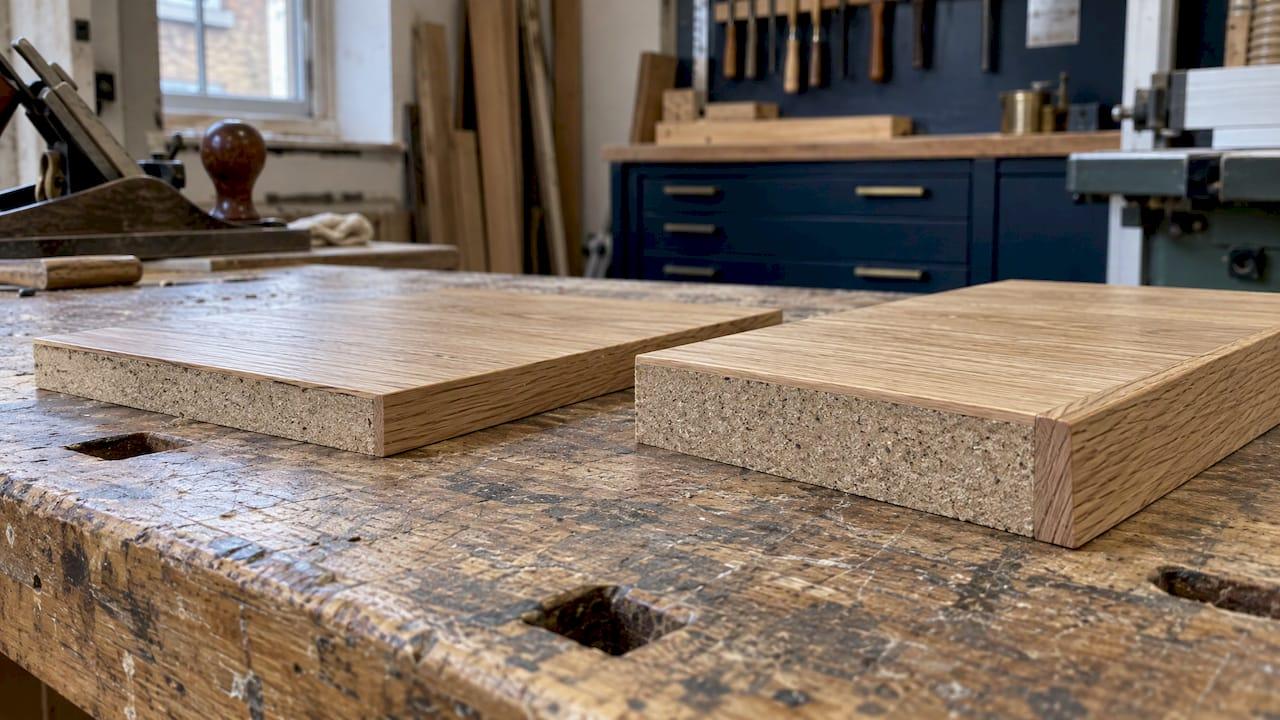
Edge banding is a thin strip, usually 0.5 to 2 mm, glued over the raw edge of a panel. Solid lipping is a thicker strip of real timber, typically 3 to 10 mm, fixed to the edge and then machined flush or shaped. Banding gives a seamless, efficient finish on veneered boards. Lipping gives an edge that can take knocks, be profiled and be refinished for decades. For a piece that will be handled daily, such as a dining table, a reception desk or a hotel console, solid lipping is usually the stronger specification. For shelves, carcase interiors and concealed panels, banding is the sensible choice.
TL;DR
- Edge banding is thin (0.4 to 2 mm), quick to apply and matches veneered MDF or plywood almost invisibly.
- Solid lipping is thick (typically 3 to 10 mm), can be profiled, sanded back and repaired, and suits edges that are touched every day.
- Choose by where the edge sits: exposed and handled means lipping; protected or hidden means banding.
- Lipping and banding both change the finished size of a panel, so say which you want before dimensions are fixed.
- On a bespoke commission, edge treatment is a design decision to settle at the start, alongside board, veneer and finish.
Table of Contents
- What each edge actually is
- Appearance: seamless versus solid
- Durability: where the edge gets hit
- Which boards take which edge
- How each edge is applied
- How to choose: a simple decision guide
- Common mistakes in specifying edges
- Our view as makers
- Commissioning a piece with the right edge
- FAQ
- Sources
What each edge actually is
A sheet of MDF, plywood or chipboard has a raw core. Left uncovered, it looks unfinished and absorbs moisture. Both banding and lipping solve that, but in different ways.
Edge banding is a thin strip supplied in rolls and applied to the edge of a panel. According to one UK supplier, oak veneer edging is typically 0.5 mm to 2 mm thick and is designed to match veneered sheet materials such as oak veneered MDF and plywood. Other materials are used too: PVC, melamine and ABS strips are common on cabinetry. A US woodworking magazine notes that veneer edge-banding is sold in rolls and comes in most of the species in which hardwood plywood is made, which is why it can match a veneered face so closely.
Solid lipping is a strip of solid timber, the same species as the face or a deliberate contrast. The same supplier gives typical lipping thicknesses of 3 mm, 5 mm, 6 mm or 10 mm, usually machined flush after fitting and often profiled or shaped. Because it is real timber with real depth, it can be rounded, chamfered or moulded in ways a 1 mm strip cannot. If you are choosing a profile, our guide to table edge profiles shows what each shape does to the look and feel of an edge.

Appearance: seamless versus solid
The visual difference matters most to designers and architects specifying a finished surface.
Veneer banding follows the face. One UK supplier says veneer edging gives a seamless appearance with consistent grain flow, whereas solid lippings may show different grain orientation, more colour variation and a more visible transition between face and edge. On a large, quiet surface such as a cabinet door in a book-matched walnut, that continuity is often the whole point. If your design leans on figured veneer, see our notes on bookmatched and slip matched veneer and on veneer types.
Solid lipping can be turned into a feature. A visible timber edge around a veneered top reads as deliberate joinery, a framing line, much like a picture frame. In a traditional or architectural scheme, a slim solid edge in a matching species gives the sense of a piece carved from a single timber. In a contemporary scheme, a contrasting species can sharpen the outline of a table or desk.
| Edge banding | Solid lipping | |
|---|---|---|
| Typical thickness | 0.4 to 2 mm | 3 to 10 mm |
| Look | Seamless, grain flows over the edge | Visible edge, can be profiled or contrasted |
| Impact resistance | Thin, can be damaged by severe knocks | Greater impact resistance |
| Repair and refinishing | Limited | Can be sanded, reprofiled and refinished repeatedly |
| Application | Faster, machine or hand applied | More preparation and machining |
| Best for | Veneered panels, shelves, concealed edges | Tabletops, desks, worktops, heavily handled edges |
The thickness and repair figures come from a UK supplier's comparison, and the 0.4 to 2 mm banding range is consistent with published manufacturer ranges.
Durability: where the edge gets hit
Edges take the most abuse in any piece of furniture. Chairs knock table edges, luggage hits hotel consoles, and cleaning equipment catches the bottoms of doors.
Thin banding sits on the surface of the panel. A veneer edging supplier says severe impacts can damage it, while solid timber edges offer greater impact resistance, durability and repair potential. A woodworking magazine adds that because iron-on veneer banding is thin, it is not suited to components that see heavy use, and since heat releases the glue it should not be used on pieces exposed to heat. That second point is worth remembering for a table near a radiator or a cabinet beside an oven.
Moisture is the other enemy. A UK Building magazine feature on whole-life costs describes delamination of surface finishes, leading to swelling of the base board, as a common failure in domestic kitchens, particularly at worktop and door edges. Its remedies include moisture-resistant boards, thicker edge lipping to doors and sealed worktop edges. The article is from 2000, but the mechanism has not changed: an edge that is thin, poorly bonded or unsealed lets water in.
The same feature compared kitchen units built to a housing consortium specification with all panels lipped in PVC against standard units. The fully lipped units cost the same at £776 per kitchen, had a 30-year service life against 20, and a lower net present value over 60 years (£939 against £1,131). These are year-2000 figures for PVC lipping in social housing kitchens, not for hardwood furniture, but they illustrate the principle: a more robust edge usually pays for itself over the life of the piece.

Which boards take which edge
Most bespoke furniture is built on a stable core, either MDF or plywood, with a veneer or paint finish. Our guide to MDF versus plywood in furniture explains where each belongs. The edge treatment follows from that choice.
- Veneered MDF or plywood: banding in the same species is the natural match. The supplier above describes oak veneer edging as designed to match veneered MDF and plywood.
- Plywood with attractive layers: the edge can be left exposed as a design feature, but it needs sealing, and it will not give the refined look of a timber edge.
- Painted or lacquered pieces: a solid lipping in a closed-grain timber takes paint cleanly and protects the corner. Our note on open grain versus closed grain wood helps you choose a species that finishes the way you want.
- Solid timber panels: these generally need no lipping, though a different species may be used for contrast.
A woodworking article on making lippings explains that lipping covers an unattractive substrate such as MDF, ply or solid wood of a different species, and that a tongue-and-groove joint (6 mm MDF or ply with a 6.5 mm groove) increases glue area and allows the lipping to be adjusted sideways during fitting. That detail is why a well-made lipping does not simply sit on the edge like a sticker: it is jointed into it.
How each edge is applied
You do not need to apply either yourself, but knowing the process helps you judge a specification.
Banding is usually machine-applied in production. The HSE's guidance on board-edge processing machinery describes machines that cut a profiled or square edge on coated or laminated chipboard or MDF, apply glue, and cover the edge with solid lipping, veneer or plastic foil in one pass, using hot melt, PVA, PU or epoxy adhesives. The adhesive matters: furniture adhesive ranges include water-resistant PVA for panel work and EVA, polyolefin and polyurethane (PUR) hot melts for edgebanding. PUR hot melts are generally chosen where heat and moisture resistance of the glue line matters; one UK supplier's product page describes a PUR adhesive that creates a joint with high resistance to water and heat.
Lipping involves more handwork. For curves, the woodworking article describes cutting the lipping from one length so the grain runs uninterrupted, mitring, gluing and taping it, shaping it to the curve, fixing it with a loose tongue and then machining it to final dimension after gluing. It also names epoxy as about the best glue for end-grain timber. This continuous grain is what makes a curved solid edge look like one piece of timber rather than several joined segments. For the joints behind such work, see our overview of furniture joinery types.
Allow for the thickness
Both edges add to the panel. A guide to edge banding explains that banding sits on top of the panel, so for strips 1 mm or thicker you subtract the thickness from the cut size on every banded edge. Its example: a 500 mm shelf with 6 mm lipping on both ends is cut at 488 mm. For a fitted piece that must slot into an alcove or a joinery opening, this arithmetic decides whether the piece fits. It is also why edge type should be settled before final dimensions.
How to choose: a simple decision guide
The woodworking magazine puts it neatly: the right edge depends on the planned use. A thick solid edge suits the exposed edge of a cabinet carcase, while shelves contained and protected inside a cabinet can be finished with an iron-on veneer edge. Apply that thinking piece by piece.
- Is the edge handled, leaned on or bumped daily? Tabletops, desks, bar tops, reception counters and bedside tables point to solid lipping.
- Do you want a profile? Rounded, chamfered or moulded edges need thickness. Choose lipping.
- Should the surface read as one continuous veneer? Wardrobe doors, cabinet fronts and panelling suit banding in the matching species.
- Will the piece be refinished in future? Hotels and busy homes benefit from lipping, which the supplier comparison says can often be sanded repeatedly, reprofiled and refinished.
- Is the edge hidden? Internal shelves and carcase backs are well served by thin banding. Manufacturers' ranges, summarised in the edge banding guide, match thickness to the job: 0.4 mm for carcase backs, 1 mm for slender edges and 2 mm for tables and high-impact edges.
- Is heat nearby? Heat can release glue on thin veneer banding, so keep it away from heat sources.
One point for hospitality and trade projects: where the same specification repeats across forty rooms, an edge that can be restored on site rather than replaced is a practical saving, and one worth raising at the briefing stage, not after delivery.
Common mistakes in specifying edges
- Treating the edge as an afterthought. It changes the finished dimensions, the look and the maintenance, so it belongs in the first drawing.
- Matching veneer but ignoring the lipping species. If a lipping is meant to disappear, the species, cut and finish must match the face. If it is meant to show, make the contrast deliberate.
- Using thin banding on high-traffic edges. It is the most common reason an edge chips or lifts in commercial settings.
- Forgetting the finish. Oil, lacquer and paint all behave differently on end grain, veneer and solid timber, so the edge can finish a shade differently from the face unless this is planned. Our wood species guide for designers is a good place to start.
Our view as makers
Whenever a client brings us a drawing, the edge is one of the first details we like to talk through. It is the line the eye follows and the part the hand touches, so it carries more of a piece's character than its size suggests.
Every piece we offer is handcrafted to order, with size and finish customised to the space, working closely with skilled artisans. That freedom is what makes the edge a real design choice rather than a default: a slim, seamless edge for a veneered cabinet, or a generous, softened timber edge for a table around which people will linger over long dinners.
Our advice to designers and architects is to decide the edge together with the board, veneer and finish, not after them. Doing so keeps dimensions honest, keeps the grain flowing where it should, and means the piece looks as considered at the edge as it does on its face.
Luke
Commissioning a piece with the right edge
If you are specifying furniture for a residential scheme, a hotel or a wider architectural project, our bespoke furniture collection is made to order with customisable sizes and finishes, so edge detail can be considered as part of the design from the outset. We also offer trade-only made-to-order rugs and mirrors from partner brands for projects that need a coordinated scheme.

Browse the bespoke furniture collection or see the bespoke nest of coffee tables for an example of a made-to-order piece.
FAQ
Is edge banding cheaper than solid lipping?
Generally yes. One UK supplier says veneer edging is faster and more cost-effective to apply, while solid lipping needs more preparation and machining. Over a long service life, the repairability of lipping can offset the higher first cost on heavily used pieces.
Can you edge band MDF?
Yes. Banding is routinely applied to MDF and other veneered or laminated boards. The HSE describes machines that apply veneer, plastic foil or solid lipping to coated or laminated chipboard and MDF in a single pass. Solid lipping can also be fixed to MDF, ideally with a tongue-and-groove joint for extra glue area.
Can solid lipping be refinished?
Yes, and this is one of its main advantages. Because it has real thickness, it can often be sanded back, reprofiled and refinished several times, according to a UK edging supplier. Thin veneer banding has far less material to work with.
Which is better for a dining table?
Solid lipping is usually the better choice. A dining table edge is touched, leaned on and knocked constantly, and it often carries a profile, both of which suit thicker timber. Our table edge profiles guide shows the shapes to consider.
Sources
- Oak Veneer Edging vs Solid Wood Lippings
- Six Ways to Edge Plywood, FineWoodworking
- Materials whole-life costs, Building
- Make lippings, Woodworker's Institute
- Board-edge processing machinery: safe working practices, HSE
- Furniture adhesive uses, ACE Adhesives
- JOWATHERM 608.01 White PUR Hot Melt, Hranipex
- Edge Banding guide, CutPlan