
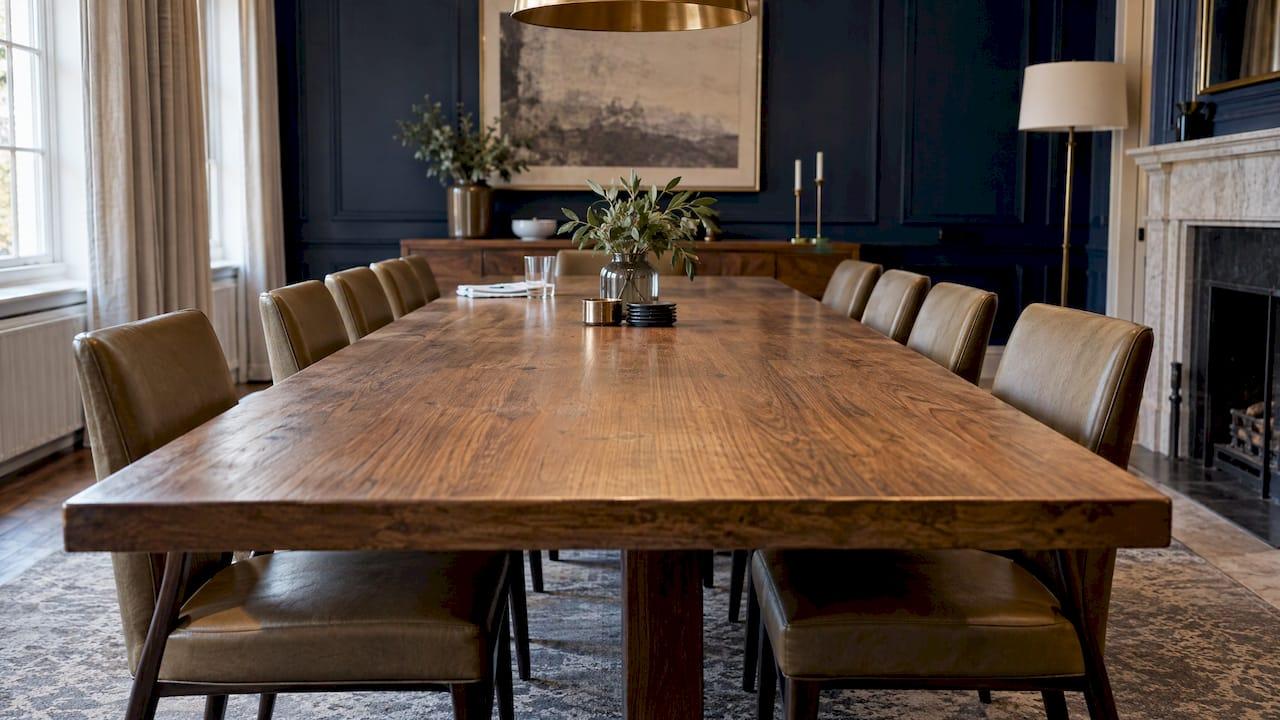
Veneer can be extremely durable in a hotel, restaurant or bar, provided three things are right: the core it is bonded to, the finish on top and the way the piece is cared for. A thin layer of fine timber on a stable core is not the weak link. A badly matched core, an untested finish or a wet cloth left on an edge is. This guide explains what decides how long veneered furniture lasts under hospitality use, which UK test methods matter, and what to put in a specification.
TL;DR
- Veneer fails because of moisture movement, heat, impact and abrasion, not because it is veneer. Core, adhesive and finish decide the outcome.
- Ask for test reports on the complete finish-and-substrate combination, ideally from a UKAS-accredited laboratory.
- Specify the performance of the final product rather than a long list of component standards.
- Daily care is simple: wipe spills at once, dry the surface, protect from heat and avoid abrasives.
- Small lifting can be corrected early; extensive damage calls for a specialist restorer.
Table of Contents
- What veneer actually is, and why that matters in a hotel
- The four stresses hospitality furniture faces
- The UK tests worth knowing
- How long should hospitality veneer last?
- What to put in a veneer specification
- Veneer or solid wood in a hotel?
- Caring for veneer day to day
- Spotting trouble early
- When to call in a restorer
- Bespoke pieces for hospitality interiors
- FAQ
- Sources
What veneer actually is, and why that matters in a hotel
Decorative veneer is a slice of timber, and the USDA Forest Service diagnostic guide puts its thickness at between 0.20 and 1.7 mm. It is glued to a substrate such as plywood or fibreboard. That construction is the reason a veneered tabletop can look like a single flawless plank of walnut or oak across a three-metre refectory table, and also the reason it behaves differently from solid timber.
Solid timber moves with humidity, sometimes dramatically across a wide board. UMAGE explains that oak veneer on a stable fibreboard core makes a tabletop less sensitive to humidity changes than solid wood. In a dining room where steam, air conditioning, heating and the occasional spilt glass all push conditions around, that stability is a real advantage.
So the honest answer to "how durable is it?" is that veneer is as durable as the system behind it. The layers work together: face veneer, adhesive, core, edge treatment and surface finish. Each has to suit the room it will live in.
The four stresses hospitality furniture faces
A bedside table in a private home may be wiped weekly. The same table in a boutique hotel is cleaned daily, hit by luggage, used as a landing spot for hot drinks and exposed to bathroom humidity. Four stresses do most of the work.
Moisture and humidity
This is the big one. The USDA guide states that most surface problems in veneered furniture begin with the shrinking or swelling of wood as its moisture content changes, which can cause buckling or cracks in the finish or the veneer itself. The same guide sets out when surface distortion will not occur:
- The veneer and substrate have similar swelling and shrinkage rates.
- Their moisture contents are similar when they are bonded.
- Only minimal changes in moisture content occur over time.
Breaking more than one of those conditions is likely to lead to surface failure. For a designer, that translates into practical choices: a well-made core, controlled manufacture, and a considered position for the piece. A vanity unit beside a shower is a different proposition from a console in a corridor, and the specification should reflect that.
Heat
Hot cups, plates and coffee pots land on tables and desks all day. Surface resistance to heat is a measurable property. BS EN 12722:2009+A1:2013 specifies a method for assessing resistance to dry heat on rigid furniture surfaces regardless of material, and is carried out on unused surfaces. Our own notes on heat resistant finishes for wood go deeper on how finishes respond to hot pans and crockery.
Liquids and cleaning
Spilt wine, coffee and cleaning sprays all meet the finish before they ever reach the veneer. BS EN 12720:2009+A1:2013, described by BSI Knowledge, covers the assessment of resistance to cold liquids across all rigid furniture surfaces, with a selection of suitable test liquids. Housekeeping routines matter as much as the finish: acidic cleaners and coarse cloths are the usual culprits when a surface dulls early.
Impact and abrasion
Knocks from luggage trolleys, chair backs and vacuum cleaners define the working life of an edge. Because veneer is thin, edges and corners deserve particular attention at design stage: a considered edge profile, a robust edge treatment and sensible detailing at the points where a piece is most likely to be struck.

The UK tests worth knowing
Specifiers in the UK are well served by a recognised set of finish tests. SATRA's overview of cabinet furniture finishes lists them:
| Test | What it assesses |
|---|---|
| EN 12720:2009+A1:2013 | Resistance to cold liquids |
| EN 12721:2009+A1:2013 | Resistance to wet heat at 55°C, 70°C and 85°C |
| EN 12722:2009+A1:2013 | Resistance to dry heat, 85°C to 160°C |
| BS 3962-5:1980 | Resistance to oils and fats |
| BS 3962-6:1980 | Mechanical damage, including scrape, penetration, impact and crosscut |
The FIRA Specifying Furniture Guide adds two valuable points. First, finishes should be tested on the substrate on which they will be used in practice, so that the finish and substrate combination is assessed rather than the finish in isolation. Second, for non-kitchen contract finishes, these methods generally carry no universal pass or fail rating. That means the specifier decides what level of performance the room needs and writes it into the brief.
How long should hospitality veneer last?
FIRA notes that product performance standards are typically written with a five-year product life in mind. That is a baseline for testing, not a ceiling on what well-made furniture can do. Many hotel owners and designers plan refurbishment cycles around brand standards rather than around the point at which furniture fails, and a carefully built piece with a suitable finish is meant to look right well beyond the first cycle.
If you are planning for a longer horizon, our guide to making hotel furniture design last 10 years covers the wider decisions: layout, wear zones, replaceable components and finish choices.
What to put in a veneer specification
A good brief is short, clear and measurable. These are the points we would want in front of us when quoting a hospitality commission.
Specify the final product
FIRA warns that it is easy to over-specify by listing the standards for each component as well as the finished item, and recommends sticking to the performance of the final product. A line such as "the finished tabletop must be tested to the relevant finish methods on the construction proposed" is more useful than a page of component references.
Ask for current test reports
FIRA advises requesting current, relevant test reports for the submitted product, ideally from a laboratory accredited to BS EN ISO/IEC 17025:2017. In the UK, testing bodies are accredited by UKAS. Reports should relate to the construction being offered, so check that the finish, substrate and veneer on the report match the piece you are buying.
Match the finish to the location
A bar top, a bedroom desk and a reception console do not need the same finish. Our articles on hospitality grade finishes and furniture finish types explain how sheen, hardness and feel vary, so you can choose a finish for the use rather than for the swatch alone. If air quality is part of your project brief, see our note on low VOC furniture finishes.
Choose species and matching with intent
Species affects look, colour change over time and how a surface reads when it picks up minor wear. Our wood veneer types guide and wood species selection guide compare the options. How leaves are laid also changes the character of a large surface, as we explain in bookmatched vs slip matched veneer.
Think about where the piece sits
Keep wet-area detailing in mind. Pieces that sit near basins, showers or open kitchens need edges and undersides that are sealed and detailed with that environment in mind, and a brief that says so plainly.
Veneer or solid wood in a hotel?
The two are partners more than rivals. Solid timber is easy to refinish deeply, which suits chair frames and legs that take the most handling. Veneer over a stable core suits large flat surfaces such as tabletops, wardrobes, headboards and wall panelling, where a consistent grain and dimensional stability matter. Many of the best commissions combine them: a solid frame with a veneered top, for instance. If you are weighing providers on this question, our veneer vs solid wood providers round-up sets out what to look for.

Caring for veneer day to day
Good housekeeping habits extend the life of any finish. Vipp's guidance for oak veneer care is to clean gently with a damp soft cloth and a mild pH-neutral detergent, remove spills immediately and dry the surface, and to avoid acidic cleaning agents, coarse cloths and sandpaper. UMAGE's advice agrees: prompt spill removal, thorough drying, and no hot or damp objects, detergents, chemicals or abrasives on lacquered surfaces.
For a hotel or restaurant, turn that into a one-page card for housekeeping and front-of-house teams:
- Wipe spills straight away, then dry the area.
- Use a soft damp cloth and mild pH-neutral detergent only.
- Keep acidic products and coarse cloths away from the surface.
- Use mats, trays or coasters for hot items.
- Report any lifting edge or cloudy patch early.
Spotting trouble early
The signs are usually visible well before a failure. White water marks, clouding, bubbling or raised edges point to moisture reaching the surface or the glue line. The Upcycler recommends keeping indoor humidity at a reasonable 30 to 50 per cent, checking edges regularly and regluing at the first sign of lifting. Caught early, a lifting edge is a small job.
When to call in a restorer
Checkatrade notes that small areas of lifting veneer can sometimes be repaired, while cracked, missing or extensively damaged veneer is usually better handled by an experienced restorer. It also warns that aggressive sanding can go through veneer sooner than expected, and that matching replacement veneer can be difficult where colour, grain and finish have changed. For wider surface problems, specialist furniture repair is the sensible route rather than a DIY attempt on a prominent piece.
Our perspective
When a hotel table fails early, it is rarely the timber's fault. It is usually a mismatch: a core that moves differently from its face, a finish chosen from a swatch rather than for a bar top, or a brief that never said where the piece would stand.
That is why we prefer to start every commission with the room. Each piece we offer is handcrafted to order with our artisans, with size and finish adjusted to the space, so the conversation about use, cleaning and position happens before anything is made, not after.
For designers and architects, the most helpful thing we can do is talk through the finish, the edge and the surroundings together, and we are always happy to work with you on that. Durability, to us, is a design decision made early and made with care.
Luke
Bespoke pieces for hospitality interiors
If you are specifying for a hotel, restaurant or private residence, we make bespoke furniture to order, with sizes and finishes tailored to your scheme. Trade customers can also access made-to-order rugs from our Signature rug collection from Colbourns, and mirrors from the Ready to Hang collection from Simpsons London. You can browse the range on our website, or see an example of our craftsmanship in the Hammered Coffee Table.
Floors matter to a hospitality scheme too: our guide to hotel rug durability sets out what procurement teams should specify.
FAQ
How durable is wood veneer on hospitality furniture?
It can be very durable when the core, adhesive and finish suit the setting. The main risks are moisture movement, heat, spills and knocks at the edges. Ask for test reports on the complete construction and plan a simple care routine for staff.
Is veneer more stable than solid wood?
Often, yes, for large flat surfaces. UMAGE notes that oak veneer on a stable fibreboard core is less sensitive to humidity changes than solid wood. That stability is why veneer is chosen for tabletops, wardrobes and panelling.
How should I clean veneered furniture in a hotel?
Use a soft damp cloth with a mild pH-neutral detergent, remove spills at once and dry the surface. Avoid acidic cleaners, coarse cloths and abrasives. A short care card for housekeeping keeps the routine consistent.
Which tests should I ask for?
Ask for current reports on the finished construction, ideally from a UKAS-accredited laboratory. Typical methods cover cold liquids (EN 12720), wet and dry heat (EN 12721 and EN 12722) and mechanical damage (BS 3962-6). FIRA notes there is generally no universal pass or fail rating, so set the level to the room.
Can damaged veneer be repaired?
Small areas of lifting can often be corrected, particularly if caught early. Extensive cracking, missing sections or water damage are better left to an experienced restorer, because matching grain and colour takes skill.
Sources
- Specifying Furniture Guide, FIRA
- Diagnostic Guide for Evaluating Surface Distortions, USDA Forest Service
- BS EN 12720:2009+A1:2013, BSI Knowledge
- BS EN 12722 preview, BSI via ANSI
- Cabinet furniture finishes, SATRA
- Care & Maintenance: Oak Veneer, UMAGE
- Oak veneer care instructions, Vipp
- Veneer Repair and Restoration, The Upcycler
- How to repair damaged wood furniture, Checkatrade