
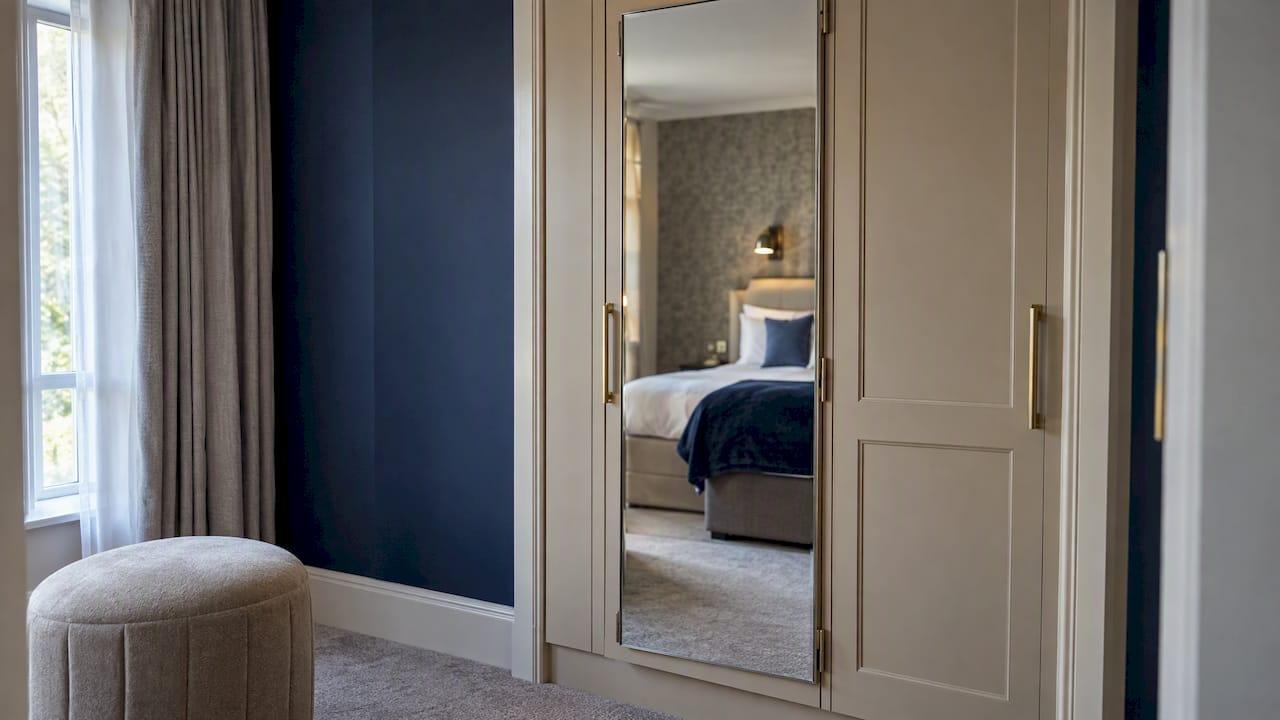
No UK law says a hotel bedroom or bathroom must contain a mirror. The requirements come from elsewhere: quality grading schemes that expect mirrors as a condition of a star rating, accessibility guidance that shapes where and how they are hung, and safety-glazing practice that governs the glass itself. If you are specifying mirrors for a hotel, a refurbishment or a boutique conversion, those three layers are what you need to design to.
TL;DR
- There is no statutory duty to provide mirrors in UK hotel rooms, but grading schemes treat them as a baseline for certification.
- Expect at least one bedroom mirror (two at three stars and above) and a lit mirror at the bathroom basin.
- Accessible bathrooms need a mirror that works for both seated and standing guests.
- Mirrors near floors or doors are critical locations for safety glazing, so specify safety-backed glass and secure fixings.
- Damp rooms call for the right backing, sealing and mounting system, not simply a bigger sheet of glass.
Table of Contents
- Is a mirror a legal requirement in a UK hotel?
- What star-rating schemes expect
- Placing, lighting and fixing hotel mirrors
- Accessible rooms and mirror usability
- Safety glass, backing and damp rooms
- A specifier's checklist for hotel mirrors
- Our perspective
- Specifying mirrors with Simmons Interior Supply
- FAQ
- Sources
Is a mirror a legal requirement in a UK hotel?
Not as such. The research we have drawn on is clear that no specific legal requirement under UK building regulations or general law mandates mirrors in every guest room. Hotels do carry statutory obligations, among them the Hotel Proprietors Act and local planning and licensing rules, but none of them lists a mirror as an item of required furniture.
What does exist is a commercial reality. Most hotels want a recognised star rating, and the schemes behind those ratings are explicit about mirrors. A hotel that omits them risks failing an assessment, which in practice makes the provision non-negotiable for any operator who markets on grade.
Two other legal threads touch mirrors indirectly. The first is accessibility: Building Regulations Part M sets the baseline for accessible rooms, and some planning authorities go further. The second is safety: where glass sits low in a wall or in a door, safety-glazing rules treat it as a critical location. We take each in turn below.
What star-rating schemes expect
The grading guidance published for Wales, which mirrors the approach used across the UK schemes, sets out mirror provision plainly. At the entry level at least one mirror is expected in the bedroom, preferably full-length and placed close to a power socket or hairdryer. From three stars upwards, two are expected, along with a lit mirror above or near the bathroom washbasin.
Public areas count too. The AA's hotel quality standards expect public toilet facilities to have ample mirrors as a minimum, and they place mirrors among the bathroom items that need particular cleanliness attention, with bedrooms, bathrooms and public spaces cleaned and checked daily.
| Area | What the standards expect | Practical note |
|---|---|---|
| Bedroom, entry level | At least one mirror, preferably full-length | Place near a socket for a hairdryer |
| Bedroom, three stars and above | Two mirrors | Pair a full-length mirror with a dressing or desk mirror |
| Bathroom | Lit mirror above or near the washbasin | Light must fall on the face, not behind the guest |
| Public toilets | Ample mirrors | Plan for daily cleaning access |
Because scheme criteria are revised, always check the current edition with the scheme you are applying to before you freeze a specification.
Placing, lighting and fixing hotel mirrors
The standards give three practical instructions that translate neatly into design decisions: put bedroom mirrors close to sockets, give bathroom mirrors good lighting at the basin, and fix every mirror securely, often mechanically, especially near floors or doors.
Bedroom
A full-length mirror earns its place when a guest can check their whole outfit before leaving the room. The best position is on a wall or the back of a wardrobe door with a clear, well-lit approach, ideally beside a dressing area with a socket nearby. A second mirror at a desk or console gives you the two that higher grades expect, and it doubles as a decorative feature. A sculptural console with a generously proportioned mirror above it can do the work of both a vanity and a welcome statement.
If headboards are part of the same scheme, coordinate the elevations early. Our guide to hotel headboard design explains how late changes to one element create rework in another, and mirrors beside a bed are a common casualty.
Bathroom
Lighting matters as much as the glass. A mirror above the basin should sit within reach of even, glare-free light, and the height should suit both the tallest and the shortest guest. Our note on bathroom mirror height gives a working centre line for homes and trade projects that carries over well to hotel bathrooms, and our guide to bathroom mirror IP ratings covers what to ask for when a mirror has integral lighting.
Mirror sizes and shapes
Hotel rooms are rarely a standard size, and a standard mirror seldom suits a non-standard wall. Made-to-measure sizing avoids awkward gaps and lets the mirror line up with basin widths, panelling or tile joints. See our overview of custom mirror sizing and custom mirror shapes for how trade buyers approach it.
Accessible rooms and mirror usability
Accessible rooms are where mirror specification most often goes wrong, because a mirror hung at standard height fails a seated guest. VisitBritain's action checklist for serviced accommodation states that accessible toilets should have a mirror usable by both seated and standing users. In practice that points to a tall mirror that starts low and rises high enough for standing use, or a mirror that is tilted, rather than a small one fixed at a single height.

The quantity of accessible rooms is set by regulation and local policy. A Greater London Authority working paper reports that Part M requires at least 1 in 20 rooms in new hotel developments, including changes of use, to be wheelchair accessible. Some boroughs ask for more: Islington's inclusive design guidance mandates a 10% quota for new hotels, which exceeds the national baseline. If your project is in London, check the borough's policy before you count mirrors.
The same GLA paper also notes that accessibility extends beyond wheelchair use, to guests who are blind or live with long-term illness. For mirrors, that means thinking about glare, contrast against the wall and edges that are easy to see, as well as height. Our article on accessible furniture design explores how to keep these spaces elegant as well as usable.
Safety glass, backing and damp rooms
This is the part of the specification that protects guests and the operator's insurance position. Three ideas matter: where the mirror hangs, what is bonded to its back and how it is fixed.
Critical locations
Guidance on Approved Document K treats low-level glazing within 800 mm of the floor, and furniture including mirrors, as critical locations. A separate industry reference notes that BS 6262 Part 4 covers mirror glazing for cupboards and wardrobes, and that glazing in doors or adjoining side panels within 1500 mm of the floor is also critical. A full-length mirror fixed to a wardrobe door or standing low on a wall therefore sits squarely in the zone where a break could injure someone.
The Glass and Glazing Federation's Glazing Manual should be used alongside the applicable UK safety-glazing requirements when you specify mirrors, although it does not itself set a hotel-specific mirror specification. Treat it as the technical reference and write the hotel brief on top of it.
Safety backing
A safety backing holds the fragments together if the glass breaks. Saint-Gobain's October 2023 installation guidance for its anti-shatter mirror says it is suitable for indoor use, including damp or humid rooms, provided the safety face is oriented toward a smooth, clean, dry supporting wall and the fixing uses mechanical fixings, neutral-cure silicone or double-sided adhesive, with joints sealed in wet rooms.
AGC's installation guide makes a similar point from a different angle: its mirror products can be used in bathrooms but should never be immersed in water, and for safety applications and damp environments it recommends a safety backing film. It also says thickness should be chosen for each panel, recommending 6 mm for wall cladding panels over 1 m², with thicker glass for very large ones. Our own primer on mirror safety backing walks through the choices in plain terms.

Fixings and humidity
SATRA, the testing body, identifies two bathroom-mirror risks: the glass must remain secure if the wall fixing fails, and humidity or heat can distort the mount and stress the glass. Its high-humidity assessment holds a mirror at 23°C and 85% relative humidity for 28 days, checking for distortion, backing-adhesion failure and loss of security. The lesson for a specifier is that the whole assembly matters: glass, backing, frame and fixing must work together, not merely the glass type.
Choosing the fixing is a decision in itself. Concealed cleats, French cleats, adhesive pads and screw-and-cap fixings each behave differently on tiled, plasterboard or masonry walls. Our guide to mirror mounting systems helps you match system to substrate, and the trade guide to custom mirror installation covers site sequencing for City of London projects.
A specifier's checklist for hotel mirrors
Use this as a working list when you write the brief or review a supplier's quote.
- Confirm the target grade. Decide which scheme and star level the hotel is aiming for, then count mirrors per room against that scheme's current criteria.
- Map the sockets. Place the bedroom mirror near a power point suitable for a hairdryer.
- Light the basin. Specify lighting at the bathroom mirror, and check any integral lighting against the room's zone and IP rating.
- Check the height range. Make sure accessible-room mirrors work seated and standing.
- Mark the critical locations. Flag anything within 800 mm of the floor or on a door, and specify safety-backed glass there.
- Choose the backing and fixings together. Ask the supplier to confirm the system is suitable for damp rooms.
- Plan for cleaning. Mirrors are a daily inspection item, so avoid detailing that traps moisture or smears.
- Budget realistically. Made-to-measure pieces are priced by size, finish and fixing. Our guide to custom mirror costs in the UK includes a request-for-quote checklist you can adapt.
Our perspective
Over the years we have noticed that the mirror is the last thing a hotel scheme considers and the first thing a guest uses. It is also the piece that most readily gives a room its character: the right proportion over a console, a softly bevelled edge in a dressing area, a generous panel that makes a narrow bathroom feel composed.
That is why we favour made-to-order work. Hotel rooms seldom conform to catalogue sizes, and a mirror that is cut, finished and fixed for the actual wall will always sit more elegantly than a compromise. Working closely with skilled artisans, we can adjust size and finish so that a piece answers the designer's intent and the practical demands of the room at the same time.
Our advice to interior designers, architects and procurement teams is to bring us into the conversation early. Tell us the grade you are aiming for, the wall construction and the lighting, and we will talk you through the options for safe backing and fixing. We are always happy to work with you on getting those details right before they reach site.
Luke
Specifying mirrors with Simmons Interior Supply
We offer made-to-order mirrors and rugs through our trade collections, alongside our handcrafted bespoke furniture, all of it customisable in size and finish for residential and hospitality interiors. If you are fitting out a hotel or a luxury residence and want mirrors, consoles and tables that belong together, start with our bespoke furniture and trade collections.

Trade customers can request quotations through an account, and we are glad to talk through dimensions, finishes and fixing details for your scheme. Pieces such as our Hammered Console Table pair naturally with a large custom mirror in a hotel bedroom or suite.
FAQ
Do all UK hotel rooms have to have a mirror?
No law requires it. Mirrors become effectively mandatory only when a hotel wants a star rating, because grading standards list them as a minimum. Anyone planning a new hotel should treat the scheme criteria as the real requirement.
How many mirrors does a hotel bedroom need?
Grading guidance expects at least one in the bedroom, preferably full-length and near a socket, and two at three stars and above. The bathroom also needs a lit mirror at the washbasin. Always check the current edition of the scheme you are applying to.
What height should a mirror be in an accessible hotel bathroom?
VisitBritain's checklist asks for a mirror that seated and standing guests can both use, rather than a fixed figure. In practice, that means a tall mirror starting low or a tilting one. A trade specialist or access consultant can confirm the dimensions for your layout.
Do hotel bathroom mirrors need safety glass?
Safety-backed mirrors are the sensible choice, particularly where glass sits within 800 mm of the floor or on a door. Manufacturers also recommend safety backing for damp environments. Ask your supplier to confirm the backing, adhesive and fixings suit the room as a complete system.
Sources
- A Guide to the Star Grading Scheme, hotel standards booklet
- AA Quality Standards, Hotels
- VisitBritain, action checklist for serviced accommodation
- Projections of demand and supply for accessible hotel rooms, Greater London Authority
- Islington Council, Inclusive Design SPD appendix
- A guide to safety glass in building design
- Glass and Building Regulations impact, safety glazing reference
- GGF Glazing Manual, June 2016
- MIRALITE EASYSAFE installation guideline, October 2023
- Mirox installation guide, AGC
- The testing of mirrors, SATRA