
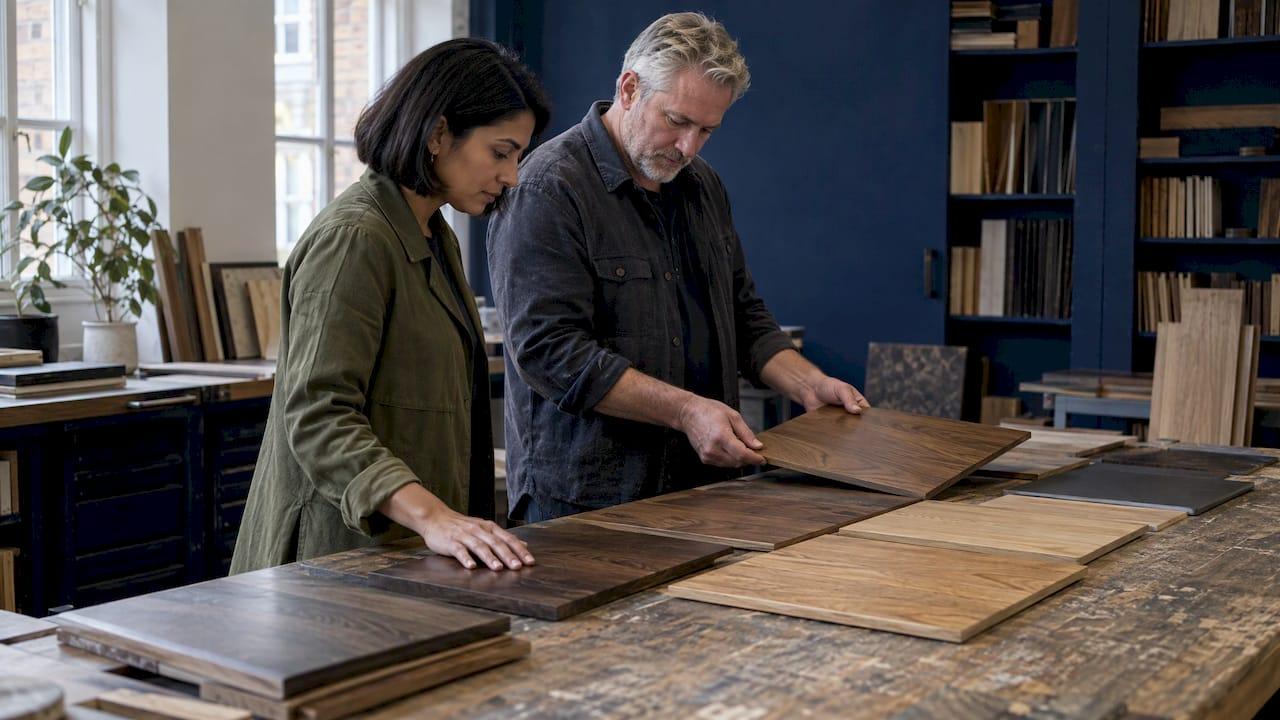
A good finish specification does three things: it says where the piece will live, it names every surface and component separately, and it describes the result in terms a maker can build to and you can check. Do that, and a bespoke piece arrives looking as you imagined it. Leave any of the three vague and the finish becomes a matter of opinion at handover. For handcrafted, made-to-order furniture, where every size and finish is set for the commission, we handle the making in close collaboration with you, and a clear specification is what allows that collaboration to run smoothly.
TL;DR
- Begin with the environment and the intended use, not with a colour or a swatch.
- Specify each finish explicitly: top or surface, frame or legs, upholstery, metalwork, each on its own line.
- Name the actual finish system (paint, lacquer, oil, veneer, foil) rather than a general look.
- Accept that natural materials, timber and leather above all, vary, and say so in the document.
- Agree colour, sheen and sample references in writing before making begins.
Table of Contents
- What a finish specification actually is
- Start with use, not colour
- Specify every component separately
- Name the finish system, not just the look
- Write down what natural materials will do
- Write performance in the language of use
- Agree colour, sheen and samples before making begins
- A step-by-step way to write the schedule
- Common mistakes and how to avoid them
- Our view: finish is where the piece is won or lost
- Bring us your specification
- FAQ
- Sources
What a finish specification actually is
A finish specification is the part of your furniture schedule that tells a maker exactly what every visible and touchable surface should be, how it should look and how it should behave in use. It sits alongside dimensions, materials and construction, and for a bespoke commission it is often the part with the most room for misunderstanding. "Walnut, satin" means different things to different people. A line that records species, cut, stain, topcoat and sheen means the same thing to everyone who reads it.
The UK furniture industry's research body, FIRA, makes a useful point in its Specifying Furniture Guide: a specification should state the intended use and the performance the product needs, and it should reach suppliers at tender stage. Finish decisions made late, after prices and programmes are fixed, are the ones that cause arguments. Put them in the first brief.
If you are building the brief from scratch, our supplier-ready furniture brief shows how to set out dimensions and tolerances so the finish notes sit on a solid base.
Start with use, not colour
The most common specifying error is choosing a finish for how it looks in a render and only afterwards asking how it will be used. Reverse the order. Before you name a finish, answer four questions:
- Who uses it? A private dining room, a hotel restaurant and a boardroom wear surfaces very differently.
- How often and for how long? A bedside table is touched a few times a day. A bar top or a lobby console is touched constantly.
- How will it be cleaned? Daily wipe-downs with commercial products are harder on a finish than occasional dusting.
- What will it meet? Sunlight, spilt drinks, hand cream, luggage, heat from cups and plates.
FIRA's guide stresses starting from the environment and the intended use, including frequency and duration of use and the cleaning expected. It also notes that upholstery can fade, wear, tear or discolour through water, sweat and cleaning agents. That is a useful reminder that cleaning regime is part of the specification, not an afterthought.
The same guide advises against asking for tests that have no bearing on how the piece will really be used. A test requirement copied from another project adds cost and tells you nothing. Describe the use, then ask for performance that matches it.
For homeowners, this simply means thinking honestly about the room. A family kitchen table and a seldom-used console in a hall call for different finishes, even in the same timber. For hospitality schemes, our guide to hospitality grade finishes sets out how to think about heavier use, and our note on what contract grade furniture means explains when to ask for it.
Specify every component separately
A piece of furniture is rarely one surface. A dining chair has a frame, a seat, possibly a back panel and sometimes metal feet. A console has a top, a carcass, a plinth and perhaps a mirrored or inlaid panel. The finish on each can differ, and a specification that gives one finish for "the piece" leaves the maker guessing.
A clear line for each component removes the guesswork. A schedule might read like this:
| Component | Material | Finish | Sheen | Notes |
|---|---|---|---|---|
| Table top | European oak, quarter-sawn | Natural oil, light stain | Matt | Edge profile as drawing, sample reference to be agreed |
| Legs | Solid oak | Matching stain and oil | Matt | Match top on all faces |
| Metal inlay | Brass | Brushed, lacquered | Low sheen | Protected against tarnish |
| Seat | Upholstered, fabric name and code | Per fabric | n/a | Pattern direction noted |
The exact materials will be your own. The point is the discipline: material, finish, sheen and notes on each row, so that nothing is left to be assumed.
For wood-based pieces, the species is half the finish. Grain, colour and the way a timber takes a stain differ widely, so settle the species first. Our wood species selection guide is a good starting point, and our article on matching finish types to use and wood helps homeowners work through the same decision.
Name the finish system, not just the look
Two surfaces can look similar and behave very differently. A lacquered surface, a painted one, an oiled one and a foil-wrapped one will each age, mark and repair in their own way. FIRA's guide lists paint, lacquer, thermoplastic foil and paper foil among the materials used for kitchen cabinet doors and frontals, which shows why it matters to name the real material system rather than describe a colour.
When you write the line, think in these layers:
- The substrate: solid timber, veneer on a board, metal, stone or another base.
- The colour treatment: natural, stained, dyed, painted or patinated.
- The protective coat: oil, wax, lacquer or another topcoat, and the sheen it gives.
- The edge and detail treatment: how corners, arrises and joints are finished.
A few practical notes on how the main families behave, in general terms:
- Oil soaks in and keeps the timber feeling natural. It is straightforward to refresh locally but gives a softer, more open surface.
- Lacquer forms a film on top. It can be made in a range of sheens and tends to suit surfaces that need a more even, controlled look.
- Paint gives the widest colour range and an opaque, uniform result, which suits designs where the form matters more than the grain.
- Wax gives a soft, tactile surface and is usually chosen for low-use, decorative pieces.
Treat these as a prompt for the conversation with your maker rather than a rulebook. The right choice depends on the timber, the use and the look you are after. Our guide to custom finish options goes into how to choose and specify with confidence.
Write down what natural materials will do
Natural materials are the reason many clients commission bespoke work, and variation is part of their appeal. It is also the thing most likely to cause disappointment if nobody mentioned it. Timber changes colour with light and age. Veneer panels cut from the same log still differ slightly. Stone carries veining that no two slabs share.
Leather is a clear example. FIRA's guide states that natural leather varies in appearance and qualities and may show healed marks and wrinkles that are natural characteristics rather than defects. If your client expects a perfectly uniform hide, say so early and choose accordingly. If they value the character, record that in the specification so it is accepted as intended.

For fabrics, the questions are different: how the cloth wears, how it handles cleaning and how its pile or weave behaves over time. Two of our guides look at this directly: mohair versus velvet and the specifier's checklist for bouclé durability.
A short "natural variation" clause in the schedule protects everyone. State which characteristics are expected (grain movement, colour variation between boards, natural markings) and which would count as a fault (cracks, delamination, coating defects).
Write performance in the language of use
A specification can fail by saying too little, but it can also fail by saying too much of the wrong thing. FIRA cautions against overloading the document with component standards when the requirement that matters is the performance of the final product. A long list of tests applied to raw components may satisfy a checklist yet say nothing about whether the finished table survives a busy restaurant.
A workable approach is to describe performance the way the piece will be used:
- Surface durability: the surface should withstand daily cleaning with the agreed products without dulling or softening.
- Heat and moisture: state whether cups, plates or wet glasses will sit directly on the surface.
- Light: note any window exposure that could affect colour over time.
- Repair: state whether the finish should be spot-repairable on site or refinished as a whole.
If the project is in a hotel or another commercial interior, add the expected lifespan between refurbishments. Our article on making hotel furniture last ten years shows how to tie finish choices to a refurbishment cycle.
Emissions and coatings
Where indoor air quality is part of your brief, say so in the specification and ask the maker to confirm the coating system accordingly. Our piece on low VOC furniture finishes for UK specifiers explains what to ask for and how to word it.
Agree colour, sheen and samples before making begins
Colour and sheen are the two things people judge first and describe worst. "Warm grey" and "light oak" mean nothing on their own. The fix is a physical or numbered reference that everyone can point to.
- Give a reference, not an adjective. Use a colour code from a recognised system, a named stain, a fabric code or a sample you hold. Write it into the schedule.
- State the sheen on a scale. Matt, satin, semi-gloss or gloss, agreed in the same document.
- Judge in the real light. A finish looks different under showroom lighting, warm evening lighting and daylight. Look at your reference where the piece will stand.
- Confirm on the actual material. The same stain on oak and on walnut will not match. A reference on the correct timber is worth more than a chip on a card.
- Record approval. Once the finish reference is agreed, note it in writing with the date, so that the final piece is judged against that reference and not against memory.
For larger or repeated runs, such as a set of chairs or a run of hotel-room pieces, it is sensible to agree the reference piece first and then build the rest to match it. For a single bespoke piece, the same logic applies at smaller scale: settle the finish reference, then proceed.
Because every Simmons piece is handcrafted to order, with size and finish set for the commission, this agreement is part of how we work with you from the start.
A step-by-step way to write the schedule
Here is a sequence you can follow on any project.
- Record the context. Room type, users, hours of use and cleaning regime.
- List every component. Top, frame, legs, panels, upholstery, hardware, metalwork.
- Choose materials and species. Name them fully, including timber cut or fabric code.
- Choose the finish system. Substrate, colour treatment, topcoat and sheen for each component.
- Add references. Colour codes, sample references and any approved precedents.
- State performance in use. Heat, moisture, cleaning and light, not a borrowed list of tests.
- Add the natural-variation clause. What is expected, what counts as a fault.
- Issue it early. Include the schedule at tender or commission stage, as FIRA's guide advises.
- Keep it with the drawing. Dimensions and finishes belong together, so nobody works from a stale version.
If you are producing drawings and schedules digitally, a short primer such as Revit for interior design can help you decide how much of the finish information to hold in the model. And if you intend to publish the same pieces online, furniture product descriptions are easier to write once the schedule is complete, since the material and finish detail is already settled.
Common mistakes and how to avoid them
- One finish for the whole piece. Different components need their own line.
- Adjectives without references. "Rich", "warm" and "natural" are not specifications.
- Ignoring cleaning. The cleaning products used on site can affect the finish. Name them.
- Copying a standard list. Tests that don't match actual use add cost without adding certainty.
- Late decisions. Finishes settled after pricing lead to variations and delay.
- Unspoken expectations about natural variation. Say what is normal.
Our view: finish is where the piece is won or lost
We make every piece by hand and to order, which means the finish is never an afterthought: it is where the artisan's work meets your intention. The best briefs we see are not the longest ones. They are the ones that say how the piece will be used, name each surface, and give a clear reference for colour and sheen.
Because we work closely with designers, architects and clients, and with the artisans who build each piece, we can talk through size and finish together before anything is made. That conversation is easier when the specification is clear, and it is the reason we encourage you to bring us in early, at brief stage rather than after the budget is set.
A bespoke finish should feel considered: a stain chosen for how it warms an oak top in evening light, a brass detail brought to the right level of sheen, a fabric picked to suit a lived-in room. Specify with confidence, and we will help you realise it.
Luke
Bring us your specification
If you are a designer, architect, hotel procurement team or homeowner working on a commission, we would be glad to see your brief. Our bespoke collection is handcrafted to order, with size and finish customised to your space, and our trade collections of made-to-order rugs and mirrors can be tailored in design and dimensions. You can explore the range on our website.

For a good starting point on a specific piece, look at our bespoke nest of coffee tables.
FAQ
What should a furniture finish specification include?
It should state the intended use and the performance the piece needs, then list each component with its material, finish system, colour reference and sheen. FIRA advises that the specification reaches suppliers at tender stage. Add a short note on natural variation so everyone knows what is expected.
How do I choose a finish for how a piece will be used?
Start with the environment: who uses it, how often, for how long and how it will be cleaned. Match the finish to that use rather than to the look alone. Heavily used surfaces such as bar tops and restaurant tables need a more resilient system than an occasional console.
What are the common types of furniture finish?
The main families are oil, wax, lacquer and paint, with veneer, foil and fabric treatments on particular components. Each differs in appearance, feel and how it can be repaired. Naming the real system in your schedule matters more than describing the look.
Is natural variation in timber or leather a defect?
No. Timber grain and colour vary, and FIRA's guide notes that natural leather can show healed marks and wrinkles that are natural characteristics rather than defects. Record the expected variation in the specification so it is accepted from the outset.