
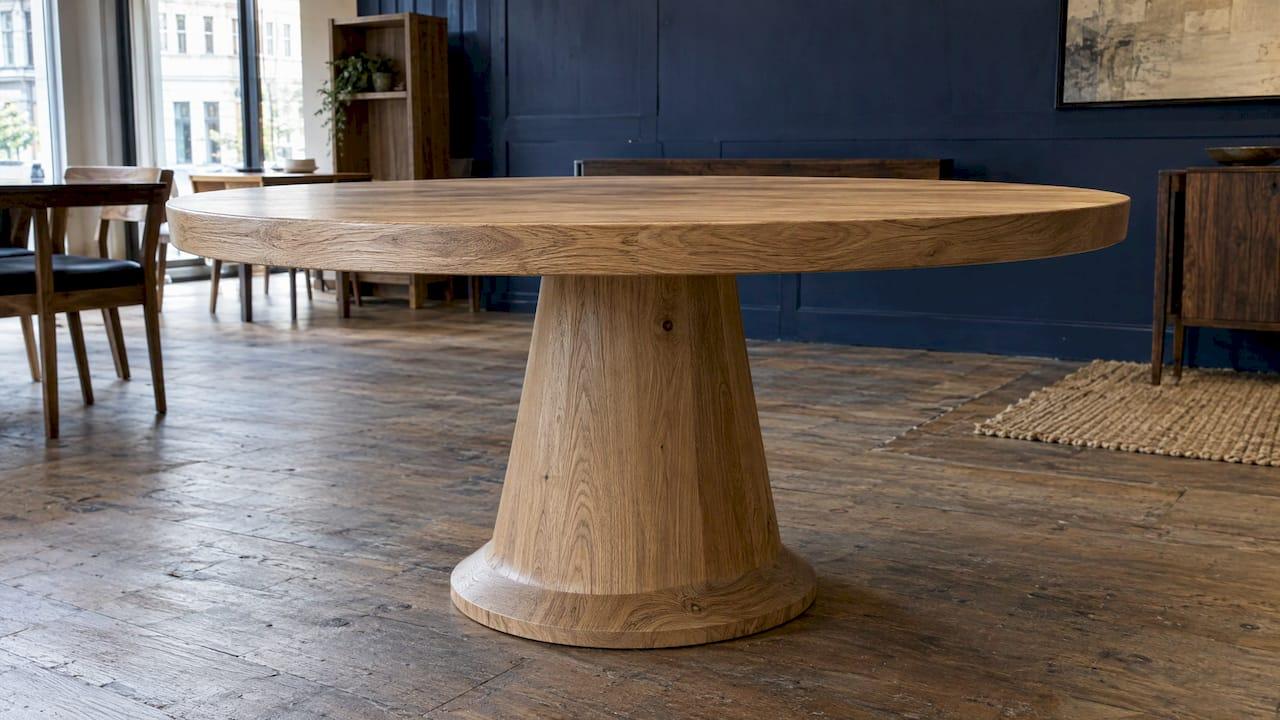
A table base is stable when its footprint is wide enough for the top it carries, its joints and fixings cannot work loose, and its feet meet the floor evenly. Get those three things right at the design stage and a table will stay quiet and planted for decades. Leave one to chance and no amount of tightening will cure it later. For a made-to-order piece, all three are decisions you can settle before a single component is cut, which is why we treat them as part of the brief rather than an afterthought.
This guide is written for designers, architects, hospitality buyers and homeowners commissioning a table. It explains how stability works, how to match a base to a top, what to ask about construction, and how to deal with an uneven floor.
TL;DR
- Stability comes from geometry: the table's centre of gravity must sit well inside the area its feet enclose, and a person leaning on an edge must not move it outside.
- Match the base to the top by size, thickness, weight and material, and keep legs set in from the edge rather than at the extreme corners.
- Fixings matter as much as the base: solid timber moves with humidity, so the connection must allow for it without loosening.
- Most wobble in a finished room is the floor, not the table. Adjustable feet solve it permanently.
- A bespoke table lets you fix size, leg position and finish together, so the base is designed around the top and the room.
Table of Contents
- What stability actually means
- How standards define a stable table
- The four design levers
- Matching the base to the top
- Construction details that keep a base stable for years
- Floors: the cause most people blame the table for
- What to ask when you specify a table
- Size and stability go together
- Our view on table base stability
- Commissioning a table made for your space
- FAQ
- Sources
What stability actually means
Stability is two separate questions that are easy to blur. The first is whether the table rocks: do all its feet carry load, or does it pivot on a diagonal pair? The second is whether it tips: when someone leans on the edge, sits on the corner or lifts a heavy dish at the table's extremity, does the load stay within the base?
Rocking is a contact problem. A table with four legs can rock on an uneven floor or because one leg is fractionally short. A table with three legs cannot rock, because three points always define a plane, although a three-legged design can tip more easily when a load lands outside the triangle.
Tipping is a geometry problem. Picture the polygon formed by the feet on the floor. As long as the combined weight of the table and whatever sits on it acts through a point inside that polygon, the table stays upright. Push the load towards the edge of the top and, if the legs are tucked well in from that edge, the point of action moves outside the polygon and the table begins to lift. The further the top overhangs the base, the less load it takes to tip.
That is why a heavy, wide top on a slender pedestal is a common source of trouble, and why a tall table such as a bar or counter-height piece needs a wider stance than a dining table of the same top size. A small sideways movement at the foot is magnified at the surface, so height and base width must be considered together.
How standards define a stable table
In the UK, non-domestic tables are assessed against BS EN 15372:2016, which sets safety, strength and durability requirements for tables used in places such as hotels, restaurants and offices. For tables up to 950 mm high, it requires that the table does not overturn in the vertical-load stability test described in EN 1730.
That test method, EN 1730:2012, applies a vertical load 50 mm in from the outer edge of the tabletop, on the side most likely to cause overturning and as far from the supports as possible. In plain terms: the test deliberately loads the worst corner, because that is where real people lean, sit and rest their weight.
For a hospitality project this gives you a useful benchmark. Designing a base so that the edge of the top can take a firm load without lifting the opposite legs is the practical meaning of the standard. If you are specifying for a contract setting, our guide to what contract grade furniture means explains how to frame that requirement in a specification.
The four design levers
Footprint and leg placement
The footprint is the area the feet enclose. A wider footprint is almost always more stable, but the relationship with the top is what counts. Legs set in from the edge leave an overhang. The more overhang, the lower the load needed to tip the table.
There is a balance, because legs placed at the extreme corners of a dining table are rarely welcome. They collide with knees and chairs. A pedestal base shows the same tension: the designer wants room for everyone's legs and also wants the widest possible base. This is where bespoke design earns its place, since the leg position can be set around the number of covers and the chairs that will be used, rather than accepted as a catalogue compromise. Our dining table size guide for designers and trade sets out the seat widths and clearances that inform where legs can sit.
Neither a pedestal nor a four-leg table is automatically the more stable. A well-proportioned pedestal with a broad plinth or splayed feet can outperform a four-leg table with spindly legs and a deep overhang. Judge the footprint, the connections and the proportions rather than the name of the style.
Leg number and shape
| Base type | Strengths | What to watch |
|---|---|---|
| Four legs | Familiar, good for rectangular tops, even support at corners | Can rock on uneven floors unless fitted with adjustable feet |
| Trestle | Wide stance along the length, stretcher adds rigidity | End legs can limit seating positions |
| Single pedestal | Free legroom, ideal for round tops | Needs a broad base or plate sized to the top |
| Three legs or tripod | Cannot rock on uneven ground | Tips more easily when loaded beyond the triangle |
| Plinth or slab | Very stable, strong presence | Weight and legroom |
A cross-member, stretcher or apron between legs does a great deal of quiet work. Legs behave like levers: without something tying them together near the bottom, a sideways push turns into a twisting force on the joint at the top. Stretchers and rails counter that leverage, and that is why traditional refectory tables, with their stout stretchers, have held their own through generations of long dinners.
Height and proportion
A base that is stable at 740 mm may not be at 1,050 mm. Taller tables raise the centre of gravity and increase the leverage on every joint. If you are designing a counter or bar-height piece, widen the stance, thicken the column or stiffen the bracing. Our guide to bar stool height is a useful companion when the table and seating must be specified together.
Mass
A heavier base resists lateral movement, which is part of why stone, solid timber and metal bases feel reassuringly planted. Mass helps, but it is not a substitute for footprint. A heavy base that is too small for its top still tips.
Matching the base to the top
Start with the top, not the base. The right base depends on the top's length, width, thickness, shape, weight and material, and on how many people will use it and where they will sit.
Weight and material. Stone, marble and porcelain tops are far heavier than laminate or veneered tops, and solid timber sits somewhere between. The heavier the top, the more substantial the legs or column must be, and the more the footprint must increase to keep the combined centre of gravity low and well supported. Heavy stone tops also change how they are fixed, because you cannot simply screw into stone: the usual route is to bond it to a supporting plate or frame.
Size. A top that overhangs a small base is the classic cause of a table that feels flimsy even though the base itself is robust. For a round top on a single pedestal, the plate or foot should be a generous proportion of the top's diameter, large enough that a person leaning on the rim does not pull the base off the floor.
Use. A coffee table taking a pair of mugs asks little of its base. A restaurant table has guests propping themselves on elbows, pushing up from the edge and shuffling chairs. A boardroom table must cope with a dozen people at once. Specify for the harshest realistic use, not the average.
Proportion. A base can be over-engineered as well as under-built. Too large, and it looks heavy and eats into legroom and circulation space. The aim is a base that is visibly confident without crowding the people sitting at it.

For a worked example, take a round dining top of 1,400 mm diameter in solid oak. A slender central column on a small foot may look elegant in a drawing, but one person leaning on the rim at the far edge puts a long lever on a small base. Widen the plinth, thicken the column, or move to a pair of broad trestle-style supports, and the same top becomes secure. The visual character changes, which is exactly why the conversation about stability belongs at concept stage.
Construction details that keep a base stable for years
Joints
Loose joints and screws are the commonest reason tables loosen over time. Joints in a base are under constant small stress from use, from moving the table and from seasonal changes. Well-made joinery, such as mortise and tenon or properly doweled and glued connections, resists this far better than butt joints held with screws alone. In metal bases, welded construction removes joints that could work loose, and box section is stiff for its weight in every direction, which suits a leg that has to resist knocks and sideways loads.
Fixing the top
This is the detail most often misunderstood. Solid timber is never static: it takes up moisture in humid months and releases it when the air is dry, expanding and shrinking mainly across the grain. If a rigid plate or bracket pins a solid wood top firmly in place, that movement has nowhere to go, and the result can be a split in the top or a joint forced apart at the apron.
The usual remedy is a fixing that allows the timber to slide, such as slotted holes, elongated screw positions or buttons that engage a groove, tightened only enough to hold the top without restraining it. A tabletop can therefore be held securely and still move gently with the seasons. It is worth asking, for any solid wood table, exactly how the top is fixed and whether movement is accommodated.
Central heating is a particular factor in UK interiors. A table made in a workshop in one humidity and installed in a hotel lobby with underfloor heating will move more than one living in a cool dining room, so a considered fixing is not a luxury.
Plates and columns
On a pedestal, a larger mounting plate spreads the load into the top across a wider area, which improves resistance to leverage and reduces the chance of the top pulling away. The column joining plate to base can be round or square and in different thicknesses, and a thicker column is appropriate for a heavy top such as stone or thick timber.
Finishes
Finish affects stability less than structure does, but it matters for the longevity of joints. A sealed, well-finished timber base takes up moisture more slowly and moves less than a raw one. Because our pieces are made with customised sizes and finishes, the finish can be chosen alongside the structure, not bolted on at the end.
Floors: the cause most people blame the table for
A table that rocks is not always a badly made table. In a finished room the floor is frequently at fault, particularly in period buildings, where boards, stone flags and screeds are rarely truly flat. A table that stood happily in a workshop can rock on a flagstone floor.
A simple diagnosis saves a great deal of time:
- Check the floor. Lay a small spirit level on the floor in the table's position and read it in two or three directions. If the floor slopes noticeably, the cure is adjustment at the foot, not tightening screws.
- Check the table. Press down on one pair of opposite corners, then the other. If the table rocks easily when a particular pair is pressed, the legs on the other diagonal are short or the floor is high there.
- Check the fixings. If the floor reads level, turn the table over and inspect every joint and fixing. Loose fixings are the most common cause of a wobble.
For uneven floors, adjustable feet are the lasting answer. A threaded foot fitted into the base of the leg lets each corner be set to the floor on site, without shims or wedged folded card. This is especially valuable in hospitality fit-outs, where dozens of tables of the same height need to sit securely across a floor that may vary from one end to the other.
Felt pads and shims can bridge a small gap, but they compress and fall out. If a table is going to move around, as café and restaurant tables do, an adjustable foot is the more dependable choice. For tables that must be levelled once and left, mention the floor condition at the order stage so the feet can be specified to suit.

What to ask when you specify a table
Whether you are an interior designer sourcing for a client, an architect detailing a restaurant or a homeowner commissioning a dining table, a short list of questions covers most of what determines stability:
- What are the exact dimensions, thickness and material of the top, and what is its approximate weight?
- How far are the legs inset from the edge, and how much does the top overhang?
- Where are the stretchers, aprons or cross-members, and what do they brace?
- How is the top fixed, and does the fixing allow for timber movement?
- Will the table have adjustable feet, and how much adjustment is available?
- What is the intended use: domestic, hospitality or heavy contract, and does it need to meet a standard such as BS EN 15372 for non-domestic use?
- If the table is extendable, how does the mechanism affect the base? Our guide to extendable table mechanisms covers this.
Answering these before manufacture means the base is designed for the table, rather than a table being made to suit whatever base is to hand.
Size and stability go together
The dimensions you choose for the room have a direct effect on base design. A longer table needs either more support points or a stronger structural link between them. A wider top needs a wider base to avoid excess overhang. And clearance requirements (space for chairs to be drawn out, walkways around the table) limit how far legs can splay. For dining tables, our size guide is the place to begin; for lower tables, see the coffee table size guide and the console table dimensions guide.
Our view on table base stability
We start every table with a simple question: what is it going to carry, and who is going to lean on it?
A table base is only stable if it was designed for its top. When size and finish can be set to the room, the leg position, the proportions and the fixing can all be resolved together. That is the reason we favour handcrafted, made-to-order work: our artisans build each piece from scratch, so the base is not a compromise between two off-the-shelf parts.
For designers and architects, this means a table that looks as drawn and sits as it should. A refined silhouette and a secure stance are not rivals. They come from the same careful thinking about footprint, joinery and proportion, and we are always happy to work through that thinking with you.
Luke
Commissioning a table made for your space
If you are specifying a table for a residence, a hotel or a restaurant, the strongest route to a stable result is to have the base designed around the top, the floor and the use. Our bespoke furniture collection is handcrafted to order, with sizes and finishes customised to the space, and our trade access supports designers, architects and hospitality teams on larger projects.

You can see how we approach proportion in pieces such as the Kensington Dining Table and the round drinks table, or explore the full bespoke collection and tell us about your project.
FAQ
Why does my table wobble even though it looks well made?
The cause is usually the floor or the fixings rather than the design. Check the floor with a spirit level, then turn the table over and inspect every joint and screw. A mismatch between the size of the top and the footprint of the base can also make a table feel unstable.
Are three legs more stable than four?
Three legs cannot rock, because three points always touch the floor. They can, however, tip more readily when a load lands outside the triangle they form. Four legs with adjustable feet give a secure result on uneven floors while keeping a more conventional layout.
Is a pedestal base less stable than four legs?
Not automatically. What matters is the footprint, the strength of the connections and the proportion of the top. A pedestal with a broad base or splayed feet, sized to its top, is perfectly stable. A single column on a small foot beneath a large top is the version to avoid.
How do I stop a solid wood table top from splitting or loosening the base?
Allow it to move. Solid timber expands and shrinks with humidity, so the top should be fixed with slotted holes or similar fixings that let it slide slightly, and not screwed or glued rigidly to the base. Ask how the top will be fixed when you commission the table.
What standard applies to tables in hotels and restaurants?
In the UK, non-domestic tables are assessed against BS EN 15372:2016, which refers to the EN 1730 test methods for stability, strength and durability. Mention the standard in your specification so the base is designed to meet it.
Sources
- BS EN 15372:2016, furniture: strength, durability and safety requirements for non-domestic tables
- EN 1730:2012, test methods for the determination of stability, strength and durability of tables and desks