
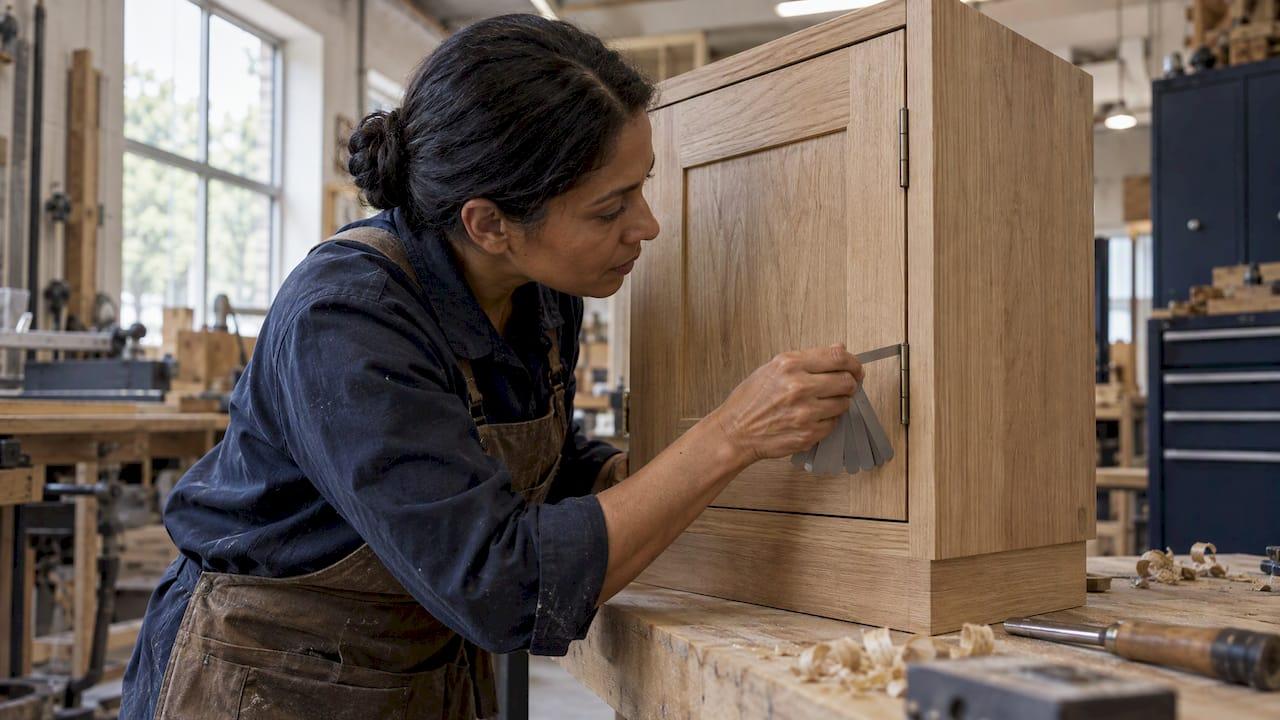
A manufacturing tolerance is the amount a dimension may vary from its nominal size while the piece still works and looks as intended. For furniture there is no single universal figure: the right tolerance depends on the component, the material, the method of making and what the piece must do. As a working guide, expect around ±1 mm on small parts and panels, ±2 to 3 mm on overall dimensions of a finished piece, and more where timber, upholstery or on-site fitting are involved. What matters most is agreeing the numbers in writing before the first cut.
This guide is written for interior designers, architects, hospitality procurement teams and homeowners commissioning bespoke pieces. It explains what the figures mean, where they come from, and how to write them into a brief so that what arrives fits the space you drew.
TL;DR
- A tolerance is a permitted range, such as 10 ± 1 mm, which means anything from 9 to 11 mm is approved.
- Typical guide figures: ±2 to 3 mm overall, ±1 to 2 mm for small parts and shelves, ±1 mm for panels. Treat them as starting points, not a standard.
- Solid timber moves with humidity, so a tight number on a wide timber top is only meaningful alongside a stated moisture content and a fitting environment.
- Tighter is not automatically better: it adds time and cost, and a process cannot be made more accurate simply by demanding it.
- Specify tolerances at the outset, by feature, with a reference point and a method of measuring.
Table of Contents
- What a furniture tolerance actually is
- Typical figures for components, panels and finished pieces
- Squareness, flatness, bow and gaps
- How timber moves, and what it does to your numbers
- What the British Standard says
- How to specify tolerances on a bespoke commission
- Commissioning with us
- FAQ
- Sources
What a furniture tolerance actually is
The Swedish Wood Joinery Handbook defines a tolerance as the permissible limit of variation in a physical dimension. Its example is simple: 10 ± 1 mm means every measurement from 9 to 11 mm is accepted. The same handbook notes that tolerances also apply to straightness and levelness, not only to length, width and thickness.
That last point is worth holding on to. A table can be exactly the right length and still rock, because the top is not flat or the legs differ by a millimetre. In furniture, tolerances fall into three families:
- Size: length, width, height, thickness.
- Form: straightness, flatness, bow, squareness.
- Fit: the gap between a door and its frame, a drawer and its carcass, a leg and its rail.
A good brief names the family as well as the number. "±2 mm" on its own leaves a maker guessing which of the three you mean.
Typical figures for components, panels and finished pieces
There is no statutory tolerance table for bespoke furniture, so figures come from makers' own practice, board suppliers and general guidance. The numbers below are indicative ranges that circulate in the trade, and each should be confirmed with your maker for the piece in question.
| Feature | Typical working range |
|---|---|
| Overall dimensions of a finished piece | ±2 to 3 mm |
| Small parts and shelves | ±1 to 2 mm |
| Sheet panels | ±1 mm |
| Panel thickness | ±0.2 to 0.5 mm |
| Overall bow of a long component | 3 mm per metre, or 2 mm, whichever is greater |
At the precise end of the scale, UK CNC specialists quote panel cutting at ±0.3 mm and CNC routing at ±0.2 mm. Those are machine capabilities on a single operation, not the tolerance of an assembled, finished, hand-fitted cabinet. Errors stack: a ±0.3 mm cut, a glue line, a sanding pass and a lacquer coat each add a little.
The same source is useful on boards. Thickness tolerances from board manufacturers are often looser than machine cutting: MDF and melamine-faced MDF are listed at ±0.3 mm, hardwood plywood at ±0.5 mm and birch plywood at ±0.9 mm. So a carcass built from birch ply can legitimately vary by nearly a millimetre in thickness before anyone has touched a saw, and a drawer runner or concealed hinge detail must be designed to absorb that. If you are choosing between boards, our comparison of MDF and plywood in furniture explains where each belongs.
Why hand-making is not the same as sloppy-making
Handcrafted work is judged differently from machine-cut flat-pack. Teaching material for UK design and technology students notes that a tape measure is accepted for measuring timber to 1 mm, because the material will change shape at some point in use anyway, while digital vernier calipers read to a hundredth of a millimetre. That is a useful reality check. Asking for 0.1 mm on a solid oak dining top is asking for a number the material will not hold through a single winter.
Squareness, flatness, bow and gaps
These are the checks that a client sees and feels, and they are rarely written down. The following are standard workshop methods rather than a published furniture standard, and a conscientious maker will agree them with you.
Squareness. Measure both diagonals of a frame, door, drawer box or top. If the two readings match within your agreed figure, the piece is square. A diagonal difference is a quicker and more honest test than checking each corner with a set square, because it reveals racking across the whole piece.
Flatness and bow. Lay a straightedge along the surface, in both directions and across the diagonals, and measure the gap beneath it with feeler gauges or a rule. Bow is usually expressed as a limit per metre of length, as in the 3 mm per metre figure in the table above, with a minimum allowance for shorter components.
Joints and gaps. Visible reveals, such as the gap around a cabinet door, are judged on evenness as much as width. A consistent 3 mm shadow gap reads as deliberate; a gap that tapers from 2 to 5 mm reads as an error, even though the average is the same. Specify both the nominal gap and the allowable variation along its length.
Level and stability. Check that a piece sits without rocking on a flat surface, and that adjustable feet, where specified, have enough travel to deal with an uneven floor. Floors in older London buildings in particular are rarely level.
For how joint choice influences fit, see our guides to furniture joinery types and dovetail versus dowel joints.
How timber moves, and what it does to your numbers
Solid timber is hygroscopic: it swells as it takes on moisture and shrinks as it dries, mostly across the grain. This is the largest single reason a measurement taken in the workshop differs from one taken on site.
Teknos, a UK coatings manufacturer, reports that in typical UK and Irish conditions timber dimensions change by about 1% for every 3% change in moisture content, and that dimensional changes as large as 3 to 4% are possible when joinery is delivered and fitted on site.
Species matter. TRADA classifies timbers by moisture movement as small, medium or large, and advises that species with small movement should be specified where stability in varying humidities is important. English Woodlands Timber gives the arithmetic: within a moisture content range of 5 to 30%, across-the-grain movement is 1% for every 5% change in moisture content for small-movement species, every 4% for medium and every 3% for large. Their worked example is a 150 mm wide oak board, a medium-movement species, which comes down to 145.5 mm when it dries from 25% to 13%.

Put that beside a ±1 mm tolerance and the point is plain. A 150 mm board can shrink by 4.5 mm as it dries, so a tolerance tighter than the movement is meaningless unless moisture content is controlled and stated.
Moisture content for interiors
BS 1186-3 guidance, as set out by English Woodlands Timber, gives target moisture contents for interior joinery by heating regime: 8 to 12% in buildings continuously heated to 20 to 24°C, and 10 to 14% where heating holds at 12 to 19°C. Intermittently heated buildings sit at 13 to 17%. A country house that is heated only at weekends and a centrally heated Mayfair apartment are, in timber terms, different climates, and it is sensible to tell your maker which one the piece is going into.
We go deeper on this in wood movement in furniture. If you are specifying wide tops, the difference between cuts is worth reading too: quarter sawn versus plain sawn timber changes how much a panel cups. For species choice, our wood species selection guide is the place to start.
What the British Standard says
The relevant national guidance is BS 5606, the British Standard on accuracy and tolerances in design and construction. It is written for building rather than for furniture, but its thinking transfers well to fitted and architectural pieces.
Its central instruction is that tolerances should be considered at the outset of each project, so that the practicality of design details can be assessed, appropriate tolerances specified and compliance monitored during construction and assembly. Its tables give ranges of deviation normally achievable for construction, with a risk of non-compliance of roughly 1 in 22, and for manufactured components.
The second idea is the more interesting one. The standard observes that the accuracy of a process cannot be improved simply by specifying tighter tolerances, and that some processes show a systematic deviation, where the average result sits off the target. In practice that means a tolerance should be drawn from what a process can honestly achieve, then confirmed by measuring, rather than set as an aspiration.
The Swedish Wood handbook makes the commercial point bluntly: too fine a tolerance makes production considerably more expensive, because of the time spent keeping measurements in check. Spend tight tolerances where the eye or the mechanism will notice, and relax them where nobody will.

How to specify tolerances on a bespoke commission
A workable specification is short. For each piece, agree the following in writing.
- Critical dimensions. Mark the two or three that cannot move, such as the width of an alcove or the height under a window sill, and give them tighter figures.
- A default tolerance. State one general figure, for example ±2 mm overall, for everything else.
- Reference points. Say what you measure from: finished floor, wall face, centre of a fixing.
- Environment. Name the building, its heating pattern and the room, so moisture content can be chosen to suit.
- Finish allowance. Confirm whether stated dimensions are before or after lacquer, veneer or upholstery.
- Gaps and reveals. Give the nominal width and the permitted variation.
- Inspection method. Agree how and where measurement happens, with what tool, and when: at the workshop before dispatch, on delivery, or both.
- Upholstery. Allow for soft materials. Handmade upholstered pieces vary far more than joinery, and a larger allowance in each dimension is normal.
Good drawings make most of this easy. Our guides to custom furniture CAD drawings, a supplier-ready furniture design brief and the eight essentials of a maker brief set out what to put on the page. If hardware is involved, check the cup and bore sizes against the hinge before drilling: soft close hinges for 35 mm cups covers the common fit.
A worked example
Imagine a bespoke walnut sideboard to fill a 1,800 mm alcove. You want a visible gap of about 3 mm each side, so the cabinet is made 1,794 mm wide. With ±2 mm overall, the finished width may land anywhere from 1,792 to 1,796 mm, which leaves gaps of between 2 and 4 mm. If your eye is sensitive to that, you tighten the width to ±1 mm, accept that it needs a final fitting check, and agree that the walls are measured on site rather than taken from the plan. Better still, scribe a filler strip. The tolerance conversation has turned a vague worry into a decision.
Our perspective on tolerances
We have found that most disappointments on a bespoke commission are not failures of craftsmanship but failures of conversation. A client imagines a number, a maker imagines a different one, and neither writes it down.
Because every piece we offer is handcrafted to order, with its size and finish customised for the room, we treat tolerance as part of the design rather than an inspection at the end. We work closely with our artisans and with you, and we are always happy to talk through which dimensions deserve the finest attention and which can breathe.
Natural materials are the reason a handmade piece has warmth and character, and we would never ask solid timber to behave like a machined plastic. We would rather agree an honest figure together, explain the reasoning, and then deliver a piece that sits beautifully in the space.
Luke
Commissioning with us
If you are specifying furniture for a residential scheme, a hotel or a project with tight architectural constraints, our bespoke furniture collection is made to order, with sizes and finishes customised to your drawings. We also offer trade-only made-to-order rugs and mirrors from our partner brands, with tailored designs and dimensions, for interior designers, architects, homeowners and luxury hotels.

Send us your drawings and the critical dimensions of the space, and we will talk you through what is achievable. For a sense of our work, see our bespoke nest of coffee tables, or read our story.
FAQ
Is there a standard tolerance for bespoke furniture?
No single figure applies to every piece. Acceptable variation depends on the component, the material and the method of making. Common working figures are ±2 to 3 mm overall and ±1 to 2 mm on small parts, but the right numbers are the ones you and your maker agree in writing.
Why does my solid wood furniture change size?
Timber takes up and gives off moisture as the air around it changes. In typical UK conditions, dimensions change by about 1% for every 3% change in moisture content. The movement is mainly across the grain, so wide tops and panels are affected most.
Does a tighter tolerance mean better furniture?
Not necessarily. Tighter tolerances raise production time and cost, and a process cannot be made more accurate just by specifying tighter limits. Reserve fine tolerances for features that are visible or mechanical, such as door reveals and drawer fits.
How do I check a finished piece on delivery?
Measure overall width, depth and height against the agreed figures, compare both diagonals of frames and drawers for squareness, and run a straightedge across tops for flatness. Check that the piece stands without rocking and that gaps are even. Agree this routine with your maker beforehand so everyone measures the same way.
Sources
- Joinery Handbook, Swedish Wood
- Cutting Tolerance, CNC Creations
- Accuracy and quality control, BBC Bitesize
- Moisture content and machining tolerances, Teknos
- Wood species definitions, TRADA
- Timber Knowledge Base, English Woodlands Timber
- BS 5606, accuracy and tolerances in design and construction