
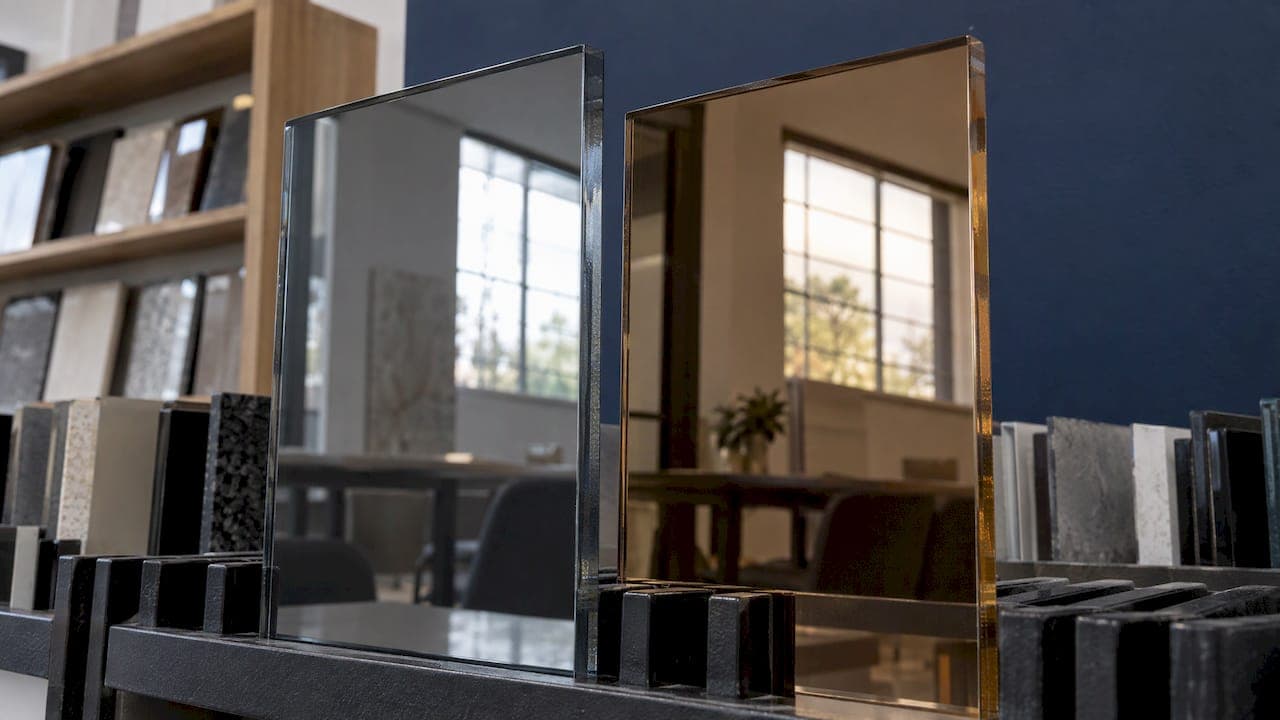
Choose smoked mirror when you want a cool, neutral, softly moody reflection that sits comfortably with black metal, charcoal, concrete and deep paint colours. Choose bronze mirror when you want a warm, golden-brown glow that flatters walnut, brass, travertine and beige stone. Both darken the reflection compared with clear glass, so both are materials to design with rather than tools for brightening a room or applying make-up.
The rest of this guide goes through what separates the two tints in practice: the colour they return, how they behave in daylight and lamplight, where each earns its place, and what to specify so the finished piece is safe as well as handsome.
TL;DR
- Smoked (grey) mirror returns a cool, neutral, slightly moody reflection; bronze returns a warm, golden-brown one.
- Pair smoked with black metal, concrete and deep colours; pair bronze with walnut, brass, stone and warm light.
- Both tints reflect less light than clear mirror, so keep a clear mirror wherever true colour or brightness matters, such as grooming.
- Specify safety backing wherever the glass could be struck, and fix it with suitable neutral-cure adhesives.
- Bring a sample into the actual room and view it in morning and evening light before you commit.
Table of Contents
- What "smoked" and "bronze" actually mean
- Colour and mood: cool versus warm
- Smoked vs bronze at a glance
- Light: what a tint does to a room
- Where each tint works best
- When clear mirror is the better choice
- Specifying tinted mirror safely
- A five-step way to decide
- Our perspective
- Working with us
- FAQ
- Sources
What "smoked" and "bronze" actually mean
The vocabulary is slightly slippery, so it helps to settle it first. In the UK trade, a smoked mirror is usually a grey-tinted mirror: ordinary mirror glass with colour added so that reflections take on a cooler, darker, softened tone. You will also see it sold simply as grey mirror, and some suppliers describe graphite as the same family. Bronze mirror uses bronze-tinted glass, which gives reflections a warm brown or amber-gold cast.
The point worth holding on to is that the colour belongs to the glass, not to a decorative film laid over a clear mirror. That is why a good tinted mirror looks deep and even rather than painted on, and why the tint is visible in the edge of the glass as well as the face.
A small number of retailers use "smoked" loosely for any dark mirror, including bronze and antiqued glass with a mottled finish. When you order, ask for the tint by name and ask to see a physical sample. A photograph on a screen will not tell you whether a bronze leans towards copper or towards grey-brown.

Colour and mood: cool versus warm
The simplest way to think about the pair is temperature.
Smoked mirror is the easy neutral. It reads as contemporary, a little theatrical, and it tends to make an interior feel composed and quiet. It is common in contemporary British schemes, where it appears on bar backs, feature walls, wardrobes and the faces of furniture.
Bronze mirror is the romantic cousin. It returns a richer, more atmospheric glow, and the warmth tends to flatter skin tones and the objects reflected in it. It sits naturally in schemes drawing on the glamour of Art Deco, or in rooms built around timber and metal with warm undertones.

Neither tint is the right answer in the abstract. The better question is what else is in the room, which brings us to the pairing guide below.
Smoked vs bronze at a glance
| Consideration | Smoked (grey) mirror | Bronze mirror |
|---|---|---|
| Reflected colour | Cool, neutral grey | Warm golden-brown |
| Mood | Moody, contemporary, restrained | Glowing, enveloping, a touch of glamour |
| Natural partners | Black metal, charcoal, concrete, deep paint | Walnut, brass, travertine, beige stone, gold-toned fittings |
| Best light | Generous daylight, neutral to cool lamps | Warm lamps and low, golden light |
| Risk | Can feel cold or heavy in a dim room | Can feel dated if the room has cool, blue-toned finishes |
| Good for grooming? | No, use clear glass | No, use clear glass |
Light: what a tint does to a room
This is where most disappointments happen. A tinted mirror reflects less light than clear silvered glass, because the light has to pass through the tinted glass on the way in and again on the way out. The result is a deeper, glossier surface that behaves more like a polished material than a window onto a brighter version of the room.
That is a strength when you want it. A large tinted panel can act as a rich feature, avoiding the showroom feel that a vast expanse of bright clear mirror sometimes has. It is a weakness when you expect the mirror to do a clear mirror's job. Two practical consequences follow.
- Do not rely on a tinted mirror to brighten a dark space. If a hallway or small room has little daylight, a clear mirror will return noticeably more of what light there is. A smoked panel in a dim foyer will simply look like a dark hole.
- Do not use either tint as the main grooming or make-up mirror. Colour is shifted and the image is dimmer, so judging foundation, a shave or a hair colour is harder than it should be.
Mirrors are also tricky from a lighting designer's point of view. Their reflection is specular, unlike the diffuse reflection of most painted walls, which is why researchers modelling mirrored interiors have suggested treating the space behind a mirror as a virtual twin of the room (peer-reviewed lighting calculation research). You do not need to run that kind of calculation for a dressing table, but for a large mirrored wall in a bar, restaurant or hotel lobby, it is worth reading about lighting design for commercial spaces before the glass is ordered, because the position of every fitting will be duplicated in the reflection.
Matching the tint to the lamp
Bronze and warm light belong together. Warm lamps, low-level wall lights and a gentle backlight bring out the amber in the glass. Smoked mirror is more forgiving: it holds up under neutral white light and looks crisp with cooler accents. A mismatch is the thing to avoid, such as a cool, bluish lamp aimed at bronze, which can leave it looking muddy.
Whatever the tint, place light sources so that the lamp itself is not seen as a bright reflected point. Dimmable fittings help you tune the effect after installation.
Where each tint works best
Smoked mirror
Smoked mirror suits modern, industrial and minimalist palettes. Think blackened steel frames, charcoal upholstery, poured concrete, and walls in deep inky greens, blues or plum. It is a fine choice for:
- bar backs and cocktail lounges, where the darkened reflection adds depth without glare;
- wardrobe doors and dressing-room panels, provided a clear mirror is also available for grooming;
- the faces or tops of console tables, sideboards and cabinets, where the tint gives a quiet, polished surface;
- wide feature walls in well-lit living and dining rooms.
Bronze mirror
Bronze mirror comes into its own alongside warm materials: walnut, oak with a warm oil, aged brass, travertine, beige stone and gold-toned fixtures. It is a good choice for:
- dining rooms and restaurants, where candlelight and warm lamps do half the work;
- fireplace surrounds and alcoves;
- bedside and dressing-table furniture, as an accent rather than the grooming mirror;
- hotel corridors, lift lobbies and bar areas that depend on atmosphere.
If you are planning a large hospitality scheme, our own guide for trade on specifying bronze mirror glass covers thicknesses and safety backing in more detail.
Scale and placement
Darker glass can feel heavy, so scale matters. Over a console or sideboard, a mirror generally looks best at roughly two thirds of the width of the piece beneath it. Our console scale rules walk through the proportions, and the same logic applies whether the glass is tinted or clear. For bathrooms, where a tint is rarely the right primary mirror, see our notes on bathroom mirror height and IP ratings.
When clear mirror is the better choice
A clear mirror is the right call when the room needs more reflected light or when true colour matters. That means grooming spaces, small rooms with little daylight, narrow hallways and anywhere the mirror is there to make the space feel larger and brighter.
The good news is that you rarely have to choose one or the other. Many of the most successful interiors combine a tinted feature (a smoked panel behind the bar, a bronze-faced cabinet) with a separate clear mirror positioned for practical use. Treat the tint as texture and the clear mirror as a tool.
Specifying tinted mirror safely
The appearance of a tinted mirror is the pleasant part of the brief. The specification is where a project is made safe and durable.
Safety backing and impact resistance
Wherever a mirror could be struck, such as low-level panels, wardrobes, gyms, children's rooms and busy hospitality areas, safety backing film holds fragments together if the glass breaks. Manufacturers make safety mirror in tinted variants: Pilkington, for example, has stated that its Optimirror Protect Plus safety mirror is available in grey and bronze on request and achieves Class 3(B)3 to BS EN 12600 for pendulum body impact (Pilkington's launch announcement). If a project calls for a rated product, confirm the current range and classification with the manufacturer or your glazier before ordering.
For a practical walk-through of what backing does and where you need it, see our guide to mirror safety backing. If the glass will also be part of a tabletop or splashback, our comparison of tempered and laminated glass explains which treatment suits which job.
Fixing and adhesives
Mirror backing can be damaged by the wrong adhesive. Saint-Gobain Glass advises fixing mirrors with alcohol-based or oxime-based neutral silicone, or dedicated mirror adhesives, together with double-sided adhesive pads to carry the weight safely (Saint-Gobain Glass guidance). Acid-cure silicones and some general-purpose sealants can attack the reflective coating over time and cause dark edges and spots, so check the label before anything is applied.
Our mirror mounting systems guide compares the usual methods, and for anything tall or heavy, how to install a large mirror safely is worth reading before the day of installation.
Edges, moisture and ageing
Edges are the vulnerable point on any mirror. Seal or frame them in damp areas, keep cleaning products away from the edge, and make sure the room is ventilated. Our three steps to prevent desilvering cover the habits that keep a surface looking crisp for years.
Sizing
Tinted glass is normally cut to order, so measure twice and allow for fixings, frames and any tolerance. If you need an unusual size, our overview of custom mirror sizing in London explains what to ask for and what to expect.
A five-step way to decide
- List the materials in the room. Warm timber, brass and stone point to bronze; black metal, concrete and cool paint point to smoked.
- Check the light. Strong daylight suits either tint. A dim room wants clear glass, or tint used only in small doses.
- Decide the job. If anyone needs to see their face accurately, add a clear mirror.
- Order a physical sample and look at it in the morning, at midday and with the lamps on in the evening.
- Specify the safety and fixing details (backing, adhesive, edge treatment) at the same time as the tint, not afterwards.
Our perspective
We handle a great many briefs in which the mirror is not an afterthought but the material that holds a scheme together, and our advice is always to begin with the room rather than the glass.
Bronze is wonderful where there is timber, brass and candlelight to answer it; it makes an evening room feel gathered and generous. Smoked is quieter and more architectural, and it gives sculptural furniture a calm, deep ground to stand against. Both reward a considered hand, and both are at their best when the proportions, finish and fixings are decided together.
That is why we favour made-to-order work. Every piece we offer is handcrafted with custom sizes and finishes, and we work closely with clients and artisans so that the result suits the room, the use and the light, rather than being the nearest thing in a catalogue. If you are weighing a smoked or bronze element for a residential or hospitality project, we are always happy to work with you on it.
Luke
Working with us
Simmons Interior Supply makes bespoke furniture, handcrafted to order and customisable in size and finish, for interior designers, architects, trade customers, luxury hotels and private homeowners. Alongside it we offer trade-only collections of made-to-order rugs and mirrors from partner brands, including the Signature rug collection from Colbourns and the Ready to Hang collection from Simpsons London.

If you are planning a scheme and want to talk through finishes, sizes and how a piece might sit with your chosen tint, explore our collections and get in touch. If you are looking for a starting point for a living room, our bespoke nest of coffee tables shows the kind of custom work we do.
FAQ
Is smoked mirror the same as grey mirror?
In most UK supplier listings, yes. Smoked mirror normally means grey-tinted mirror glass, which returns a cool, darkened reflection. Some sellers use "smoked" more loosely for any dark mirror, so ask for the tint by name and request a sample.
Is bronze mirror warmer than smoked mirror?
Yes. Bronze glass returns a golden-brown, amber tone, while smoked glass stays neutral to cool. That is why bronze pairs so well with walnut, brass and warm lamps, and smoked with black metal, concrete and deep paint colours.
Do smoked and bronze mirrors make a room darker?
They reflect less light than clear mirror, so they will not brighten a room, and in a dim space they can look heavy. They work best in well-lit rooms, or as a feature in small doses. Use clear glass where you need brightness or accurate colour.
Can I use a tinted mirror in a bathroom?
Yes, as a feature, but keep a clear mirror for grooming. Seal the edges, ventilate the room and check the IP rating of any integrated lighting for the zone it sits in.
Do tinted mirrors need safety backing?
Wherever the glass could be struck or is installed at a low level or in a busy area, safety backing is sensible because it holds fragments together if the glass breaks. Ask your glazier which treatment suits the location.
Sources
- Pilkington: safety mirror launch, grey and bronze availability and BS EN 12600 class
- Saint-Gobain Glass: mirror fixing and adhesive guidance
- MDPI Sustainability: lighting calculations in mirrored indoor spaces
- Lighting design for commercial spaces